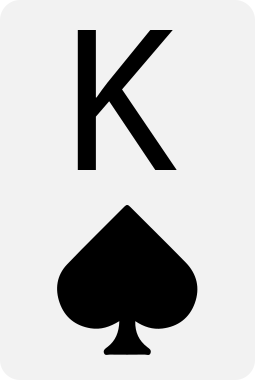
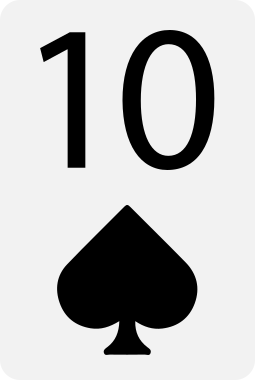
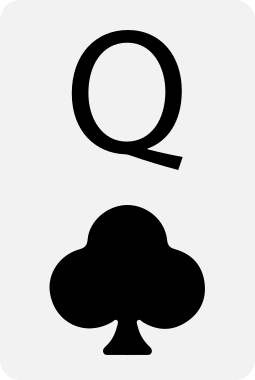
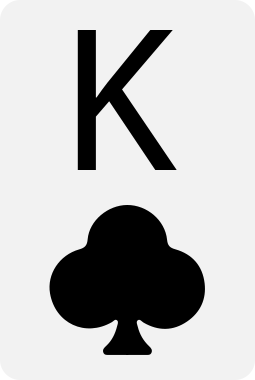
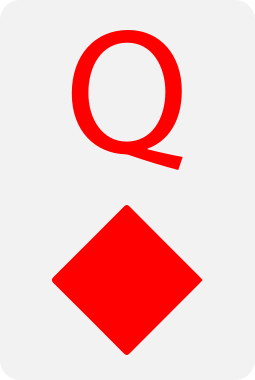
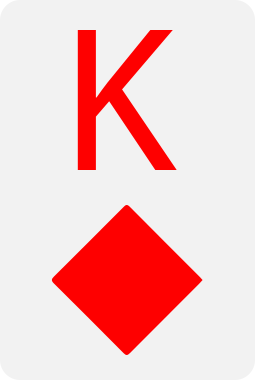
King-Ten Suited is a hand with a split personality. From one angle it resembles the King-x suited hands above it – KQs and KJs – sharing the same King anchor, the same flush potential, and the same narrow overcard exposure. From another angle it resembles the Ten-centred drawing hands below it, sharing the Ten’s unusual connectivity across both the broadway and middle-straight ranges.
The result is a hand that earns its place in the rankings through a combination of assets rather than any single dominant feature – and one whose true value is frequently underestimated by players who focus only on the gap between the King and the Ten.
What These Odds Show for KTs
The draw odds for KTs follow the established pattern of suited broadway hands in most categories. The high card flop rate of 52.39% is identical to KQs, one pair settles at 42.19% by the river, two pair at 22.02%, and the flush at 6.48% – all within fractions of the other King-x suited hands as expected.
Two numbers define KTs more than any others.
The first is the straight rate. At 5.40% by the river, KTs sits decisively above KJs at 5.05% and well above KQs at 4.70%. Placing it in the full context of hands covered on this site:
KTs produces one of the highest straight rates of any hand but is behind hands like QJs. This is the Ten’s influence at work. While the King on its own is a peripheral straight card – it can only anchor from the top (A-K-Q-J-T) – the Ten sits at the heart of an unusually wide network of straight combinations. A-K-Q-J-T, K-Q-J-T-9, J-T-9-8-7, Q-J-T-9-8, and T-9-8-7-6 all feature the Ten in a central or participating role. Any board showing Q-J, J-9, Q-9, J-8, or 9-8 gives KTs an open-ended straight draw or a meaningful gutshot, and several of those combinations also intersect with the flush draw when suited board cards appear.
The straight flush rate of 0.11% edges above KJs at 0.10%, consistent with the Ten’s additional connectivity.
The second defining number is the overcard table: 22.55% on the flop, 29.14% by the turn, 35.30% by the river – figures identical to KQs, KJs, and KK. Only an Ace constitutes an overcard to KTs. On fewer than a quarter of all flops will the board contain a card that outranks the King – a figure that remains remarkably low given KTs sits considerably further down the overall hand rankings than any King-x hand covered previously.
This is the understated strength of the King anchor. Regardless of how the Ten performs as a kicker or straight-drawing card, the King ensures that KTs carries the same low overcard exposure as hands rated far above it. That narrow flop overcard rate is a genuine and recurring asset.
Hand Strength Summary
- Hand type: Strong suited gapper with exceptional straight potential and low overcard exposure
- Relative strength: Top 20–25 starting hands; the last of the King-x suited broadway sequence
- Dominates: Weaker King-x and Ten-x combinations, QT, JT, T9s
- Main vulnerabilities: All pocket pairs preflop; kicker problems on both King-high and Ten-high boards; the two-rank gap between King and Ten creates complex postflop situations
KTs is a hand that earns its value primarily through drawing equity. The flush draw in the King’s suit and a straight rate that ranks second only to QJs across all hands covered make it a powerful vehicle for semi-bluffing on the right boards.
How King-Ten Suited Wins
KTs reaches the best hand through several distinct paths, with drawing combinations being the most important:
- Completes straights in 5.40% of all runouts – second only to QJs among all hands covered on this site
- Hits a strong flush in 6.48% of hands – not the nut flush when an Ace of the same suit is possible, but near-nut quality on most boards
- Combines flush and straight draws simultaneously on connected board textures, producing powerful semi-bluffing positions
- Makes top pair with a Ten kicker on King-high boards against ranges that do not frequently contain AK or KQ
- Dominates weaker King-x hands (K9, K8 and below) and weaker Ten-x hands (T9, T8 and below)
- Forces folds through aggression when flush and straight equity stack together on connected boards
The simultaneous draw scenario deserves emphasis. On a board of J♠ 9♠ 4♦ with K♠ T♠ in hand, KTs holds both an open-ended straight draw (any Queen or Eight completes a straight) and a flush draw to a King-high flush. The combined equity of these draws can comfortably exceed 50%, making aggressive semi-bluffing correct even without any improvement on the flop. This is the same multi-draw dynamic seen with KQs and KJs, but activated by a wider range of board textures because the Ten participates in more straight combinations.
Main Weaknesses
KTs faces kicker vulnerability on both of its natural connecting cards – a problem that grows with the size of the gap between the King and the Ten.
On King-high boards:
- AK holds top pair with an Ace kicker – KTs’s Ten kicker is dominated
- KQ holds top pair with a better Queen kicker – KTs is dominated again
- KJ holds top pair with a Jack kicker – KTs is still dominated
- Only K9, K8, and weaker King-x hands are below KTs in a King-high kicker confrontation
On Ten-high boards:
- AK, AQ, AJ, and AT all hold overcards with varying degrees of straight draw involvement
- KQ and KJ both hold a King overcard and a straight draw that partially shares KTs’s territory
- AT holds top pair with an Ace kicker – dominating KTs’s King kicker when the Ten pairs
The Ten-high kicker situation is worth understanding clearly. When the Ten pairs on the board, KTs holds top pair with a King kicker. QT and JT both lose to the King kicker. However, AT holds top pair with an Ace kicker, which beats KTs. The kicker landscape is more navigable on Ten-high boards than on King-high boards, where three common holdings dominate KTs before any draw is considered.
Other weaknesses include:
- Behind all pocket pairs before the flop
- Misses the flop in 52.39% of cases
- The flush is not the nut flush – an Ace of the same suit in an opponent’s hand draws to a higher flush
- Without drawing equity on a blank flop, the hand has limited continuation value
Best and Worst Flop Textures
Strong flops
- J-9 or Q-J boards in the suited suit – open-ended straight draw and flush draw simultaneously, with multiple overcards providing showdown backup
- Q-9 boards – gutshot to the broadway straight plus possible flush draw
- 9-8 boards in the suited suit – open-ended straight draw to a King-high or Jack-high straight alongside the flush draw
- King-high boards against wide ranges where AK and KQ are unlikely – top pair with a Ten kicker is workable
- Low, dry boards with two suited cards – flush draw with two strong overcards providing fold equity through semi-bluffing aggression
Dangerous flops
- King-high boards against tight, aggressive ranges – AK, KQ, and KJ all dominate KTs and are common holdings for opponents who raised or 3-bet from early position
- Ten-high boards against ranges that include AT heavily
- Ace-high boards – both an overcard threat and, if the Ace is in KTs’s suit, a player with Ace-suited has a higher flush draw
- Boards with no flush draw and no straight draw where the hand has completely missed – without drawing equity, continued aggression has a narrow basis
How It Plays by Position
- Early position: Playable as a raise in most game formats, though the postflop complexity of KTs – particularly the kicker vulnerability on King-high boards – benefits considerably from position. Some tighter strategies prefer to open KTs from middle position rather than UTG.
- Middle position: Standard raise. A solid hand against wide calling ranges that frequently contains multiple draw combinations on connected boards.
- Late position: Where KTs performs at its very best. In position, the combined flush and straight draw equity can be pressed across multiple streets, pot-control is clean when draws miss, and opponent ranges are easier to narrow before large commitments are made.
- Blinds: Playable but navigate carefully, particularly on King-high boards out of position. The three-hand kicker domination problem (AK, KQ, KJ) is hardest to manage when facing aggression without the benefit of acting last.
KTs in the King-x Suited Family
Looking across the three King-x suited broadway hands covered on this site, the straight rate progression reflects the Ten’s growing connectivity as the second card moves further down the rank scale:
- KQs: 4.70%
- KJs: 5.05%
- KTs: 5.40%
Each step adds approximately 0.35 percentage points of straight equity, as the lower card gains access to additional straight combinations. All three hands share the identical 22.55% overcard flop rate and 6.48% flush rate – the King anchor and the suited nature produce the same overcard exposure and flush structure regardless of the lower card. The straight rate is the primary dimension along which these three hands differ, and KTs sits at the top of that range within the King-x suited group.
Comparing KTs to ATs – both feature a Ten as the lower card – the straight rates are 5.40% vs 4.14% respectively. KTs produces more straights because both the King and Ten sit within overlapping straight combinations, whereas the Ace can only anchor a broadway straight from one end. The absence of an Ace in KTs is offset in the straight-draw dimension by the King’s own participation as a middle broadway card.
The Overcard Advantage in Context
The 22.55% overcard flop rate for KTs is easily its most underappreciated feature, particularly given where the hand sits in the overall rankings. To illustrate how significant it is, consider the overcard rates for hands broadly rated above KTs:
- AA: 0.00%
- KK: 22.55%
- QQ: 41.43%
- JJ: 56.96%
- TT: 69.47%
- KQs: 22.55%
- KJs: 22.55%
- KTs: 22.55%
KTs carries the same overcard flop exposure as KK, KQs, and KJs – all hands rated well above it. The only overcard to a King is an Ace, and Aces appear on the board no more frequently because the hand holding a King is ranked lower. This shared overcard rate means KTs faces fewer board-texture surprises per flop than virtually any other hand outside the top King-x or premium pair category.
Common Mistakes with King-Ten Suited
- Over-valuing top pair on King-high boards without accounting for the three-hand kicker domination (AK, KQ, KJ) that is common in opponents’ ranges
- Under-using the hand’s semi-bluffing potential on connected boards where flush and straight draws combine into overwhelming equity
- Treating KTs identically to KJs or KQs and applying the same top-pair continuation betting frequency – the wider kicker gap makes King-high boards more dangerous for KTs than for the hands above it
- Folding too quickly on mid-range connected boards where the Ten’s straight draw equity is genuinely strong and the King provides overcard backup
- Failing to appreciate the low overcard rate as an asset – KTs can be played with more postflop confidence than lower-ranked hands because the board introduces a threatening overcard far less often
Comparison to Similar Hands
- Stronger than: QTs, JTs, KTo, and most non-premium non-pair hands
- Behind: All pocket pairs, all Ace-x hands, KQs, KJs, QJs
- A notably strong straight rate for a King-high hand (5.40%), combining with the same 22.55% flop overcard rate shared by KK, KQs, and KJs
Examples:
- Against QJs: KTs is a moderate underdog in a direct confrontation – QJs has superior connectivity and a closer rank pairing, while KTs has the King anchor. Approximately 40% to win overall.
- Against ATs: KTs is dominated on Ten-high boards by the Ace kicker – roughly 35% to win overall, though both hands share the Ten’s strong straight draw characteristics
- Against QTs: KTs is a clear favourite – the King outranks the Queen as the top card in most pairing and overcard situations
How King-Ten Suited Performs in Multiway Pots
KTs is a capable multiway hand, primarily through its drawing equity. Completed straights and flushes win larger pots when more players are involved, and KTs’s 5.40% straight rate and 6.48% flush rate both represent clean, high-value completions that scale effectively with pot size. The 22.55% overcard flop rate also means that a majority of multiway flops do not introduce a card threatening KTs from above – a meaningful practical advantage compared to hands with higher overcard exposure.
The kicker vulnerability on King-high boards is more acute multiway, since more players increases the likelihood that at least one holds AK, KQ, or KJ. Pursuing draws rather than made-hand strength in multiway pots is the correct orientation for KTs – the hand performs best when it is building toward a completed straight or flush rather than trying to protect a dominated top pair.
FAQ: King-Ten Suited
Is KTs a strong hand?
It is a genuinely strong hand in the top 20–25 starting hands, with an unusual combination of low overcard exposure and high straight potential that makes it more dangerous than its ranking position might suggest. It merits a raise from most positions and plays exceptionally well in position.
How do you handle the two-rank gap between King and Ten?
By leaning into the drawing equity the gap creates rather than trying to play it as a top-pair hand. The Ten’s connectivity means a wide variety of boards activate meaningful straight draws, and those draws – particularly in combination with the flush – are the hand’s primary source of value.
Should you continuation bet KTs on a King-high flop?
Situationally. Against wide ranges where AK, KQ, and KJ are infrequent, a continuation bet can work. Against tight, early-position callers where those hands are common, the three-hand kicker domination problem makes multi-street commitment without improvement a significant leak.
How does KTs compare to KJs?
Both share the same overcard rate and flush potential. KTs has a marginally higher straight rate (5.40% vs 5.05%) because the Ten accesses more straight combinations than the Jack. KJs has a cleaner kicker situation on Jack-high boards, while KTs faces fewer domination hands on Ten-high boards than KJs faces on Jack-high boards. In practice, the hands play similarly – KTs’s slightly wider gap is offset by the Ten’s superior straight connectivity.
Related Hands