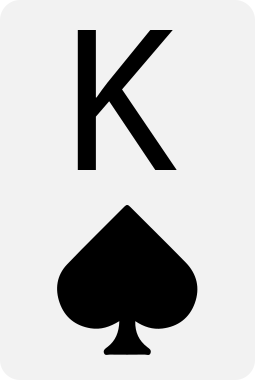
Ace-Ten Suited is the last of the suited Ace-x broadway hands and the point at which the character of Ace-suited holdings shifts noticeably. AKs, AQs, and AJs each carry a broadway card close enough to the Ace that top-pair hands are common and often strong. With ATs, the Ten introduces a meaningful gap – not large enough to make the hand speculative, but wide enough to change how it should be approached on the boards it most naturally connects with.
What ATs gains in return for that wider gap is a straight draw rate unlike any other suited Ace-x hand. The numbers on this page tell the story clearly.
What These Odds Show for ATs
The draw odds for ATs align closely with the rest of the suited Ace-x broadway family in most categories. The high card flop rate of 52.71% is identical to AKs, AQs, and AJs. One pair settles at 42.87% by the river, two pair at 22.14%, and the flush at 6.52% – all tracking within fractions of the other suited Ace-x hands, as would be expected given the shared structure of an Ace plus one other card in the same suit.
The straight rate is where ATs breaks from the pattern established by its predecessors. At 4.14% by the river, it comfortably surpasses every suited Ace-x hand in the series:
The reason is the Ten’s unique position in the deck. Unlike the King, Queen, or Jack, the Ten can participate in straights both within the broadway range (A-K-Q-J-T) and across the middle-straight range (T-9-8-7-6, J-T-9-8-7, Q-J-T-9-8, K-Q-J-T-9). This gives ATs an unusually wide network of straight-completing combinations relative to any other Ace-x hand. A board showing J-9, Q-9, K-J, Q-J, 9-8, or 8-7 all give ATs either an open-ended straight draw or a strong gutshot, and many of those combinations also intersect with the flush draw when two or more board cards share ATs’s suit.
The straight flush rate of 0.06% is also consistent with AQs and AJs, reflecting the same underlying connectivity advantage.
Hand Strength Summary
- Hand type: Strong suited Ace-x hand with premium straight potential
- Relative strength: Top 15–20 starting hands; fourth in the suited Ace-x broadway sequence
- Dominates: A9s weaker kickers, KT, QT, JT, T9s, and most weaker Ace-x and Ten-x combinations
- Main vulnerabilities: All pocket pairs preflop; wider kicker domination than any prior suited Ace-x hand on connecting boards; the gap between Ace and Ten creates more complex postflop situations
ATs is a hand that plays most profitably through its drawing equity rather than its raw card strength. The nut flush draw and best-in-class straight potential are its defining assets. Top pair with a Ten kicker, while playable, is more vulnerable than any equivalent in the Ace-x suited family above it.
How Ace-Ten Suited Wins
ATs reaches the best hand through several distinct paths, with drawing combinations being the most important:
- Flops the nut flush draw – as with all suited Ace-x hands, any flush made in the Ace’s suit is the highest possible flush
- Completes a straight in 4.14% of all runouts – the highest rate of any suited Ace-x hand covered on this site
- Makes top pair with a Ten kicker on Ace-high boards against ranges that do not include AK, AQ, or AJ
- Makes top pair with an Ace overcard on Ten-high boards, though the kicker landscape is complex
- Dominates weaker Ace-x hands (A9, A8, A7 and below) in top-pair confrontations where the Ace is shared
- Forces folds through aggressive semi-bluffing when flush and straight draws combine on the same board
The simultaneous flush-and-straight draw scenario is particularly powerful with ATs. On a board of 9♠ 8♠ 3♦ with A♠ T♠ in hand, ATs holds both a flush draw to the nuts and an open-ended straight draw to a Jack-high or Ace-high straight. The combined equity of these draws frequently exceeds the equity of made one-pair hands, making aggressive play correct even without improvement on the flop.
Main Weaknesses
ATs faces a wider kicker vulnerability than any suited Ace-x hand above it in the rankings. When an Ace falls on the board:
- AK dominates – top pair with a King kicker
- AQ dominates – top pair with a Queen kicker
- AJ dominates – top pair with a Jack kicker
- Only weaker Ace-x hands (A9, A8, and below) are dominated by ATs in a top-pair confrontation
This means that Ace-high boards – the boards ATs is most naturally drawn towards – are boards where three common, frequently-played hands have ATs beaten on the most obvious connecting card. Unlike AJs, which faces kicker domination from AK and AQ only, ATs adds AJ to the list. Every step down the Ace-x ladder adds one more hand that dominates on Ace-high boards.
When a Ten falls on the board the kicker situation is also more complex than with any prior Ace-x hand:
- AK, AQ, and AJ all hold an overcard and may have draws
- KT, QT, and JT all have top pair with a better kicker
- Only weaker Ten-x hands (T9, T8 and below) are behind in a top-pair confrontation
Other weaknesses include:
- Behind all pocket pairs before the flop
- Misses the flop entirely 52.71% of the time
- The gap between Ace and Ten means the hand is never a clean top-pair-top-kicker holding except against very weak ranges
Best and Worst Flop Textures
Strong flops
- Two or more cards of the Ace’s suit – nut flush draw, often with straight draw equity simultaneously, producing one of the most powerful semi-bluffing positions in poker
- Connected mid-range boards in the suited suit (e.g. J♠ 9♠ 4♦) – flush draw and open-ended straight draw together
- Non-suited boards with J-9, Q-9, K-J, 9-8, or 8-7 combinations – open-ended straight draw to the broadway or middle-straight range, often with an Ace overcard providing showdown backup
- Ace-high boards against very wide ranges where AK, AQ, and AJ are unlikely – top pair with a Ten kicker is workable in these spots
- Ten-high boards against weak ranges – top pair with the Ace as a strong overcard kicker
Dangerous flops
- Ace-high boards against tight or aggressive opponents – top pair with a Ten kicker is dominated by three common hand types (AK, AQ, AJ)
- Ten-high boards where KT, QT, or JT are plausible holdings – the kicker is dominated from both directions
- Boards where no flush or straight draw is present and the hand has failed to connect – without drawing equity, ATs becomes difficult to continue with profitably
- Multiway pots on Ace-high boards where at least one opponent likely holds a better Ace
How It Plays by Position
- Early position: A raise is reasonable in most game formats, though some tighter strategies prefer to open ATs from middle position rather than UTG. The hand’s postflop complexity – particularly the wide kicker vulnerability – benefits substantially from position.
- Middle position: Standard raise or occasional 3-bet against wide openers. The combination of nut flush draw and straight potential gives ATs genuine semi-bluffing equity in 3-bet pots.
- Late position: Where ATs performs at its very best. In position, every drawing combination can be leveraged through multiple streets, pot-control is accessible when draws miss, and reads on opponent ranges are easier to develop.
- Blinds: Playable, but the kicker vulnerability is hardest to navigate out of position on Ace-high boards. Avoid building large pots with top pair alone when facing pressure from early-position ranges.
ATs in the Suited Ace-x Hierarchy
Looking across all four suited Ace-x broadway hands, the straight rate progression is the most distinctive trend:
Each step down the Ace-x ladder adds approximately 0.35 percentage points of straight equity, as the lower card gains access to additional middle-straight combinations. ATs completes that progression at 4.14% – still below KQs at 4.70% and KJs at 5.05%, which benefit from having both cards available for middle-straight combinations rather than one Ace that can only anchor from one end. But within the Ace-x suited family, ATs produces the most straight combinations of the group.
The flush rate across all four hands is virtually identical (6.52–6.53%), because suitedness interacts with flush probability only through card rank combinations in backdoor draws, not through the fundamental flush draw structure. All four hands hold the same nut flush draw potential.
The kicker vulnerability, as noted, is the dimension that grows most materially with each step down: AKs faces it from nothing, AQs from AK only, AJs from AK and AQ, and ATs from AK, AQ, and AJ. This is the structural trade-off for the improving straight rate.
Common Mistakes with Ace-Ten Suited
- Treating top pair of Aces with a Ten kicker as a strong made hand against tight, aggressive opponents – it is not, given how many common hands dominate it
- Failing to leverage the nut flush draw aggressively when suited board cards appear, particularly in combination with straight draw equity
- 3-betting out of position against tight ranges that are heavily weighted towards AK, AQ, and AJ, then facing difficult decisions on the Ace-high boards that follow
- Playing the hand too passively on connected boards where drawing equity is at its peak
- Folding too quickly on mid-range boards where straight draws are live – the 4.14% straight completion rate across all runouts represents a genuine and recurring asset
Comparison to Similar Hands
- Stronger than: A9s, KTs, QTs, ATo
- Behind: All pocket pairs, AKs, AQs, AJs, KQs, KJs
- Highest straight rate of any suited Ace-x hand (4.14%), offsetting some of the kicker disadvantage that comes with a wider Ace-to-lower-card gap
Examples:
- Against JJ: ATs is an underdog at roughly 30%, but with two live overcards, a nut flush draw, and straight potential – a genuinely dangerous drawing hand
- Against AJs: ATs is dominated on Ace-high boards – approximately 25% to win overall when an Ace falls
- Against KTs: ATs is a clear favourite – the Ace dominates the King as the top card across most board textures
How Ace-Ten Suited Performs in Multiway Pots
ATs is one of the stronger non-premium hands in multiway pots, specifically because its drawing equity scales with pot size. Completed straights and flushes win larger pots when more players are involved, and the combination of a 4.14% straight rate and 6.52% flush rate gives ATs two clean, often nut-level completion paths that do not depend on opponents folding. The hand performs best in multiway pots when it is working with a draw rather than relying on top pair – top pair with a Ten kicker is a progressively less reliable holding as the number of opponents increases and the likelihood of a better Ace in someone’s hand rises.
FAQ: Ace-Ten Suited
Is ATs a premium hand?
It is a strong hand in the top 15–20 starting hands, but it is not premium in the same sense as AKs or the top pocket pairs. The Ten kicker creates recurring postflop complexity on both Ace-high and Ten-high boards that prevents it from having the clean top-pair strength of the hands above it.
Should you 3-bet ATs?
Selectively and situationally. In position against late-position openers with wide ranges, 3-betting as a semi-bluff is frequently profitable – the hand has the flush draw and straight potential to support multi-street aggression. Out of position against tight ranges that contain AK, AQ, and AJ in volume, calling and playing for drawing value is often the better line.
How do you play ATs on an Ace-high flop?
With significant caution against any opponent from a tight range. Against wide calling ranges where AK, AQ, and AJ are rare, a continuation bet is reasonable. Against players who 3-bet or raised from early position – where AK, AQ, and AJ are common – checking back and pot-controlling is usually the correct approach.
What makes the Ten a better suited companion to the Ace than it might appear?
The straight rate. The Ten’s access to both broadway and middle-straight combinations gives ATs the highest straight completion rate of any suited Ace-x hand. That drawing equity, combined with the permanent nut flush draw, gives ATs more ways to make the best hand than a simple look at the rank gap might suggest.
Related Hands