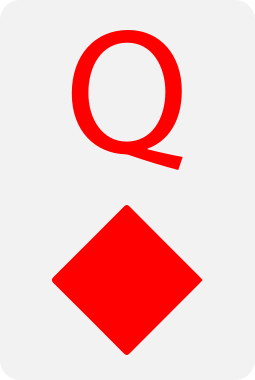
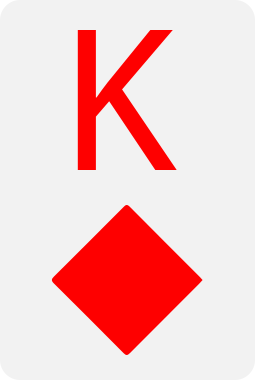
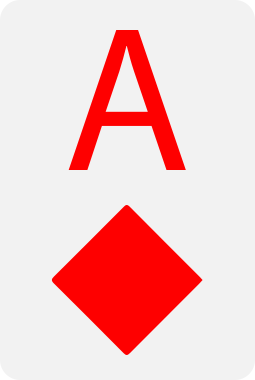
Ace-Jack Offsuit is a hand that occupies a well-understood but frequently misplayed position in the Texas Hold’em hand rankings. It is strong enough to be a clear favourite over most of the hands it will encounter, yet vulnerable enough to the hands at the top of opponent ranges that it requires careful navigation — particularly in raised and 3-bet pots. It sits one rung below AQo in the broadway hierarchy, and that single rank difference in the second card matters more than it might initially appear.
Before the flop, AJo is a comfortable open from most positions and a hand with genuine showdown value against wide ranges. Its challenges emerge when facing significant aggression from tight ranges, where the hands that dominate it — AK, AQ, and premium pairs — feature heavily. Understanding exactly when AJo is strong and when it is in trouble is the central skill associated with playing this hand well.
What These Odds Show for AJo
The high card flop rate of 53.55% is identical to AQo and reflects the shared structure of all unpaired Ace-x hands — the pair probability is determined by the number of outs to pairing either card, which is the same regardless of whether the second card is a Queen, Jack, or lower. You miss the board more often than not, and the frequency of those misses is a constant across the entire Ace-x offsuit family.
The pair rate of 40.41% on the flop is consistent across all unpaired hands. When AJo pairs the Ace it has top pair with a Jack kicker — a strong holding that beats the majority of hands that also pair the Ace with a weaker kicker. When it pairs the Jack, it typically has top pair or a very strong second pair depending on the board, since the Jack is a high card that sits above most board textures.
The straight odds of 0.33% on the flop, 1.50% by the turn, and 4.05% by the river are worth examining carefully in comparison to the other Ace-x offsuit hands in this series. AQo reaches 3.68% by the river, and AJo surpasses it at 4.05%. The reason is the Jack’s superior straight connectivity compared to the Queen. While AQo’s primary straight combination is the nut straight (A-K-Q-J-T), AJo can make the nut straight on a K-Q-T board and also connects through K-Q-J-T-9 and Q-J-T-9-8, both of which involve the Jack directly. The Jack sits one step closer to the middle of the deck than the Queen, giving it access to one additional straight combination on the lower end that AQo cannot reach. It is a modest but genuine structural advantage in straight terms, and it is the one dimension where AJo outperforms AQo in the draw odds table.
The two pair rate of 4.04% on the flop climbing to 22.66% by the river is consistent with AQo, reflecting the same structure of Ace-x hands developing two pair as the board runs out. The full house, four of a kind, and straight flush figures are all essentially identical to AQo as expected — these rare outcomes are driven by the same deck mechanics regardless of the second card.
The flush rate of 1.96% by the river confirms the offsuit nature of the hand and is the most direct reminder of what AJo gives up compared to AJs. Without a flush draw to fall back on when missing the board, AJo’s post-flop equity is entirely concentrated in its pair outs and straight draw potential.
The Kicker Hierarchy
AJo sits third in the Ace-x offsuit kicker hierarchy, behind AK and AQ. This positioning defines its strategic identity more than any individual odds figure. In a pot where two players share an Ace, the kicker determines the winner, and AJo loses that battle to both AK and AQ — two of the most common hands in an aggressive opponent’s raising and 3-betting range.
This means that on Ace-high boards, AJo faces a persistent and invisible threat. When you flop top pair with the Ace and the Jack kicker, you cannot be certain whether an opponent holding an Ace has you outkicked. Against a tight opponent who 3-bet preflop, the probability of facing AK or AQ is high enough that continued aggression on an Ace-high board requires either a strong read or additional equity in the form of a straight draw or two pair.
The Jack kicker is not weak in absolute terms — it beats all Ace-x hands below AJo — but in the context of hands that raise and 3-bet, it is frequently the worst kicker at the table.
Hand Strength Summary
- Hand type: Offsuit broadway, high Ace-x
- Relative strength: Top 8–10% of all starting hands
- Dominates: ATo and below, KQ, KJ, QJ, and most broadway hands without an Ace or premium pair
- Dominated by: AK, AQ (share the Ace, hold a better kicker), AA, KK, QQ, JJ
AJo is a hand with strong absolute equity against a wide range but significant kicker vulnerability against the specific hands that populate tight raising ranges. The skill in playing it is recognising which of those two contexts you are in before committing chips.
How AJo Wins
AJo has clear and reliable routes to winning:
- Flopping top pair (Ace) with a Jack kicker and holding against opponents who have not connected or who hold weaker Ace-x hands
- Flopping top pair (Jack) on boards where opponents are unlikely to hold a Jack with a better kicker
- Making two pair with both the Ace and Jack
- Completing a broadway straight — 4.05% by the river, the highest straight rate of any Ace-x offsuit hand covered in this series
- Forcing folds preflop against wide ranges through aggression
- Out-kicking dominated hands at showdown — AT, A9, KJ, QJ all lose the kicker battle to AJo
The straight draw is AJo’s most underappreciated asset. On boards containing K-Q-T, Q-T-x, or K-Q with action, AJo has a genuine straight draw to the nut straight or near-nut straight. This is not a draw that opponents typically assign to an Ace-Jack holding, and it creates disguised value that more obvious Ace-x hands do not generate as cleanly.
Main Weaknesses
AJo’s weaknesses are structural and consistent:
- Dominated by AK and AQ — both common hands in tight raising and 3-betting ranges
- No flush draw equity — without a suit bonus, AJo’s post-flop options are limited to pairs and straights
- On Ace-high boards, the kicker uncertainty is constant — you cannot easily determine whether an aggressive opponent has a better Ace
- In 3-bet pots, AJo is frequently on the wrong side of the kicker battle — the hands that 3-bet most often include AK and AQ at high frequency
- Jack-high boards are also potentially dangerous — KJ and QJ are common holdings that have the kicker covered
The kicker problem is the defining weakness. AJo is not a hand to get carried away with when facing sustained aggression on Ace-high boards, particularly from opponents whose ranges skew toward the top of the deck.
Best and Worst Flop Textures
Strong flops
- Ace-high dry boards (A♠ 7♦ 2♣) — top pair Jack kicker, minimal draw danger, opponents with weaker Ace-x are losing
- Jack-high boards where the Jack is clearly the top card — top pair with a strong kicker relative to the board
- K-Q-T or Q-T-x boards — open straight draw to the nut or near-nut straight, a valuable and disguised equity source
- Low boards well below the Ace and Jack — both cards are well above the board texture and opponents connecting weakly
Dangerous flops
- Ace-high boards in 3-bet pots — AK and AQ feature heavily in 3-betting ranges and have the kicker covered
- Ace-high boards with Jack in a multiway pot — the Jack kicker becomes less reliable as more players are present
- Jack-high boards where KJ or QJ are realistic holdings for aggressive opponents
- Coordinated boards in any suit — without a flush draw, AJo cannot participate in the draw equity that suited holdings generate
How It Plays by Position
- Early position: A standard raise; be prepared to face 3-bets and consider your options carefully — calling a 3-bet out of position with AJo against a tight range is a difficult spot where you are frequently dominated
- Middle position: Aggressive play is standard; the decision to call or 4-bet a 3-bet depends heavily on the specific opponent and their 3-betting tendencies
- Late position (CO/BTN): Where AJo is most comfortable — raise wide, realise your equity in position, and navigate post-flop decisions with the informational advantage of acting last
- Blinds: A reasonable defend against late position steals; in 3-bet pots out of position the kicker vulnerability is most acute and caution across multiple streets is warranted
Common Mistakes with AJo
- Calling 4-bets — AJo is almost always behind in a 4-bet pot and should rarely continue
- Over-committing on Ace-high boards in 3-bet pots without additional equity — the most common and expensive leak associated with this hand
- Not recognising when the straight draw is live — K-Q-T and Q-T-x boards give AJo a powerful and disguised draw that is easy to overlook when focusing on the pair
- Under-folding to 3-bets from tight ranges out of position — AJo is dominated by a significant portion of those ranges and the multi-street positional disadvantage compounds the problem
- Treating AJo identically to AQo — the one rank difference in the second card meaningfully changes the kicker dynamic against the most common strong hands
Comparison to Similar Hands
- Stronger than: ATo, A9o and all weaker Ace-x offsuit hands; KQo, KJo, QJo and most broadway hands without an Ace
- Slightly weaker than: AQo — the Queen is a stronger kicker against the Ace-x hands it competes with most often, and AQo’s nut straight (A-K-Q-J-T) is marginally more accessible than AJo’s primary combinations
- One rank below: AQo in the broadway hierarchy, with the key difference being that AQo dominates AJo when an Ace falls — a common and costly scenario
Examples:
- Against AQo: AJo is dominated — both pair an Ace equally but the Queen kicker wins decisively; this is the most important matchup to recognise and avoid in large pots
- Against AKo: AJo is dominated further — the King kicker is the strongest possible, and AJo has the worst of the kicker battle on any Ace-high board
- Against KQo: AJo is a clear favourite — the Ace dominates both the King and Queen, and AJo wins the large majority of runouts
- Against JJ: AJo is a modest underdog preflop — pocket Jacks is ahead, but the Ace gives AJo a meaningful overcard out, and the hand is close to a coin flip
How AJo Performs in Multiway Pots
AJo in multiway pots faces a compounding version of its central problem:
- More opponents means a higher collective probability that someone holds AK or AQ — the hands that dominate through the kicker
- Top pair Jack kicker becomes progressively weaker as the number of players increases
- The 53.55% high card flop rate means frequent misses, and continuation betting into multiple opponents without a strong made hand or draw is rarely profitable
- The straight draw — 4.05% by the river — generates better implied odds multiway when it completes, since more opponents contribute to a larger pot
The strategic approach multiway is to play conservatively with top pair and aggressively only when the board strongly supports it — specifically when the straight draw is live, when two pair or better is made, or when the board texture is so dry that top pair Jack kicker is unlikely to be dominated. Multiway aggression without these conditions costs chips steadily over time.
FAQ: Ace-Jack Offsuit
How does AJo compare to AQo in practice?
The gap is larger than one rank suggests. AQo dominates AJo when an Ace falls — the Queen beats the Jack in a kicker battle — and that scenario occurs on roughly 40% of flops. AQo also has a marginally lower straight rate (3.68% versus 4.05%), which is the one area where AJo has a measurable edge. Overall AQo is the stronger hand, and the difference is most significant in 3-bet pots where kicker strength matters most.
Should you call a 3-bet with AJo?
It depends heavily on position and the opponent. In position against a wide 3-betting range, calling is reasonable — AJo has enough equity and playability to justify it. Out of position against a tight 3-bettor, AJo is frequently dominated by AK and AQ, and folding or 4-betting as a bluff are often better options than calling and navigating multiple streets with kicker uncertainty from out of position.
Why does AJo have a higher straight rate than AQo?
The Jack sits one position closer to the middle of the deck than the Queen, giving it access to one additional straight combination on the lower end — specifically straights running through Q-J-T-9-8, which the Queen cannot contribute to from its own hand. The Ace participates in the nut straight for both hands, but the Jack’s additional downward connectivity gives AJo a slight edge in raw straight probability. It is the one statistical category where AJo outperforms AQo.
Is AJo strong enough to 3-bet with?
Yes, particularly in position against late position openers with wide ranges. AJo has enough equity against a wide opening range to generate profit as a 3-bet, and playing it with initiative in position maximises its top pair and straight draw value. Against early position openers with tight ranges, caution is warranted — those ranges contain AK and AQ at high frequency.
Related Hands