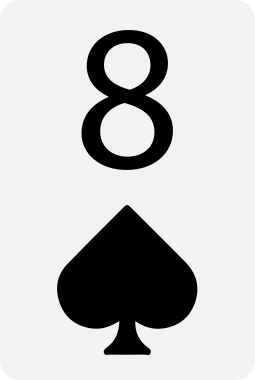
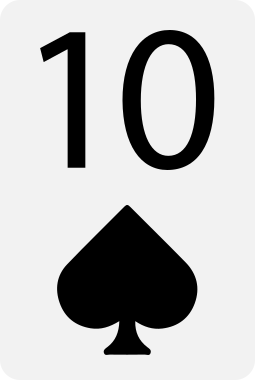
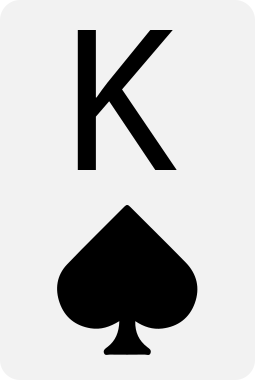
Ace-Ten Offsuit is a strong broadway hand that sits at an interesting crossroads – powerful enough to be a default open from most positions, but vulnerable enough to create genuinely difficult post-flop situations when it runs into better aces or strong broadway combinations. It is a hand that many players either overvalue or undervalue, and getting the balance right is one of the markers of solid intermediate play.
Before the flop, ATo is a clear open from late position and a reasonable one from middle position, but it demands caution in the face of aggression from players representing tight ranges.
What These Odds Show for ATo
The pair odds are the dominant feature of ATo’s draw table. Pairing up peaks at 47.71% on the turn and settles at 45.15% by the river – slightly higher than lower ace-x hands because the ten itself has more board coverage than a six or a two, connecting with more flop textures. When the ace pairs, ATo has top pair with a strong kicker – one of the better top-pair holdings available to any unpaired hand. When the ten pairs, the result is more vulnerable but still competitive on boards where tens are the highest card.
The straight equity of 4.43% by the river is a meaningful number. ATo can make broadway straights (A-K-Q-J-T) and ten-high straights (J-T-9-8-7 style combinations), giving it more straight potential than lower ace-x hands. The 0.33% flop straight frequency reflects the specific board requirements for these combinations, rising to 1.61% by the turn as more cards are dealt. The broadway straight in particular – when it arrives – is a premium holding that is difficult for opponents to put you on when you hold an ace.
With no flush equity due to the offsuit nature, ATo is entirely reliant on pair strength and straight draws for its post-flop value. The 53.55% flop miss rate is consistent with other unpaired hands and reinforces the importance of selecting the right boards and situations to continue.
Hand Strength Summary
- Hand type: Offsuit broadway hand, strong unpaired holding
- Relative strength: Upper-middle tier starting hand
- Dominates: Weaker aces (A2–A9), weaker tens (KT, QT, JT on the right boards)
- Main vulnerability: Dominated by AJ, AQ, AK; the ten kicker loses to any ace with a better kicker
ATo is a hand whose strength is heavily dependent on whether the ace pairs and whether an opponent also holds an ace. When the kicker is live, it is a powerful holding. When it is not, it becomes a trap.
How Ace-Ten Offsuit Wins
- Flopping top pair of aces with the ten as a strong kicker, winning against weaker aces and non-ace holdings
- Making the broadway straight (A-K-Q-J-T) – a premium made hand that is disguised by the ace’s dual role as a top-pair card
- Pairing the ten on low boards and holding up as the best pair against missed hands
- Taking uncontested pots preflop or with continuation bets on boards that completely miss opponent ranges
- Two pair by the river (22.66%) when both the ace and ten connect with the board
The broadway straight is worth highlighting. When the board runs out with king, queen and jack alongside the ace and ten in hand, ATo makes the highest possible straight. The implied odds in this scenario are excellent – opponents holding top pair of kings or a set will frequently not lay down their hand against a broadway straight.
Main Weaknesses
- Dominated by AJ, AQ and AK – three very common holdings that share the ace and hold a better kicker
- No flush equity – the offsuit nature removes an entire category of draw that ATs enjoys, giving up roughly 4–5% equity in head-to-head comparisons
- The ten kicker, while strong, still loses to jacks, queens and kings when both players pair the ace
- Straight draws require specific broadway board textures – more constrained than suited connectors with natural two-way connectivity
- Miss rate of 53.55% on the flop demands discipline to avoid spewing chips on boards that do not connect
The domination risk is the central concern. ATo looks like a strong hand and often is, but it is one of the most frequently dominated holdings in Texas Hold’em because the hands that beat it – AJ, AQ, AK – are all natural opening and 3-betting hands for opponents.
Best and Worst Flop Textures
Strong flops
- Ace-high boards with low undercards (A♠ 7♦ 2♣) where top pair with a ten kicker is very likely the best hand
- Ten-high boards with no overcards where the ten makes top pair safely
- Broadway boards containing kings, queens and jacks where straight potential is at its highest
Dangerous flops
- Ace-high boards in multi-way pots or against 3-bet ranges where AJ, AQ or AK is plausible
- Jack or queen-high boards where the ten is middle pair and the ace is an overcard with no pair
- Boards with flush draws that opponents can hold and ATo cannot – a positional disadvantage with no reciprocal draw equity
How It Plays by Position
- Early position: A marginal open in full-ring games – playable but should be folded to 3-bets from tight ranges, particularly from the blinds or early position opponents
- Middle position: A standard open; the hand has sufficient strength and post-flop playability to justify it in most formats
- Late position (button/cutoff): A comfortable and profitable open – fold equity combined with top-pair and straight potential makes it a strong late-position hand
- Blinds: A strong defend from the big blind against late-position opens; less comfortable from the small blind where positional disadvantage compounds the kicker vulnerability
ATo plays best when it is the aggressor. Calling raises with ATo, particularly from out of position, creates difficult spots where the kicker problem is most likely to be exposed.
Common Mistakes with Ace-Ten Offsuit
- Calling 3-bets out of position – ATo is frequently dominated by 3-betting ranges and loses its post-flop navigability without position
- Overcommitting with top pair of aces when facing aggression from opponents likely to hold AJ, AQ or AK
- Treating ATo like ATs – the absence of flush equity is a meaningful difference that should reduce willingness to continue on suited boards where opponents have draw equity and ATo does not
- Underplaying the broadway straight potential – players sometimes fail to recognise when the board has delivered a disguised straight and do not extract maximum value
The most common and costly mistake is continuing too aggressively after pairing the ace in a 3-bet pot. Against a range that 3-bets with AJ, AQ and AK, a pair of aces with a ten kicker is frequently in poor shape and should be played cautiously.
Comparison to Similar Hands
- Stronger than: A9o, A8o and below (weaker kickers with less straight and board coverage potential), KTo, QTo (weaker high card)
- Comparable to: ATs (the suited version – roughly 4–5% stronger due to flush equity; ATs is a meaningfully better hand in most formations)
- Weaker than: AJo, AQo, AKo (better kickers that dominate ATo when the ace pairs)
The gap between ATo and ATs is more significant than the gap between offsuit and suited versions of most other hands, because ATs also picks up broadway straight draw equity alongside the flush draw. ATs is a comfortable 3-bet call in many spots where ATo is a fold.
How Ace-Ten Offsuit Performs in Multiway Pots
ATo loses value in multiway pots for several compounding reasons:
- The kicker problem is magnified – with more players in the hand, the probability that at least one opponent holds a better ace increases substantially
- No flush draw means ATo cannot benefit from suited board textures the way ATs can, and cannot draw to a flush against opponents who are doing exactly that
- Broadway straight potential becomes more valuable in multiway pots when it hits, but the specific board requirements mean it arrives infrequently
- Top pair with the ten kicker, while strong heads-up, is a difficult holding to navigate against two or more opponents
In multiway pots, ATo plays best when it connects cleanly – top pair of aces on a dry board or a strong two-pair – and should be cautious about committing significant chips with marginal holdings against multiple opponents.
FAQ: Ace-Ten Offsuit
Is Ace-Ten Offsuit a strong starting hand?
Yes, it is one of the stronger non-premium hands. However, it is also one of the most commonly dominated holdings at the table – AJ, AQ and AK all beat it when the ace pairs, and all are frequent opens and 3-bets for competent opponents.
How does ATo compare to ATs?
ATs is meaningfully stronger. The suited version adds flush draw equity of roughly 6.5% by the river and improves the hand’s ability to continue profitably in a wider range of post-flop situations. ATo should be played more conservatively, particularly in 3-bet pots.
How often does ATo make a straight?
By the river, ATo completes a straight 4.43% of the time. The broadway straight – A-K-Q-J-T – is the primary target and a very strong disguised holding when it arrives.
Should you call a 3-bet with ATo?
Generally no, particularly out of position. ATo is frequently dominated by 3-betting ranges, and without flush equity or positional advantage the hand struggles to realise its equity efficiently. In position against wide 3-bet ranges it becomes more viable.
Related Hands