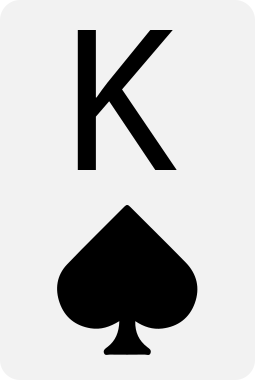
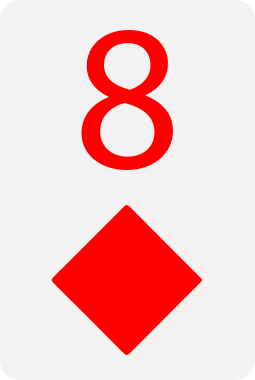
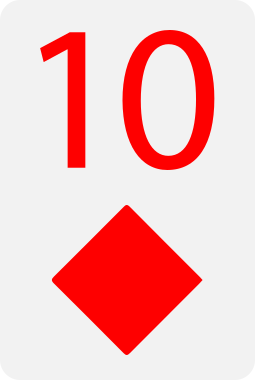
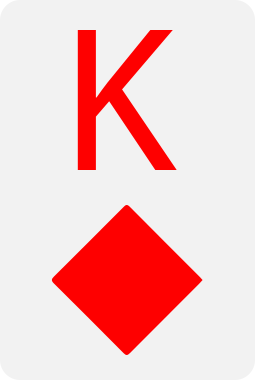
King-Ten Offsuit is one of the stronger offsuit broadway hands – a hand with two high cards, meaningful straight potential, and top-pair value on a wide range of boards. It is not a premium hand, but it sits comfortably in the upper tier of non-premium holdings and is a standard open from most positions in most formats.
Before the flop, KTo is a hand that plays straightforwardly in many spots but requires careful judgment when facing aggression. Its strengths are real, its weaknesses are specific, and understanding both is the key to extracting value from it consistently.
What These Odds Show for KTo
The straight equity of 5.76% by the river is the most distinctive feature of KTo relative to other king-x offsuit hands. The ten provides genuine broadway connectivity – straights involving ace, queen, jack and ten are all within reach, and the combination of king and ten means that any board containing ace, queen and jack, or queen, jack and nine, delivers either a made straight or a strong draw. On the flop, 0.65% of runouts complete a straight immediately, rising to 2.46% by the turn. This straight potential is meaningfully higher than lower king-x hands like K7o or K8o, and it is one of the primary arguments for KTo’s inclusion in wider opening ranges.
The pair odds peak at 47.42% on the turn and settle at 44.44% by the river – slightly higher than lower king-x hands because the ten itself connects with more board textures, pairing on ten-high flops that a seven or eight would miss. When the king pairs, KTo has top pair with a ten kicker – a strong made hand on most boards. When the ten pairs, the result is more vulnerable but still competitive on ten-high or lower boards.
The overcard table is KTo’s most favourable structural feature. With a 22.55% chance of an overcard on the flop – identical to K7s and K8s – only aces outrank the king, meaning top pair is available on the vast majority of non-ace boards. By the river, that figure rises to 35.30%, still one of the lower overcard exposures available to any unpaired starting hand.
Hand Strength Summary
- Hand type: Offsuit broadway hand, strong non-premium holding
- Relative strength: Upper-middle tier starting hand
- Dominates: Weaker kings (K2–K9 offsuit), weaker tens (QT, JT on the right boards), most low and medium unpaired hands
- Main vulnerability: Dominated by AK, QK, JK and any king with a better kicker; the ten kicker loses to any king with a jack, queen or ace
KTo combines low overcard exposure with meaningful straight potential – a combination that gives it more post-flop versatility than most offsuit hands at a similar strength level.
How King-Ten Offsuit Wins
- Flopping top pair of kings with a ten kicker and holding up – with overcard exposure of just 22.55% on the flop, this is a frequent and reliable outcome
- Completing a broadway straight (A-K-Q-J-T or K-Q-J-T-9) – a premium made hand that is often disguised by the king’s dual role as a top-pair card
- Pairing the ten on lower boards and holding up as the best pair in uncontested pots
- Taking uncontested pots with continuation bets on boards that completely miss opponent ranges
- Two pair by the river (22.53%) when both the king and ten connect with the board
The broadway straight potential is particularly valuable. When KTo makes a king-high straight on a board containing ace, queen and jack, it holds the second-best possible straight – a hand that is almost impossible for opponents to put you on and one that extracts significant value from opponents holding top pair or sets.
Main Weaknesses
- The ten kicker, while stronger than most, still loses to jacks, queens and aces when both players pair the king
- Dominated by AK, QK and JK – three common holdings that share the king and hold a better kicker
- No flush equity – the offsuit nature removes an entire drawing category, giving up roughly 4–5% equity compared to KTs
- Misses the flop entirely 53.22% of the time, requiring discipline on boards that do not connect
- Straight draws require specific broadway board textures – less two-way connectivity than suited connectors
The domination risk is the most important constraint. KTo looks and feels like a strong hand, and often is, but AK, QK and JK all dominate it when the king pairs, and all are natural opening and 3-betting hands for competent opponents.
Best and Worst Flop Textures
Strong flops
- King-high boards with low or medium undercards (K♠ 7♦ 2♣) where top pair with a ten kicker is comfortably ahead of most ranges
- Ten-high boards with no overcards where the ten makes top pair safely and the king is a strong overcard
- Broadway boards containing ace, queen and jack where straight potential is at its highest and draws are live
Dangerous flops
- Ace-high boards where top pair disappears and only a pair of tens or a straight draw remains
- King-high boards in multiway pots or against 3-bet ranges where AK, QK or JK is plausible
- Boards with flush draws that opponents can hold and KTo cannot – a positional disadvantage with no reciprocal flush equity
How It Plays by Position
- Early position: A marginal open in full-ring games – playable but should be folded to 3-bets from tight ranges where domination by AK, QK and JK is most likely
- Middle position: A standard open in most formats; the hand has sufficient high-card strength and straight potential to justify it
- Late position (button/cutoff): A comfortable and profitable open – low overcard exposure, straight potential, and fold equity combine to make KTo a strong late-position hand
- Blinds: A solid defend from the big blind against late-position opens; the 22.55% flop overcard odds mean top pair of kings is a useful and frequent outcome in blind defence scenarios
KTo plays best as the aggressor. Calling raises with KTo, particularly out of position, creates difficult spots where the kicker problem and the lack of flush equity are most likely to be exposed.
Common Mistakes with King-Ten Offsuit
- Calling 3-bets out of position – KTo is frequently dominated by 3-betting ranges containing AK, QK and JK, and without flush equity or positional advantage the hand struggles to realise its equity efficiently
- Overcommitting with top pair of kings when facing aggression from players likely to hold a better kicker
- Treating KTo like KTs – the absence of flush equity is a meaningful difference that should reduce willingness to continue on suited boards where opponents have flush draw equity and KTo does not
- Underestimating straight potential – players sometimes fail to recognise clean broadway draw situations and fail to continue or semi-bluff appropriately
The most common and costly mistake is continuing too aggressively in 3-bet pots. Against ranges that 3-bet with AK, QK and JK, top pair of kings with a ten kicker is frequently in poor shape and demands cautious play.
Comparison to Similar Hands
- Stronger than: K9o, K8o and below (weaker kickers with less straight and board coverage potential), QTo, JTo (weaker high card)
- Comparable to: KTs (the suited version – roughly 4–5% stronger due to flush equity; KTs is a meaningfully better hand in most formations), QJo (similar straight profile, different high card)
- Weaker than: AKo, AKs (the premium king hand), KQo, KJo (better kickers that dominate KTo when the king pairs)
The comparison to KTs is the most instructive. KTs adds flush equity and becomes a comfortable 3-bet call in position – a spot where KTo should almost always fold. That gap in playability across a wider range of situations is what separates the suited and offsuit versions more than the raw equity difference suggests.
How King-Ten Offsuit Performs in Multiway Pots
KTo loses value in multiway pots for compounding reasons:
- Top pair of kings with a ten kicker is vulnerable against multiple opponents – the probability of at least one player holding AK or a better king increases with every additional player
- No flush draw means KTo cannot benefit from suited board textures the way KTs can, and cannot draw to a flush against opponents who are doing exactly that
- Broadway straight potential becomes more valuable in multiway pots when it hits, but the specific board requirements mean it arrives infrequently
- Two pair (king and ten) is a strong holding in multiway pots but still vulnerable to sets and better two-pair combinations
In multiway pots, KTo plays best when it connects cleanly – top pair of kings on a dry board with no obvious better king in the field, or a strong two-pair or straight. Marginal single-pair holdings against multiple opponents should be approached with significant caution.
FAQ: King-Ten Offsuit
Is King-Ten Offsuit a strong starting hand?
Yes, it is one of the stronger non-premium hands. Low overcard exposure, meaningful straight potential, and two high cards make it a consistently playable hand from most positions. However, it is frequently dominated by AK, QK and JK and must be played with that in mind.
How does KTo compare to KTs?
KTs is meaningfully stronger. The suited version adds flush draw equity of roughly 6.5% by the river and increases the hand’s ability to continue profitably across a wider range of situations, including 3-bet pots in position. KTo should be played more conservatively.
How often does KTo make a straight?
By the river, KTo completes a straight 5.76% of the time. The broadway straight – combinations involving ace, queen, jack and ten – is the primary target and a well-disguised premium holding when it arrives.
Should you call a 3-bet with KTo?
Generally no, particularly out of position. KTo is frequently dominated by 3-betting ranges containing AK, QK and JK, and without flush equity the hand does not have sufficient equity to call comfortably. In position against wide 3-bet ranges it becomes more viable but remains a marginal call at best.
Related Hands