Queen Jack Offsuit Draw Odds

back of playing card back of playing card back of playing card back of playing card back of playing card
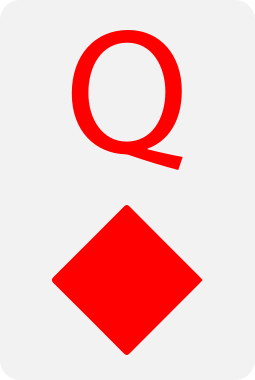
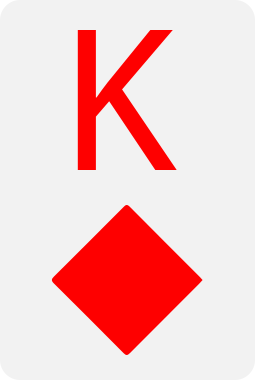
Queen of Spades Jack of Hearts
Two of Spades
Three of Spades
Four of Spades
Five of Spades
Six of Spades
Seven of Spades
Eight of Spades
Nine of Spades
Ten of Spades
Jack of Spades
Queen of Spades
King of Spades
Ace of Spades
Two of Hearts
Three of Hearts
Four of Hearts
Five of Hearts
Six of Hearts
Seven of Hearts
Eight of Hearts
Nine of Hearts
Ten of Hearts
Jack of Hearts
Queen of Hearts
King of Hearts
Ace of Hearts
Two of Clubs
Three of Clubs
Four of Clubs
Five of Clubs
Six of Clubs
Seven of Clubs
Eight of Clubs
Nine of Clubs
Ten of Clubs
Jack of Clubs
Queen of Clubs
King of Clubs
Ace of Clubs
Two of Diamonds
Three of Diamonds
Four of Diamonds
Five of Diamonds
Six of Diamonds
Seven of Diamonds
Eight of Diamonds
Nine of Diamonds
Ten of Diamonds
Jack of Diamonds
Queen of Diamonds
King of Diamonds
Ace of Diamonds

Draw Odds

Hand On The Flop By The Turn By The River
High Card 52.90 % 33.97 % 18.08 %
Pair 40.41 % 47.13 % 43.73 %
Two Pair 4.04 % 11.43 % 22.40 %
Three Of A Kind 1.57 % 3.06 % 4.37 %
Straight 0.98 % 3.30 % 7.09 %
Flush 0.00 % 0.43 % 1.96 %
Full House 0.09 % 0.63 % 2.22 %
Four Of A Kind 0.01 % 0.05 % 0.13 %
Straight Flush 0.00 % 0.00 % 0.02 %

Odds Of An Overcard On The Board

On The Flop By The Turn By The River
41.43 % 51.40 % 59.85 %

Queen-Jack Offsuit (QJo) – Odds Breakdown and Analysis

Queen-Jack Offsuit is one of the strongest non-premium starting hands in Texas Hold’em. It combines two high cards with significant straight potential, giving it multiple ways to connect with the board and build strong made hands.

Before the flop, QJo is not a hand you are looking to get all the money in with, but it is a comfortable open from most positions and a hand that plays well in a variety of post-flop scenarios.


What These Odds Show for QJo

Like most unpaired hands, QJo misses the flop entirely 52.90% of the time – but that headline figure somewhat undersells the hand. The straight equity is where QJo separates itself from weaker broadway hands. There is a 7.09% chance of making a straight by the river, one of the highest straight probabilities available to an unpaired starting hand. On the flop alone, 0.98% of runouts already complete a straight, rising to 3.30% by the turn.

The pair odds follow a familiar pattern for high card hands – peaking at 47.13% on the turn and settling at 43.73% by the river as two pair and better hands develop. Two pair arrives 22.40% of the time by the river, a solid figure that reflects how well the two connected cards work together on coordinated boards.

The overcard table is a notable feature for QJo. There is a 41.43% chance of an overcard appearing on the flop, rising to 59.85% by the river. With only aces and kings outranking the queen, this is a hand that will frequently face board pressure from higher cards, making it important to read opponents carefully before committing significant chips with just top pair.


Hand Strength Summary

  • Hand type: Offsuit broadway connector
  • Relative strength: Strong speculative hand, upper-middle tier
  • Dominates: Weaker broadway hands (QT, JT, J9), low and medium pairs on the right boards
  • Main vulnerability: Overcard pressure (A, K on the board), dominated by AQ, AJ, KQ, KJ

QJo is a hand that wins by connecting well with the board rather than relying on raw card strength alone.


How Queen-Jack Offsuit Wins

  • Flopping top pair with a strong kicker and holding up at showdown
  • Completing a straight, particularly on T-high or K-high connected boards
  • Making two pair on coordinated flops and building a strong made hand
  • Taking down pots with continuation bets on boards that miss opponent ranges

The straight potential is the hand’s most distinctive asset. Boards containing any combination of A-K-T, K-T-9, T-9-8, or 9-8-7 all give QJo either a made straight or a strong draw, keeping it competitive even when it misses top pair.


Main Weaknesses

  • No flush draw – the offsuit nature removes an entire category of equity that QJs enjoys
  • Overcard exposure is significant; by the river there is nearly a 60% chance at least one overcard has appeared
  • Dominated by AQ, AJ, KQ and KJ, all of which share part of QJo’s value while holding better kickers
  • Top pair with either the queen or jack can be a difficult hand to navigate – strong enough to call, weak enough to lose to a range of holdings

The lack of flush potential is the most tangible cost of playing the offsuit version. Against QJs, QJo gives up roughly 4–5% equity in most scenarios.


Best and Worst Flop Textures

Strong flops

  • Connected boards that complete or heavily draw to a straight (e.g. T♠ 9♦ 2♣, K♥ T♦ 3♠)
  • Queen-high or jack-high boards where top pair is likely ahead
  • Dry low boards where a continuation bet can take the pot uncontested

Dangerous flops

  • Ace-high or king-high boards where top pair is no longer an option and opponent ranges connect well
  • Flush-heavy boards where QJo has no draw equity to fall back on
  • Paired boards where the hand’s straight potential is partially neutralised

How It Plays by Position

  • Early position: A marginal open in full-ring games – playable but should be folded to significant 3-bet pressure
  • Middle position: A standard open; the hand has enough post-flop playability to justify it
  • Late position (button/cutoff): A strong open, particularly against players who fold to steals frequently
  • Blinds: Reasonable defend from the big blind given the pot odds; less attractive from the small blind out of position

QJo rewards positional awareness. In late position, the combination of fold equity and post-flop playability makes it a consistently profitable hand to open.


Common Mistakes with Queen-Jack Offsuit

  • Overcommitting with top pair on boards where the kicker is outgunned
  • Continuing too aggressively after missing the flop with no draw equity
  • Underestimating the overcard risk – nearly six in ten rivers will show an ace or king
  • Calling 3-bets out of position where the hand loses much of its post-flop advantage

The most costly error tends to be playing a single pair of queens or jacks too strongly when the board and opponent aggression suggest a better hand is possible.


Comparison to Similar Hands

  • Stronger than: JTo, QTo, KTo (less straight potential or weaker cards)
  • Comparable to: QJs (the suited version; roughly 4–5% stronger due to flush equity)
  • Weaker than: AQo, KQo, AJo (better kicker or higher card strength)

The natural comparison is always QJs. The suited version is meaningfully better, but QJo remains a strong hand in its own right and should not be treated as a significant downgrade in most spots.


How Queen-Jack Offsuit Performs in Multiway Pots

QJo can perform reasonably in multiway pots due to its straight potential, but several factors reduce its value:

  • Top pair becomes much harder to continue with against multiple opponents
  • Straight draws are more likely to be challenged by flush draws held by other players
  • Overcard pressure increases as more hands are in play, raising the likelihood one opponent holds an ace or king

In multiway pots, QJo plays best when it connects strongly with the board – a draw or made straight is far safer than a single pair in these spots.


FAQ: Queen-Jack Offsuit

Is Queen-Jack Offsuit a good hand?

Yes, it is one of the better non-premium hands. Its strength comes from straight potential and two high cards rather than raw dominance, so it rewards players who can navigate post-flop well.

How does QJo compare to QJs?

QJs is the stronger hand by virtue of its flush draw potential, adding roughly 4–5% equity. However, QJo is still a solid hand and not a significant downgrade in most situations.

How often does QJo make a straight?

By the river, QJo completes a straight 7.09% of the time – one of the highest straight probabilities for any unpaired starting hand.

Should you 3-bet with QJo?

Occasionally, as a bluff or semi-bluff from late position. However, QJo is generally better used as a flat call or open raise rather than a 3-bet hand, particularly out of position.


Related Hands

Poker Odds Calculator Explained
Use Bet Shrew Poker Odds Calculator to calculate the odds of making a hand while playing Texas Hold‘em poker.

Poker is a game of incomplete information as you do not have access to your opponent's hole cards while making your betting decisions. Unlike other online Poker Odds Calculators, the Bet Shrew Poker Odds Calculator reflects this and calculates your odds based only on the cards that you can see.

The Bet Shrew Poker Odds Calculator is perfect for beginners and intermediate players wanting to calculate their draw odds and outs quickly and accurately without any complicated maths.

The various odds tables that you may encounter while using the Bet Shrew odds calculator are explained below.

Starting Hand Odds

Before you have even been dealt your hand, the calculator will show you the odds of being dealt different possible starting hands. For example, it will show you the odds of being dealt pocket aces (note: this can be applied to any specific pair).

These odds can be particularly useful when you are short stacked, waiting for that all-in opportunity.

Draw Odds

When you specify your hole cards, the calculator will consider every possible combination of cards that can still be drawn from the deck, evaluate what hand you would make for each possible combination and calculate the odds of you making each hand.

The draw odds table will breakdown your odds of making a hand on the flop, by the turn and by the river.

Odds of a Higher Poker Pair

When you have a pocket pair, the Poker Odds Calculator will show you the odds of an opponent holding a higher pocket pair.

The odds of an opponent holding a higher pocket pair is dependent on how high your pocket pair is and the number of players at you table. The odds presented will automatically consider the cards you are holding and then show you a breakdown of the odds based on the number of players.

Please note that these odds are based on the number of players at your table, not the number of players in the hand. This is important to note because a player at your table could be dealt a higher pocket pair but fold.

Odds of an Over Card

The odds of an over card table shows the odds that a card with a higher value than your highest denomination card will be drawn on the board.

Knowing the odds of an over card being drawn allows you to bet an appropriate amount to price out players fishing for a higher pair.

To set your hole cards or any community cards, simply click on the card you wish to set from the deck. As you click on cards from the deck, first your hole cards will be set, followed by the flop, the turn and then the river. As you set the cards in the hand, draws odds will automatically be calculated and displayed.

To unset a card, simply click on it to return it to the deck. Clicking the new hand button will reset the whole table and allow you to calculate the odds for a new hand.

How are draw odds calculated?

To calculate your draw odds, the calculator generates every possible combination of cards that could be drawn from the deck. For each combination, it evaluates the best 5 card hand that can be made and tallies up how often that a hand is made. This yields the precise probability of making each hand type.

This is a computationally expensive process. For speed and performance benefits, draws odds have been pre-computed and stored. This means that rather than recalculating draw odds every time, the calculator only needs to lookup the correct values from a table; albeit a very large table.

For a guide on how to calculate draw odds manually yourself, see our guide to calculating draw odds and outs.

Why are the draw odds different to what I expected?

Calculating draw odds is tricky. To understand how and why the odds above may not be quite what you expected it is best to use an example.

Let's say that you have AS and KS in your hand and you want to know the odds of making a pair on the flop. There are 6 cards that can make you a pair (3 Aces and 3 Kings).

To calculate your odds you may intuitively say that the odds of drawing an Ace or a King as the first card of the flop is 6 divided by the 50 remaining cards in the deck and you would be correct.

For the second card of the flop you might be inclined to say that it would be 6 divided by the 49 cards remaining in the deck. However, you must also consider what impact the first flop card made on your odds. This is where the math can get tricky.

Let’s say the first flop card is a 7D. If the second flop card is any other 7, even though you have not paired your hole cards, the hand you have made is still a pair; a pair of sevens.

Using the same example of AS, KS, another consideration is what if you make a better hand like 2 pair or 3 of a kind?

If the first of the flop cards is an Ace, great you've made top pair! However, if another Ace or a King comes you have no longer made a pair you have made a better hand.

The Bet Shrew odds calculator factors these consideration in as it determines every possible combinations of cards that could be drawn, evaluates the best 5 card hand that can be made and aggregates the results to determine their probabilities.

For draw odds based on outs, check out our drawing odds and outs table.