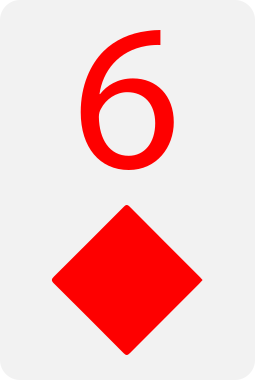
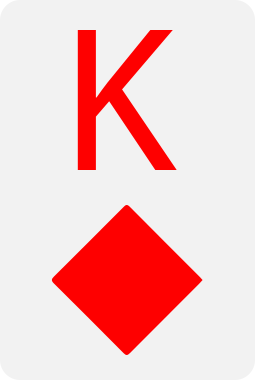
King-Queen Offsuit is one of the strongest non-pair, non-Ace starting hands in Texas Hold’em. It combines two of the highest broadway cards beneath the Ace, giving it excellent straight potential, strong top pair value, and the ability to make two pair with premium ranks. It is not a dominant hand in the way that AA, KK, or AK are, but it is a consistently profitable holding that plays well across a wide range of board textures.
Before the flop, KQo sits comfortably in the top tier of broadway hands. Its main vulnerabilities are Ace-x holdings – any hand with an Ace has KQo drawing to overcards or dominated – and pocket pairs of King or higher, which have it crushed from the start.
What These Odds Show for KQo
KQo shares the same high-card flop rate as other unpaired broadway hands: 53.22% of the time, the flop will not improve your hand beyond what you started with. This is the nature of playing two unconnected high cards and is the most important number to internalise when thinking about how often you will face a continuation decision with nothing made.
The pair rate of 40.41% on the flop is reliable and meaningful. When you pair a King, you typically have top pair on most boards. When you pair a Queen, you usually have top pair too, since most boards run below Queen-high. Either way, KQo connects with the board at a high rate relative to weaker hands, and the pairs it makes tend to be strong ones.
Where KQo genuinely stands out is its straight potential. At 0.65% on the flop, 2.24% by the turn, and 5.01% by the river, these are the highest straight odds of any offsuit hand covered so far on this site. The reason is structural: King and Queen sit in the middle of the broadway corridor, meaning they can connect with Ace, Jack, and Ten to form the nut straight (A-K-Q-J-T) or near-nut straights (K-Q-J-T-9). Both cards participate in multiple straight combinations, and that gives KQo a legitimate straight draw path that hands like A9s or AQo simply cannot match.
The overcard odds table is also directly relevant here. With a King as your highest card, any Ace on the board is an overcard. The 22.55% flop rate and 35.30% river rate mirror the Pocket Kings overcard table exactly – because the highest denomination in both cases is a King, and there are four Aces in the deck that can appear. This is a useful reminder that KQo, despite its strength, regularly faces boards where an opponent holding an Ace has you outkicked or dominated.
Two pair climbs from 4.04% on the flop to 22.53% by the river, consistent with similar broadway hands. On boards where both a King and Queen land, KQo makes top two pair – one of the strongest two-pair combinations possible.
Flush odds are low at 1.96% by the river, reflecting the offsuit nature of the hand. Unlike KQs, there is no flush draw to fall back on when you miss the board entirely.
Hand Strength Summary
- Hand type: Offsuit broadway connector
- Relative strength: Top 5–8% of all starting hands
- Dominates: KJ, KT, QJ, QT, and weaker broadway hands that share a card
- Dominated by: AK (shares King, weaker kicker), AQ (shares Queen, weaker kicker), AA, KK, QQ
KQo is a double-edged broadway hand. It dominates many hands that share one of its cards, but it is itself dominated by any Ace-x holding – a range that opponents will hold frequently, particularly in raised pots.
How KQo Wins
KQo has several clear paths to winning:
- Flopping top pair (King or Queen) with a strong kicker
- Making two pair, particularly top two pair on King-Queen boards
- Completing a broadway straight, most commonly A-K-Q-J-T or K-Q-J-T-9
- Forcing folds preflop through aggression, particularly against weaker broadway and suited connector hands
- Out-kicking dominated KJ, KT, QJ, and QT hands at showdown
The straight draw is the most strategically interesting of these. A flop of J-T-x gives KQo an open-ended straight draw to both the King-high and Ace-high straights, meaning any Ace or nine completes a straight. That is up to 8 clean outs on top of any pair outs, making KQo a significant equity favourite in those spots even when currently behind.
Main Weaknesses
Despite its strength, KQo carries real risks:
- Any Ace on the board puts KQo in a difficult spot – the overcard table shows this happening 22.55% of the time on the flop alone
- Dominated by AK (shares King) and AQ (shares Queen) – both common hands in a raiser’s range
- No flush draw equity as compensation when missing the board
- Straight draws, while excellent, require specific board textures to be live
- In multiway pots, the dominated-by-Ace-x problem compounds – more opponents means more chances someone holds an Ace
The Ace problem is the defining weakness of KQo. It is a hand that plays comfortably on King-high and Queen-high boards, but must proceed cautiously on any Ace-high board without significant additional equity.
Best and Worst Flop Textures
Strong flops
- King-high or Queen-high dry boards – top pair, strong kicker, minimal draw danger
- J-T-x boards – open-ended broadway straight draw with up to 8 outs
- King-Queen boards – top two pair, an extremely strong made hand
- Low boards well below your cards – your overcards have significant equity even without pairing
Dangerous flops
- Ace-high boards – you are immediately behind any Ace-x holding
- Ace-high boards with a King or Queen – you may have top pair but are still outkicked by AK or AQ
- Coordinated boards in a suit you don’t hold – draws you can’t participate in, limited outs
- Multiway Ace-high boards – the probability that someone holds an Ace rises significantly with each additional opponent
How It Plays by Position
- Early position: A standard open raise; be prepared to fold or 4-bet against tight 3-bets where Ace-x dominance is likely
- Middle position: Aggressive play is standard; the hand is strong enough to open and defend against most 3-bets
- Late position (CO/BTN): Excellent – KQo has enough equity and board coverage to play profitably in position across a wide range of flops
- Blinds: Plays well as a defend against late position steals; in 3-bet pots out of position, be selective about which boards you continue on
Position matters more for KQo than for premium hands, largely because the Ace-high board problem is much easier to navigate when you act last.
Common Mistakes with KQo
- Continuing too aggressively on Ace-high boards without a specific read or additional draw
- Folding too often preflop – KQo is strong enough to call 3-bets in position against most ranges
- Under-valuing the open-ended straight draw – a flopped straight draw with KQo is a significant equity holding, not just a backdoor possibility
- Over-folding to aggression when you hold top pair with a King kicker – this is a strong made hand on most non-Ace boards
- Forgetting that KQo dominates a wide portion of the calling range it will encounter at lower stakes
Comparison to Similar Hands
- Stronger than: KJs, KJo, QJs, QJo – KQo holds better kickers against shared-card hands and has superior straight potential
- Slightly weaker than: AKo, AQo – the absence of an Ace means any Ace-high board becomes a danger zone
- Competitive against: Pocket Jacks and Tens – KQo is approximately a coin flip against JJ and a modest underdog against TT, with meaningful straight draw outs
Examples:
- Against AKo: KQo is dominated – the shared King means an Ace-high board gives AK top pair top kicker while KQo has second pair
- Against AQo: KQo is similarly dominated through the Queen – a Queen-high board pairs both hands but AQ holds the better kicker
- Against JJ: KQo is close to a coin flip preflop – two overcards versus a pair, with straight draws as additional equity
- Against KJo: KQo dominates – both pair a King equally, but the Queen kicker wins the kicker battle at showdown
How KQo Performs in Multiway Pots
KQo’s multiway performance is a mixed picture. On the positive side, its straight potential becomes more valuable with more players in the pot – implied odds on a completed broadway straight are highest when there are multiple opponents to pay it off. On the negative side:
- More opponents means a higher collective chance someone holds an Ace
- Top pair value decreases as the number of players increases
- Fold equity on continuation bets drops off in multiway pots
- The 53.22% high-card flop rate becomes a larger problem when you face multiple opponents
The strategic takeaway is to use preflop raises to limit the field when out of position, but to welcome callers when in position on non-Ace boards where your straight draw or top pair equity can be maximised.
FAQ: King-Queen Offsuit
Is KQo a strong starting hand?
Yes. It is one of the best non-pair hands in the game and comfortably sits in the top 8% of all starting hands. Its main limitation is the lack of an Ace, which means it is frequently dominated when an Ace appears.
Should you 3-bet KQo?
In position, yes – particularly against late position openers with wide ranges. Out of position against early position raisers, calling or folding is usually preferable, since early position ranges are Ace-heavy and KQo is frequently dominated.
How does KQo compare to KQs?
KQs gains additional flush equity – approximately 1.96% by the river – and the possibility of a straight flush, making it marginally stronger overall. The suited version also benefits from having a backdoor flush draw in spots where KQo has nothing. The gap is real but not enormous; both hands play similarly in most situations.
What is the best possible straight for KQo?
The nut straight: Ace-King-Queen-Jack-Ten. KQo can also make King-Queen-Jack-Ten-Nine, which is the second-nut straight. These are among the strongest straights possible and are rarely beaten at showdown.
Related Hands