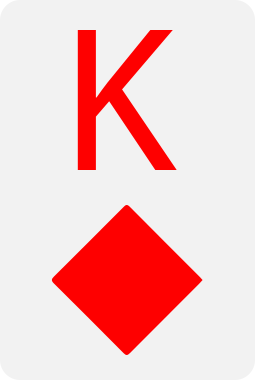
King-Queen Suited sits at an interesting crossroads in hand rankings. It is not quite a premium hand in the way that AKs or the top pocket pairs are, but it is a long way from being merely a speculative hand. KQs is a strong, playable hand with genuine multi-way equity, real straight and flush potential, and the ability to make top pair with a strong kicker on a wide variety of boards.
What makes it distinctive – and what the numbers on this page illustrate well – is that KQs achieves its edge through drawing potential more than raw card strength. It is a hand that benefits enormously from being played well, and that punishes passive or mechanical play more than most.
What These Odds Show for KQs
The headline draw odds look familiar at first glance: 52.39% high card on the flop, dropping to 17.58% by the river, with one pair the most common outcome at 40.41% on the flop and 42.46% by the river. Two pair arrives in 22.02% of all runouts, and the flush completes in 6.48% of hands – figures broadly in line with other suited broadway combinations.
But two numbers stand out and define this hand’s character more than anything else.
The first is the straight draw rate. KQs makes a straight in 4.70% of all runouts by the river. This reflects the geometric advantage of the King-Queen combination: it can form straights in both directions and sits at the heart of the most common broadway straight combinations. A-K-Q-J-T, K-Q-J-T-9, and Q-J-T-9-8 all involve at least one of KQs’s hole cards, and several involve both. That 4.70% figure is noticeably higher than AKs at 3.09% and AQs at 3.44%, because the Queen can sit in the middle of straight combinations in a way the Ace never can.
The second standout figure is the overcard rate: just 22.55% on the flop, rising to 35.30% by the river. The only overcard to KQs is an Ace – and these numbers are identical to those seen on the KK page. That is a meaningful advantage compared to hands like JJ at 56.96% or even QQ at 41.43%. With KQs, only the Ace presents an overcard threat, and that single-rank exposure gives the hand a much cleaner postflop experience than its position in the rankings might suggest.
The straight flush rate also climbs to 0.10% by the river – modest in absolute terms, but double the figure seen for AQs, again reflecting KQ’s centrality within straight-making combinations.
Hand Strength Summary
- Hand type: Strong suited broadway hand
- Relative strength: Top 10–12 starting hands
- Dominates: KJ, QJ, KT, QT, and most weaker King-x and Queen-x combinations
- Main vulnerabilities: All pocket pairs preflop; Ace-x hands when an Ace falls; dominated kicker situations with AK or AQ
KQs is a hand that plays with the texture of the board more than most. On the right flop, it is an extremely powerful holding. On the wrong one, careful navigation is required.
How King-Queen Suited Wins
KQs reaches the best hand through a wider variety of routes than almost any non-premium hand:
- Makes top pair with a strong kicker on King-high or Queen-high boards
- Completes straights at the highest rate of any hand covered on this site so far (4.70% by river)
- Hits the nut flush or near-nut flush in the suited suit
- Applies pressure through semi-bluffing when multiple draws are live simultaneously
- Dominates weaker King-x and Queen-x hands that connect with the same boards
The combination of a straight draw and a flush draw on the same hand – which happens with meaningful frequency given the connected ranks and suited nature – produces some of the most powerful semi-bluffing situations in poker. When KQs flops both a flush draw and an open-ended straight draw simultaneously, it has upwards of 15 outs to the best hand, making it mathematically correct to put chips in aggressively even as a drawing hand.
Main Weaknesses
KQs faces a broader set of preflop vulnerabilities than the hands above it in the rankings:
- Behind every pocket pair before the flop, including small pairs
- Dominated by AK when a King falls (top pair, dominated kicker)
- Dominated by AQ when a Queen falls (same problem from the Queen side)
- An Ace on the board is always a potential danger, regardless of which card connects
- Misses the flop entirely in 52.39% of cases
The dominated kicker problem is the most significant recurring issue. KQs connecting with a King-high board looks strong, but AK has the same top pair with a better kicker. Similarly, Queen-high boards invite action from AQ. Reading opponent ranges carefully on these textures is essential for avoiding costly over-commitments.
Best and Worst Flop Textures
Strong flops
- King-high or Queen-high boards with no Ace – top pair with a strong kicker and clean postflop play
- Two cards of your suit – nut or near-nut flush draw, often combined with overcard equity
- J♠-T or T-9 boards – open-ended straight draw with two overcards, a genuinely powerful semi-bluffing position
- Boards pairing a low card – opponent ranges are less likely to have connected, and overcards retain significant value
Dangerous flops
- Ace-high boards – the single overcard threat materialises, and both AK and AQ now dominate any pair made with KQs
- King-high or Queen-high boards when facing early-position aggression – opponent’s range may include AK or AQ
- Coordinated boards in a different suit where opponents may have stronger flush draws
The J-T flop in particular is one of the more exciting textures for KQs – an open-ended straight draw to the nuts with two overcards is a hand that can be played very aggressively.
How It Plays by Position
- Early position: A raise is reasonable in most game types, though some tighter strategies treat KQs as a middle-position open rather than UTG. The hand is strong enough but benefits substantially from position postflop.
- Middle position: Standard raise. A good candidate for isolation against loose openers.
- Late position: Excellent. In position, KQs can exploit its drawing equity, apply fold pressure with semi-bluffs, and pot-control cleanly when draws miss.
- Blinds: Playable, but the dominated kicker issue on Ace-high and even King/Queen-high boards is harder to navigate out of position. Lean towards calling rather than 3-betting unless the situation is favourable.
Position amplifies KQs’s strengths considerably. Out of position, many of the hand’s best features – semi-bluffing, pot control, reading board texture – become harder to execute cleanly.
The Straight Draw Advantage
The 4.70% straight rate by the river is not just a number – it reflects a structural feature of KQs that shapes how the hand should be played on many board textures. Any flop containing a Jack and a Ten, a Jack and a Nine, or a Ten and a Nine gives KQs an open-ended or double-gutshot straight draw alongside its high-card equity. These boards, which might seem threatening to a one-pair hand, are actually ideal for KQs precisely because drawing equity transforms a potentially marginal holding into a powerful semi-bluff.
This is a meaningful strategic difference from hands like AKs or AQs, where straight draws are less frequent and often less clean. With KQs, connected boards that look dangerous for top-pair hands can actually be where the hand performs best.
Common Mistakes with King-Queen Suited
- Over-committing on King-high or Queen-high boards without considering whether AK or AQ dominates the kicker
- Failing to recognise and press the advantage of combined straight and flush draw flops
- Under-using the hand’s semi-bluffing potential on connected boards by playing passively
- 3-betting out of position against tight ranges that are heavily weighted towards hands that dominate KQs
- Treating KQs like a premium pair and expecting to win at showdown without improvement on many boards
Comparison to Similar Hands
- Stronger than: KJs, QJs, KQo, and most non-premium holdings
- Behind: All pocket pairs, AKs, AKo, AQs
- Has one of the highest straight rate of any hand, giving it a meaningful drawing edge over AKs and AQs in connected-board scenarios
Examples:
- Against JJ: KQs is an underdog preflop at roughly 43%, but with two overcards and drawing potential
- Against AQs: KQs is dominated when a Queen falls, but has reasonable overall equity – approximately 37% preflop
- Against KJs: KQs dominates – the superior Queen kicker is a significant advantage
How King-Queen Suited Performs in Multiway Pots
KQs performs well in multiway pots relative to its position in the rankings, primarily because its drawing equity scales with pot size. A completed straight or flush wins a larger pot when multiple players are involved, and the hand’s 4.70% straight rate and 6.48% flush rate both represent clean, often nut-level hands that can stack opponents. The 22.55% overcard flop rate also means that a majority of multiway flops do not introduce a card that obviously threatens KQs from above, which is a notable advantage over lower-ranked hands.
The risk in multiway pots, as always, is the dominated kicker problem – more players means a higher chance that someone holds AK or AQ and shares the top card on a high board. Playing draws aggressively and top pair cautiously in multiway situations is the right general approach.
FAQ: King-Queen Suited
Is KQs a premium hand?
It is a strong hand, consistently ranked in the top 10–12 starting hands in Texas Hold’em, but it does not quite carry the same preflop power as the top five or six. It plays more like a high-equity drawing hand than a made-hand favourite.
Should you 3-bet KQs?
Frequently, yes – particularly in position against late-position openers with wide ranges. The hand has enough equity and semi-bluffing potential to warrant 3-betting in many spots. Against early-position tight ranges where AK and AQ are heavily represented, calling and playing postflop can be preferable.
How do you play KQs on an Ace-high flop?
Check-fold or check-call with equity, depending on the draw. Unless there is a flush draw or straight draw to continue with, an Ace-high flop is typically a give-up spot for KQs against continued aggression.
What makes KQs better than KQo?
The suited nature adds approximately 3–4% equity in most match-ups, raises the flush rate to 6.48% by the river, and – crucially – makes certain semi-bluffing lines significantly more powerful by combining flush and straight equity simultaneously.
Related Hands