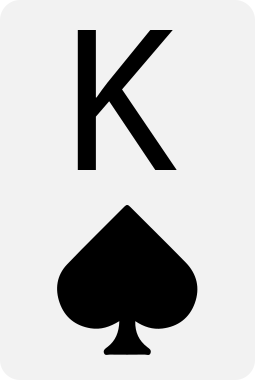
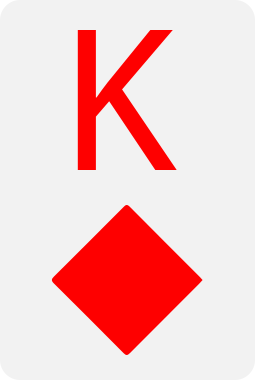
King-Jack Offsuit is a hand that sits in a well-defined and frequently misunderstood position in the broadway hierarchy. It is strong enough to be a clear favourite over most of the hands it will encounter at a loose table, yet vulnerable enough to the specific hands that dominate it — AK, AQ, AJ, KQ, and premium pairs — that it requires careful position and range-reading to play profitably in raised pots. It is one rank below KQo in the King-x offsuit family, and that single step down from Queen to Jack carries more strategic weight than the raw rank difference might suggest.
Before the flop, KJo is a comfortable open from late position and a reasonable open from middle position at most tables. Its challenges emerge in the same situations that challenge all dominated broadway hands — when facing aggression from tight ranges where the hands that have the kicker covered or share a card with a better kicker are disproportionately represented.
What These Odds Show for KJo
The high card flop rate of 53.22% is consistent with KQo and the broader unpaired broadway hand family. The pair rate of 40.41% is identical across all unpaired hands. These baseline figures are shared across the offsuit broadway family and require no individual comment — the story of KJo is told by the figures that diverge from those baselines.
The straight odds of 0.65% on the flop, 2.35% by the turn, and 5.38% by the river are the first number that defines KJo’s character distinctly. The 5.38% river figure places KJo among the strongest straight-drawing hands in this series — ahead of KQo (5.01%), AJo (4.05%), AQo (3.68%), and every suited Ace-x hand covered. It trails only the connected mid-range hands like J9s (6.97%), T9s (8.57%), and Q9s (5.36%), and is competitive with Q9s despite KJo being offsuit and holding a higher top card.
The structural reason is the Jack’s central position in the broadway corridor combined with the King’s reach to the top of the straight. KJo can make the nut straight (A-K-Q-J-T) when a Queen, Ten, and Ace complete the board, and it can make King-Queen-Jack-Ten-Nine when a Queen, Ten, and Nine appear. The Jack also connects downward — Q-J-T-9-8 is a straight that involves the Jack directly without the King — giving KJo access to a wider range of straight-completing boards than KQo achieves. The King anchors the top of the nut straight while the Jack connects through the middle of the broadway zone, and the combination of both directions from two different cards is what produces the 5.38% figure.
The overcard table is the same as KQo: 22.55% on the flop, 29.14% by the turn, and 35.30% by the river. This is expected and for the same reason — the King is the highest card in both hands, and only the four Aces in the deck constitute overcards to the King. The overcard exposure is identical to every King-high hand covered in this series, and it is one of the genuine structural advantages of holding a King. Whatever else is true about KJo, any card below an Ace leaves the King uncontested at the top of the board.
The flush rate of 1.96% by the river confirms the offsuit nature of the hand. Like KQo and AJo, KJo gives up the flush draw that suited versions of these hands carry, and that absence is felt most acutely on boards where missing the pair and having no draw leaves the hand with no path to equity.
Two pair rises from 4.04% on the flop to 22.53% by the river, consistent with KQo and AQo. The full house, four of a kind, and straight flush figures are all marginal and consistent across the broadway offsuit family.
The Kicker Hierarchy: KJo's Central Challenge
KJo sits fourth in the King-x offsuit kicker hierarchy, behind KQo, and is dominated by AK and AQ from the Ace-x family. This positioning creates a specific and important vulnerability: KJo shares a card with multiple common holdings in ways that consistently put it on the wrong side of the kicker battle.
When an opponent holds KQ, both players pair a King equally, but the Queen kicker beats the Jack. When an opponent holds AJ, both players pair a Jack equally, but the Ace kicker beats the King. When an opponent holds AK, the King connects but the Ace kicker is decisive. When an opponent holds KQ specifically — one of the most natural raising hands at any table — KJo is dominated through the Queen kicker on King-high boards and dominated through the King on Queen-high boards where AJ is also lurking.
This dual-domination risk — sharing a card with multiple hands and losing the kicker battle in both directions — is the defining strategic challenge of KJo and the primary reason it requires more positional and range-reading discipline than KQo. With KQo, the Queen kicker is only threatened by AQ. With KJo, the Jack kicker is threatened by KQ on King-high boards, and the King kicker is threatened by AJ on Jack-high boards. The number of dominating hands is larger, and they come from two different directions.
Hand Strength Summary
- Hand type: Offsuit broadway, mid King-x
- Relative strength: Top 10–12% of all starting hands
- Dominates: KT, K9 and below, JT, J9 and weaker Jack-x hands, QT and weaker Queen-x hands
- Dominated by: AK (shares King, weaker kicker), AQ (shares neither card but both are common), AJ (shares Jack, weaker kicker), KQ (shares King, weaker kicker), AA, KK, QQ, JJ
KJo is a hand with genuine strength against wide ranges but significant dual-domination vulnerability against the specific hands that populate tight raising ranges. The skill in playing it profitably is recognising which of those two environments you are in.
How KJo Wins
KJo has several clear routes to winning:
- Flopping top pair with the King on boards where opponents have not connected or hold weaker King-x hands
- Flopping top pair with the Jack on boards where opponents holding King-x hands have missed and Jack-high is the top of the board
- Making the nut straight or near-nut straight — the 5.38% river rate is a genuine and valuable equity source
- Making two pair with both the King and Jack on boards containing both ranks
- Forcing folds preflop against wide ranges through aggression
- Out-kicking dominated hands at showdown — KT, K9, JT, J9 all lose kicker battles to KJo
The straight draw is KJo’s most important secondary asset. On a board of Q-T-x, KJo has an open-ended straight draw to both the nut straight (needing Ace) and the second-nut straight (needing Nine). On a board of A-Q-T, KJo has already made the nut straight. These are not obscure scenarios — broadway boards appear regularly, and KJo is positioned to benefit from them more than most hands at its strength level.
Main Weaknesses
KJo’s weaknesses are structural and persistent:
- Dominated by AK through the King, AJ through the Jack, and KQ through both — three common types of domination from three different hands
- No flush draw equity — without the suited bonus, post-flop options are limited to pairs and straights
- On King-high boards, KQ has the kicker covered; on Jack-high boards, AJ has the kicker covered — two different board types create two different kicker problems
- In 3-bet pots, the frequency of dominating hands in the 3-betting range is highest — KQ, AK, and AJ all appear with greater frequency in 3-bet ranges than in opening ranges
- The 53.22% high card flop rate creates frequent difficult decisions without a made hand or clear draw
The dual-domination characteristic is the most important weakness to internalise. KQo only faces kicker domination from AQ on Queen-high boards. KJo faces kicker domination from KQ on King-high boards and from AJ on Jack-high boards. This doubles the number of board textures where continued aggression with top pair risks being behind.
Best and Worst Flop Textures
Strong flops
- King-high dry boards where opponents are unlikely to hold KQ — top pair Jack kicker with minimal kicker danger in the specific spot
- Jack-high boards where King-Jack is clearly top two pair or top pair with overcard — strong made hand with good kicker relative to the board
- Q-T-x boards — open-ended straight draw to both the nut and near-nut straight, the most valuable draw scenario for KJo
- A-Q-T boards — nut straight already made; one of the strongest possible flop outcomes for KJo
- Low boards well below both hole cards — both cards are well above the texture and opponents connecting weakly
Dangerous flops
- King-high boards in 3-bet pots — KQ features heavily in 3-betting ranges and has the Jack kicker covered
- Jack-high boards against aggressive opponents — AJ is a natural 3-betting hand that shares the Jack with a better kicker
- Ace-high boards — the King is no longer the top card, and opponents with Ace-x hands are connecting strongly
- Boards with heavy coordination in any suit — without a flush draw, KJo cannot participate in draw equity and must rely entirely on pair and straight potential
How It Plays by Position
- Early position: A marginal open; be prepared to fold to 3-bets from tight ranges where AK, AQ, AJ, and KQ are all disproportionately represented — those four hands all dominate KJo in different ways
- Middle position: A standard open at most tables; the 3-bet decision depends heavily on the specific opponent and their tendencies
- Late position (CO/BTN): Where KJo is most comfortable — wide opens, post-flop decisions made in position, and the straight draw equity realised at the right price
- Blinds: A reasonable defend against late position steals given the board coverage; in 3-bet pots out of position the dual-domination risk is most acute and caution across multiple streets is warranted
Position amplifies KJo’s straight draw value and reduces the cost of its kicker weaknesses. Acting last means you can fold cleanly when the board texture signals danger, and extract value when the straight draw completes or top pair holds cleanly.
Common Mistakes with King-Jack Offsuit
- Calling 3-bets out of position too liberally — KJo is dominated by a significant portion of 3-betting ranges from two different directions, and navigating multiple streets without position compounds the problem
- Continuing aggressively on King-high boards in 3-bet pots without recognising the KQ kicker risk
- Continuing aggressively on Jack-high boards without recognising the AJ kicker risk
- Not recognising when the open-ended straight draw is live — Q-T-x boards give KJo up to eight outs to a very strong straight, and that draw warrants continued investment
- Treating KJo identically to KQo — the Queen-to-Jack step down creates a meaningfully different kicker vulnerability profile, and the hands require different levels of aggression in 3-bet pots
Comparison to Similar Hands
- Stronger than: KTo, K9o and all weaker King-x offsuit hands; JTo, J9o and weaker Jack-x hands
- Slightly weaker than: KQo — the Queen is a stronger kicker with simpler domination exposure (only AQ threatens the kicker on Queen-high boards versus AJ and KQ both threatening KJo)
- Comparable to: ATo in relative hand strength, though the specific domination scenarios differ; both sit in the fourth tier of their respective Ace-x and King-x families
Examples:
- Against KQo: KJo is dominated — sharing the King means the Queen kicker wins decisively on King-high boards; this is the most important matchup to avoid in large pots
- Against AJo: KJo is dominated through the Jack — both pair a Jack equally but the Ace kicker wins; a less obvious but equally costly domination scenario
- Against QTo: KJo is a clear favourite — the King dominates the Queen and the Jack dominates the Ten, giving KJo a strong kicker advantage on most board textures
- Against JJ: KJo is a modest underdog preflop — pocket Jacks is ahead, but the King gives KJo a meaningful overcard out, and the hand is close to a coin flip with straight draw outs adding further equity
How KJo Performs in Multiway Pots
KJo in multiway pots faces the compounding version of its dual-domination problem:
- More opponents means a higher collective probability that someone holds KQ (dominating on King-high boards), AJ (dominating on Jack-high boards), or AK (dominating across most board textures)
- Top pair Jack kicker is particularly weak in multiway pots — more players means more chances someone has either a better King or a better Jack
- The straight draw implied odds improve multiway — a completed broadway straight in a multiway pot yields a larger pot, and KJo’s 5.38% river straight rate translates to better returns with more opponents contributing
- Flush draw equity is absent — unlike suited versions of these hands, KJo cannot benefit from draw equity on flush-textured boards
The strategic approach multiway mirrors KQo: use preflop raises to thin the field when out of position, welcome callers when in position on non-Ace boards where straight draw and top pair equity can be maximised, and be willing to fold top pair on boards where domination is likely regardless of the number of opponents.
FAQ: King-Jack Offsuit
How does KJo compare to KQo?
The gap is wider than one rank suggests. KQo faces kicker domination primarily from AQ on Queen-high boards. KJo faces kicker domination from KQ on King-high boards and from AJ on Jack-high boards — two different threat types from two different board textures. KQo also has a slightly lower straight rate (5.01% versus 5.38%), which is the one area where KJo has a measurable advantage. Overall KQo is the clearer hand to play because its kicker vulnerability comes from one direction; KJo’s dual-domination characteristic requires more nuanced board-reading.
Is KJo worth playing from early position?
Marginally, in some formats. The dual-domination risk is most acutely felt from early position, where tight 3-betting ranges are weighted toward AK, AQ, AJ, and KQ — all of which dominate KJo in some way. Against those ranges, KJo is frequently on the wrong side of the kicker battle. From late position, where opening ranges are wide and 3-betting ranges are less polarised toward dominating hands, KJo plays much more comfortably.
Why does KJo have a higher straight rate than KQo?
Because the Jack sits closer to the middle of the broadway corridor than the Queen and connects into straight combinations that the Queen cannot reach. Specifically, KJo can make Q-J-T-9-8 — a straight where the Jack is a direct participant but the Queen is not involved — adding a combination that KQo lacks. The King contributes to the nut straight in both hands, but the Jack’s additional downward connectivity gives KJo a slightly wider range of straight-completing boards. The 5.38% versus 5.01% difference is modest but real.
Should you 3-bet KJo?
Rarely. As a 3-bet value hand it is frequently dominated by 3-betting ranges. As a 3-bet bluff it lacks the specific equity properties — nut flush draw, wheel draw — that make hands like A5s ideal for that role. In position against very wide late-position openers, an occasional 3-bet is defensible, but KJo is better treated as an open-raise or call hand rather than a 3-bet hand in most situations.
Related Hands