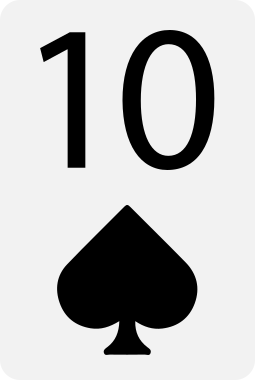
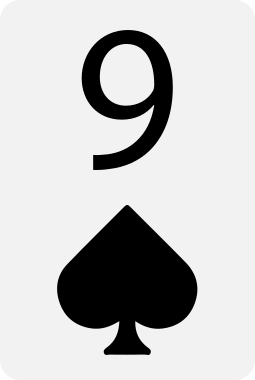
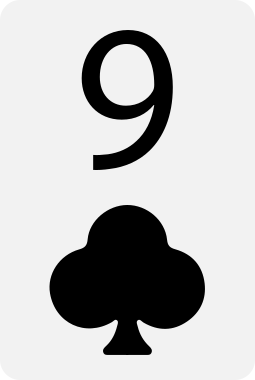
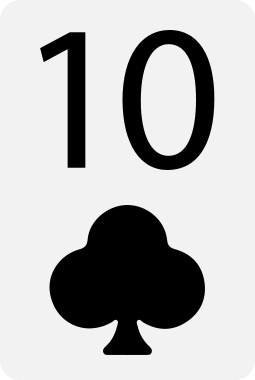
Ten-Nine Suited is one of the most beloved speculative hands in Texas Hold’em, and the draw odds table explains exactly why. It is not a hand built on raw high-card strength – it will rarely dominate at showdown through rank alone – but it is a hand with an exceptional number of ways to make strong, disguised holdings that opponents struggle to put you on. Flush draws, straight draws, two pair, and occasional monster combinations all flow naturally from T9s, and the numbers bear that out clearly.
Before the flop, T9s is a hand you play for its post-flop potential rather than its preflop equity. It is not a 3-bet hand in most situations, and it does not expect to be ahead of most opening ranges. What it does have is a unique combination of straight and flush draw equity that gives it more post-flop playability than almost any hand outside the premium tier.
What These Odds Show for T9s
The high card flop rate of 51.75% is the lowest of any non-pair hand in this series so far, and it reflects the sheer number of ways T9s can connect with a board. Connected cards in the middle of the deck touch more board textures than gapped or high-card hands, and the suited nature adds a further layer of connectivity. You still miss the majority of flops, but the gap between T9s and hands like AQo (53.55%) or K9s (52.71%) is meaningful – it compounds over thousands of hands.
The straight odds are the standout numbers on this page. At 1.29% on the flop, 4.20% by the turn, and 8.57% by the river, T9s has by far the highest straight probability of any hand covered in this series. For context, KQo – the best straight-drawing offsuit hand previously discussed – reaches 5.01% by the river. T9s exceeds that by more than three percentage points. The reason is the central position of Ten and Nine in the deck: they sit surrounded by connecting cards on both sides. A Ten connects upward through Jack, Queen, King, and Ace, and downward through Eight, Seven, and Six. A Nine connects upward through Ten, Jack, Queen, and King, and downward through Eight, Seven, Six, and Five. The number of board combinations that give T9s a straight draw – open-ended, gutshot, or completed – is larger than for any broadway or high-card hand.
The flush odds of 0.82% on the flop, 2.86% by the turn, and 6.38% by the river are slightly lower than A9s (6.57%) and K9s (6.52%), reflecting the lower rank of the flush that T9s produces. A Ten-high flush is the fourth-highest possible flush, behind Ace, King, and Queen-high. It is still a strong hand in most situations, but it carries more risk of being beaten by a higher flush than the suited Ace or King combinations.
The straight flush odds deserve particular attention: 0.02% on the flop, 0.08% by the turn, and 0.20% by the river. These are the highest straight flush odds of any hand covered in this series, and the reason is the same as for straights – T9s sits in the middle of the deck where both cards contribute to overlapping straight flush combinations. A straight flush with T9s can run from Five-Six-Seven-Eight-Nine through Six-Seven-Eight-Nine-Ten through Seven-Eight-Nine-Ten-Jack, and so on. Multiple combinations exist, and they all flow naturally from the connected suited structure of this hand.
The overcard table tells a different story from the King-high hands. With a Ten as your highest card, 69.47% of flops will contain at least one overcard – a Jack, Queen, King, or Ace. By the river that rises to 86.87%. This is lower than Pocket Eights (86.73% on the flop) but far higher than the King-high hands (22.55%). The Ten simply does not dominate boards the way a King does, and the overcard exposure reflects the 32 cards in the deck that rank above it. This is the structural cost of playing a mid-connected hand – the board will frequently appear threatening – and it is why T9s relies on its drawing equity rather than its pair value to generate profit.
Hand Strength Summary
- Hand type: Suited connector, mid-range
- Relative strength: Top 20–25% of all starting hands
- Dominates: Very few hands outright – T9s is not a dominating hand by nature
- Thrives against: Hands it flips or has equity against – pairs it can draw out on, and boards where its drawing potential creates disguised monsters
- Vulnerable to: Any hand with a Ten or Nine and better kicker, high pairs, Ace-high or King-high flushes in its suit
T9s is fundamentally different in character from every hand covered previously in this series. It is not a hand that expects to win by being ahead – it is a hand that builds equity through draws and makes strong hands that opponents don’t see coming.
How T9s Wins
T9s has more distinct paths to winning than almost any hand at its strength level:
- Completing a straight – at 8.57% by the river, this is the most likely route to a big pot
- Making a flush – 6.38% by the river, producing a Ten-high flush
- Flopping top pair with the Ten on low boards and holding up
- Making two pair with both the Ten and Nine contributing
- Semi-bluffing with a flush draw or open-ended straight draw and winning through fold equity
- Making a full house from a set or two pair runout
- Occasionally making a straight flush – rarer, but more likely with T9s than almost any other hand
The open-ended straight draw is the signature weapon. When T9s flops an open-ended straight draw – for example on a board of J-8-x or 8-7-x – it has eight clean outs to a straight, often with flush draw outs stacked on top. In those spots, T9s can be a favourite or near-favourite even against a made hand.
Main Weaknesses
The weaknesses of T9s are real and must be managed:
- 69.47% overcard rate on the flop – the Ten is frequently not the highest card on the board, limiting pair value
- Top pair with a Nine kicker is a weak made hand against any opponent who holds a Ten with a better kicker
- The Ten-high flush loses to Ace, King, and Queen-high flushes – three possible better holdings in the same suit
- Drawing hands lose equity when draws miss – a hand built on 8.57% straight equity and 6.38% flush equity is frequently a nothing hand at showdown
- In large pots without a draw, T9s has limited showdown value
The most common costly mistake with T9s is continuing in large pots without a meaningful draw. The hand’s equity is concentrated in its drawing potential, and without a draw, one pair of Tens or Nines is a moderate holding at best.
Best and Worst Flop Textures
Strong flops
- J-8-x or 8-7-x – open-ended straight draw, eight outs minimum
- Q-8-x or 7-6-x in your suit – straight draw and flush draw simultaneously, a monster semi-bluffing hand
- Ten-high or Nine-high boards with two cards of your suit – top pair and flush draw
- Boards with J-8, 8-7, Q-J, or 7-6 of your suit – potential straight flush draw, the strongest draw possible
- Low boards where the Ten is an overpair – rare but clean spots
Dangerous flops
- Ace-high or King-high dry boards – you have missed, have no draw, and face overcards to both hole cards
- Boards with a Ten but heavy coordination in a different suit – top pair but no draw and potential flush threats against you
- Paired boards with high cards – your drawing potential is reduced and opponents with pairs are ahead
- Three-flush boards in a different suit – your flush draw is eliminated and pair value is weak
How It Plays by Position
- Early position: Generally a fold; T9s relies on seeing cheap flops and realising draw equity in position – playing it from under the gun exposes you to 3-bets and out-of-position decisions on multi-street draws
- Middle position: A marginal open in some formats, but better used as a call behind an open than as a raise; the hand benefits from a loose, passive table
- Late position (CO/BTN): The natural home of T9s. Raise or call to see flops cheaply, fold when you miss and have no draw, and attack hard when you have an open-ended straight draw or flush draw in position
- Blinds: A strong defend against late position steals – the pot odds and positional discount make T9s an excellent big blind call; in 3-bet pots out of position the hand is harder to play profitably
T9s is more position-dependent than almost any other hand in the standard preflop range. Its equity requires realisation, and realisation requires position.
Common Mistakes with T9s
- Playing it from early position too often, creating out-of-position draw problems across multiple streets
- Continuing on the flop without a draw or made hand – T9s without equity on the flop is a fold, not a call
- Not semi-bluffing aggressively enough with a flopped open-ended straight draw or flush draw – these are strong hands disguised as draws
- Over-valuing the Ten-high flush on boards with heavy action – Ace and King-high flushes are realistic holdings for opponents who also continue on flush board textures
- Chasing draws without correct pot odds – T9s generates its profit when draws are taken at the right price, not at any price
Comparison to Similar Hands
- Stronger than: 98s, 87s in terms of straight potential reach and high-card value; T9o by virtue of flush and straight flush equity
- Slightly weaker than: JTs – one rank higher gives significantly better overcard odds and stronger straight combinations toward the top of the deck
- Most similar to: JTs in character, 98s in position in the range
Examples:
- Against AKo: T9s is approximately a 40% underdog preflop – two overcards dominate, but T9s has significant straight and flush draw outs
- Against JJ: T9s is roughly a 35% underdog – a pair versus a connected hand with draws; T9s can win but is a clear underdog
- Against 98s: T9s is a modest favourite – the Ten provides better board coverage and the straight combinations partially overlap but Ten-high is superior
- Against KQo: T9s is close to a coin flip – high cards versus connected suited hand, with T9s drawing roughly even in many runouts
How T9s Performs in Multiway Pots
T9s is one of the hands that genuinely improves in multiway pots, and the draw odds table explains why:
- Straight and flush draw implied odds increase with more players – an 8.57% river straight and 6.38% flush build larger pots when multiple opponents call
- Disguised hands become more valuable – opponents in multiway pots are less likely to put you on a specific straight or flush combination
- Semi-bluffing becomes less effective as a pure bluff, but the underlying equity of the draw remains intact regardless of fold equity
- The 69.47% overcard rate is less damaging in multiway pots when you have a draw – your hand is not defined by its pair value, so overcards matter less
The caveat is pot control. In multiway pots, calling multiple streets without a draw or completed hand drains equity quickly. T9s in multiway situations plays best as a draw-or-fold hand: continue with full draws, fold without them, and never try to win a multiway pot with one pair of Tens or Nines on an overcard board.
FAQ: Ten-Nine Suited
Why is T9s considered such a strong speculative hand?
Because it combines the two most valuable draw types – straight and flush – at the highest rates available to any non-premium hand. The 8.57% river straight rate and 6.38% flush rate mean that by the river, roughly one in six runouts produces a strong made hand from a draw. Combined with the disguised nature of those hands, the implied odds are excellent.
Should you ever 3-bet T9s?
Occasionally, as a light 3-bet in position against wide late-position openers. It has enough equity to be a profitable semi-bluff 3-bet and benefits from playing in position with initiative. It is not a standard 3-bet hand, but it is a reasonable choice in the right spots.
How does T9s compare to JTs?
JTs is stronger in almost every measurable way – better overcard odds, stronger straight combinations toward the top of the deck, and higher flush rank. However, T9s is not far behind and plays similarly in most situations. The rank gap matters most in spots where top pair value is relevant, which is relatively rare for either hand.
What makes the straight flush odds for T9s so much higher than other hands?
The central position of Ten and Nine in the deck creates more overlapping straight flush combinations than any other hand. T9s can make straight flushes from the Five-high end all the way to the King-high end depending on which cards land, and multiple combinations run through both the Ten and the Nine simultaneously. This variety is simply not available to high-card or gapped hands.
Related Hands