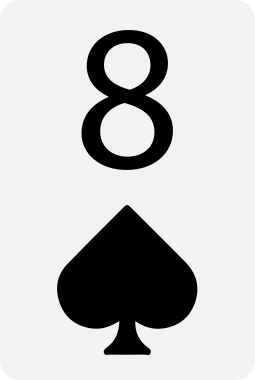
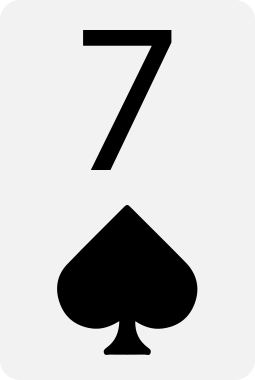
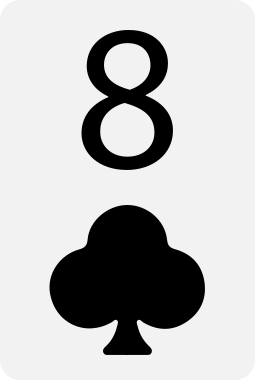
Eight-Seven Suited is a premium suited connector – a hand that sits just one step below 98s on the connector ladder but shares virtually the same drawing profile. It combines strong straight potential, reliable flush equity, and genuine straight flush capability into a hand that is deceptively powerful in the right conditions. Players who understand suited connectors well consistently include 87s in their opening ranges, and for good reason.
Before the flop, 87s has no pretensions of winning through raw card strength. It is a drawing hand through and through, and its entire value is post-flop and position-dependent. Played correctly it is a profitable and enjoyable hand to navigate; played incorrectly it becomes an expensive lesson in chasing equity without realising it.
What These Odds Show for 87s
The straight equity of 8.53% by the river is the headline number – identical to 98s and among the highest straight probabilities of any starting hand in the game. On the flop, 1.29% of runouts already complete a straight, rising to 4.20% by the turn. Like 98s, the eight and seven form a two-way connector that can build straights in both directions – boards containing nines, tens and jacks on the high side, or fours, fives and sixes on the low side, all present clean straight-making opportunities. That range of connectivity is the defining strength of true suited connectors and 87s possesses it fully.
The flush equity of 6.38% by the river is consistent with other suited hands and provides a reliable secondary drawing path. The straight flush probability of 0.20% by the river mirrors 98s exactly – reflecting the same two-way connectivity that creates overlapping straight and flush draws on the right boards. When a straight flush does materialise, it is almost always the product of a combination draw that opponents had no realistic chance of reading.
The high card miss rate of 51.75% on the flop and 15.94% by the river slightly edges out higher-gap hands, confirming that true connectors connect with more board textures than one-gap or two-gap alternatives. The overcard table, however, tells the hand’s most significant limitation clearly – there is an 86.73% chance of an overcard on the flop, rising to 96.90% by the river. With nines through aces all outranking the eight, top pair is almost never a hand to build a pot around. 87s must be played as a drawing hand on the vast majority of board textures.
Hand Strength Summary
- Hand type: Suited connector, premium speculative hand
- Relative strength: Upper-middle tier among speculative hands
- Dominates: Weaker draws and low unpaired hands on connected boards
- Main vulnerability: Severe overcard exposure, non-nut flush, top pair almost never safe in contested pots
87s wins through drawing and board interaction, not through card strength. It is a hand that needs to connect meaningfully to be dangerous.
How Eight-Seven Suited Wins
- Completing a straight on connected boards – with 8.53% river equity and wide board coverage in both directions, this is the primary high-value outcome
- Making a flush and winning at showdown – an eight-high flush is not the nut flush but is a strong made hand in most scenarios
- Flopping combination draws – open-ended straight draw plus flush draw simultaneously – and semi-bluffing aggressively with enormous equity against a single opponent
- Building two pair or trips by the river (21.77% and 4.26% respectively) on boards where both hole cards connect
- Occasionally making a straight flush (0.20% by the river) – one of poker’s most profitable hands due to the near impossibility of opponents reading its strength
The combination draw is where 87s is at its most dangerous. A flop of 6♠ 9♠ 2♦ with 8♠ 7♠ in hand produces both an open-ended straight draw and a flush draw simultaneously – a position of enormous equity that justifies aggressive semi-bluffing and can make an opponent with top pair a significant underdog.
Main Weaknesses
- Overcard exposure reaches 96.90% by the river – among the most severe of any playable hand, and a clear signal that top pair should almost never be the basis for continued investment
- Neither the eight nor the seven is a strong made-hand card – pairing either produces holdings that are extremely difficult to continue with under any meaningful pressure
- Non-nut flush potential introduces reverse implied odds on flush-completing boards – an eight-high flush loses to any higher flush
- Draws miss the majority of the time despite the strong equity figures, requiring consistent discipline to fold when the board does not deliver
The overcard problem is even more pronounced than for 98s (93.27% by the river) or T8s (86.87%). 87s sits lower on the rank ladder and faces a wider range of overcards as a result. This makes it one of the most position-sensitive hands in the game – out of position, its drawing equity is extremely difficult to realise without being exploited.
Best and Worst Flop Textures
Strong flops
- Connected middle boards giving open-ended straight draws in either direction (e.g. 9♥ 6♦ 2♣, T♠ 6♦ 3♥, 6♠ 5♦ 2♣)
- Suited flops in the matching suit with straight draw potential (combination draw – maximum equity)
- Low boards where 87s has top pair or an overpair to the board alongside draw equity
Dangerous flops
- High dry boards (A♠ K♦ Q♣, K♥ J♦ T♣) where 87s has no pair, no realistic draw, and no semi-bluffing equity worth pursuing
- Flush-completing boards where a higher flush is plausible given the field
- Paired high boards where straight draw outs are partially neutralised and made-hand potential is minimal
How It Plays by Position
- Early position: A fold in full-ring games – the combination of severe overcard exposure, non-nut drawing equity, and vulnerability to 3-bets makes it impossible to navigate profitably without position
- Middle position: Borderline in full-ring; increasingly viable in six-max formats where ranges widen and implied odds are more accessible
- Late position (button/cutoff): The natural home for 87s – cheap flops, maximum control over drawing decisions, and the ability to take free cards or fold cleanly when the board does not cooperate
- Blinds: A reasonable defend from the big blind when pot odds are favourable; the hand’s board coverage and drawing equity justify calling in many spots, though the out-of-position constraint limits how efficiently those draws can be realised
87s is among the most position-sensitive hands in the game. The gap between playing it on the button and playing it from early position is as wide as for any hand in the suited connector family.
Common Mistakes with Eight-Seven Suited
- Continuing with top pair of eights or sevens in the face of any meaningful opposition – the 96.90% river overcard exposure makes this almost always a losing play
- Calling raises and 3-bets without the implied odds or position to justify the speculative investment
- Over-bluffing missed draws in spots where opponents are calling stations or the board has not changed character meaningfully
- Underestimating reverse implied odds on flush-completing boards – an eight-high flush can be a very expensive second-best hand in deep-stacked play
The defining error is treating 87s as a made-hand. It is not. On the overwhelming majority of board textures it is a drawing hand, and approaching it with any other mindset leads to unnecessary losses on streets where it has no realistic chance of being best.
Comparison to Similar Hands
- Stronger than: 86s, 76s (one-gap hands with reduced straight combinations), 87o (loses flush and straight flush equity entirely)
- Comparable to: 98s (nearly identical drawing profile – 98s has marginally stronger high cards and slightly better overcard odds at 93.27% versus 96.90% for 87s), T8s (similar connector structure, slightly different straight combinations and higher card)
- Weaker than: JTs, T9s, 98s (higher cards offer better straight combinations and more top-pair value on a wider range of board textures)
The natural comparison is 98s. The two hands share identical straight and straight flush equity figures, identical flush equity, and the same fundamental approach. The practical difference is that 98s connects with slightly higher boards – making top pair marginally more useful and reducing overcard exposure by a meaningful amount. Both hands demand the same discipline post-flop, but 87s requires it even more strictly.
How Eight-Seven Suited Performs in Multiway Pots
87s has a nuanced multiway dynamic that mirrors 98s closely:
- Completed straights and flushes win considerably larger pots in multiway scenarios – the implied odds when draws complete are at their highest with more players involved
- Combination draws retain strong equity even against multiple opponents – 15 outs with both a flush draw and open-ended straight draw is competitive against several players simultaneously
- Non-nut flushes carry meaningful reverse implied odds risk in multiway pots – more players means a higher probability that someone holds a higher flush
- Top pair is completely unplayable in multiway pots given the 96.90% river overcard exposure – this is not a grey area
In multiway pots, 87s should be played exclusively as a drawing hand. The implied odds when draws complete are the best argument for seeing cheap flops with multiple opponents, but any continuation without strong draw equity should be treated with extreme caution.
FAQ: Eight-Seven Suited
Is Eight-Seven Suited a strong hand?
It is one of the stronger speculative hands in Texas Hold’em. Its straight equity of 8.53% by the river matches 98s – one of the most connected suited hands available – and its combination draw potential makes it a powerful semi-bluffing tool in position.
How does 87s compare to 98s?
The two hands share virtually identical drawing profiles. 98s has slightly stronger high cards, which reduces overcard exposure marginally (93.27% versus 96.90% by the river) and gives its top-pair holdings slightly more value. In practice both hands are played the same way, with 87s requiring slightly stricter discipline about folding unimproved holdings.
How often does 87s make a straight flush?
By the river, 87s makes a straight flush 0.20% of the time – identical to 98s, reflecting the same two-way connectivity that creates overlapping draw opportunities on middle-board textures.
Should you open 87s from early position?
In most full-ring games, no. The hand is too reliant on position to realise its drawing equity efficiently, and it is vulnerable to 3-bets from a wide range of stronger hands. In six-max formats the calculation changes somewhat, but even there early position is a marginal spot at best.
Related Hands