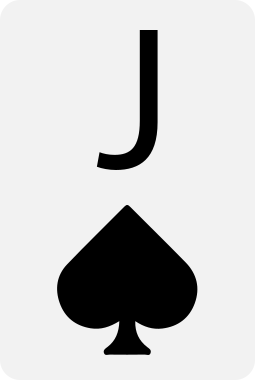
Jack-Ten Suited has a reputation as the best suited connector in Texas Hold’em, and the numbers on this page explain exactly why that reputation is deserved. It is not a premium hand in the traditional sense – it lacks the raw card rank to dominate preflop ranges and its made-hand value is consistently threatened by overcards. But in terms of pure drawing equity, flexible straight-making potential, and the power of simultaneous draw combinations, JTs sits at a genuinely unique point in the hand rankings.
The draw odds table for JTs breaks records across multiple categories. Understanding what those numbers mean in practice is the key to unlocking what makes this hand special.
What These Odds Show for JTs
Several figures on this page are the highest of any hand covered on this site, and they deserve to be taken one at a time.
The straight rate of 8.62% by the river is the headline. It surpasses QTs at 7.01% and every other hand in the series by a meaningful margin. To see the full progression in context:
- AKs: 3.09%
- AQs: 3.44%
- AJs: 3.79%
- KQs: 4.70%
- ATs: 4.14%
- KJs: 5.05%
- KTs: 5.40%
- QJs: 6.66%
- QTs: 7.01%
- JTs: 8.62%
The jump from QTs to JTs is the largest single step in this progression – 1.61 percentage points – reflecting the structural fact that Jack-Ten is the most centrally embedded consecutive rank pairing in the entire deck. Both the Jack and the Ten participate in the broadest possible range of straight families. A-K-Q-J-T, K-Q-J-T-9, Q-J-T-9-8, J-T-9-8-7, and T-9-8-7-6 all feature one or both of JTs’s hole cards as active participants. No other two-card combination sits as deeply within overlapping straight combinations while still being ranked high enough to threaten opponents with top pair equity.
Crucially, the flop straight rate of 1.29% is also the highest of any hand covered – nearly double the 0.96% seen for QJs and QTs. This means JTs not only completes more straights overall, it flops complete straights – dry, immediate made hands – more than any other starting hand yet encountered. On a board of Q-9-8, for example, JTs has already made a straight before any further drawing is required.
The straight flush rate of 0.20% is also a new high – more than double the 0.10% seen for KQs and KJs, and meaningfully above QJs and QTs at 0.15%. The straight flush is the rarest made hand in poker and wins the pot at showdown in virtually all circumstances. JTs’s 0.20% rate means it makes this hand once in every 500 runouts – still rare, but more than twice as frequently as most suited broadway hands.
The straight rate at 8.62% now dramatically exceeds the flush rate at 6.38% – a gap of 2.24 percentage points, the widest seen across any hand covered so far. JTs is not just a hand where straights are more likely than flushes; it is the hand where that distinction is most pronounced.
The overcard table completes the picture with a figure worth pausing on: 56.96% on the flop, 67.95% by the turn, and 76.31% by the river. These numbers are identical to the overcard rate for JJ – because both hands share the Jack as the highest card. An Ace, King, or Queen can all arrive as overcards, meaning that on more than half of all flops, and on more than three quarters of all rivers, the board will contain at least one card that outranks JTs’s Jack. This is a significant constraint on the hand’s made-hand value and the primary reason why JTs’s drawing equity – rather than its top-pair potential – is its defining asset.
Hand Strength Summary
- Hand type: Elite suited connector; the benchmark drawing hand in Texas Hold’em
- Relative strength: Top 15–25 starting hands depending on game format; outperforms its nominal ranking in multiway and deep-stacked situations
- Dominates: T9s, 98s, weaker Jack-x and Ten-x combinations
- Main vulnerabilities: All pocket pairs preflop; Ace, King, and Queen overcards (56.96% flop rate); kicker domination on Jack-high and Ten-high boards; non-nut flush
JTs is the gold standard of suited connectors. Its ranking in preflop hand charts does not fully capture what it does postflop in connected-board situations, which is where it operates at a level that few hands of any rank can match.
How Jack-Ten Suited Wins
JTs has more distinct paths to the best hand than almost any non-premium starting hand:
- Makes a straight in 8.62% of all runouts – the highest rate of any hand covered on this site
- Flops a complete straight in 1.29% of cases – again the highest recorded, producing immediate made-hand strength without further improvement required
- Completes a flush in 6.38% of hands – strong, though not the nut flush
- Makes a straight flush in 0.20% of runouts – the highest rate on this site; the rarest and most definitive winning hand in poker
- Combines flush and straight draws simultaneously on a vast range of board textures, producing combined equity that regularly exceeds 50% even against made pairs
- Makes top pair on Jack-high or Ten-high boards against wide ranges
- Dominates weaker suited connectors (T9s, 98s) that share its drawing-dominated game plan but produce it less efficiently
- Forces folds through semi-bluffing aggression across a wider range of boards than any hand previously covered
The simultaneous draw scenario is where JTs is at its most formidable. On a board of Q♠ 9♠ 3♦ with J♠ T♠ in hand, JTs holds both an open-ended straight draw (any King or Eight completes a straight) and a flush draw to a Jack-high flush. The combined equity of these two draws – typically around 54% going to the turn – means JTs is statistically the favourite against a flopped top pair of Queens. The hand that looked like it was up against a strong made hand is actually the mathematical favourite. This situation arises on a wider range of board textures with JTs than with any other starting hand.
Main Weaknesses
JTs’s weaknesses are real and structural, and they all flow from the same source: the Jack is not a high card by absolute standards.
The overcard problem: With three ranks above it (Ace, King, Queen), JTs faces an overcard on the flop in 56.96% of all hands. By the river, that figure reaches 76.31%. Made-hand strength – top pair of Jacks or Tens – is consistently under threat from boards that have passed it by. Unlike premium hands where top pair is often reliable, JTs can only trust its made hands on relatively low boards, which are the minority.
The kicker problem on pairing boards:
- On Jack-high boards: AJ, KJ, and QJ all hold top pair with a better kicker. Only J9, J8, and lower Jack-x hands are below JTs in a kicker confrontation.
- On Ten-high boards: AT, KT, QT, and JT all have kicker issues relative to JTs – but specifically AT and any Ten with an Ace or face card beats JTs’s Jack kicker. QTs beats JTs’s Jack kicker on Ten-high boards too (Queen > Jack).
The non-nut flush: The Jack-high flush is strong but not invincible. Any opponent with an Ace, King, or Queen in JTs’s flush suit holds a higher draw. On monotone boards, this becomes a genuine consideration.
Preflop vulnerability: Behind all pocket pairs. Against AA, JTs is roughly 22% to win. Against JJ – the pocket pair sharing JTs’s highest card – it is approximately 27%.
Best and Worst Flop Textures
Strong flops
- Q-9 or K-9 in the suited suit – open-ended straight draw to a broadway or King-high straight, plus flush draw: peak JTs semi-bluffing equity
- 9-8 in the suited suit – open-ended straight draw through the middle range alongside flush draw
- Q-8, K-8 – gutshot straight draw with flush equity; still significant combined equity
- Any two suited cards in JTs’s suit on a connected board – flush draw plus straight draw active simultaneously
- Jack-high or Ten-high boards with no Ace, King, or Queen against wide ranges – top pair with reasonable, navigable kicker situations
- Low, dry boards with two suited cards – flush draw with two significant overcards, providing both fold equity and draw equity
Dangerous flops
- Ace-high, King-high, or Queen-high boards without a draw – three possible overcards, all common; without a live draw, JTs has little basis for continuation
- Monotone boards in JTs’s suit where an opponent could hold Ace-suited, King-suited, or Queen-suited – the flush becomes a second-best draw
- Jack-high boards against tight ranges where AJ, KJ, and QJ are plausible – three-way kicker domination
- High, coordinated boards where opponents’ ranges connect strongly and JTs has neither a draw nor clean made-hand value
How It Plays by Position
- Early position: JTs can be raised in most game formats, but it is genuinely one of the hands that benefits most from position. Early-position opens with JTs invite 3-bets from ranges that contain many hands which dominate it on the high boards that arrive more than half the time. Many tighter strategies prefer to open JTs from middle position at the earliest.
- Middle position: Standard raise. The drawing equity makes it a comfortable hand to build pots with against wide calling ranges.
- Late position: Where JTs is at its unequivocal best. Fold equity, pot control, multi-street draw extraction, and the ability to read board texture all operate at maximum efficiency in position with the draw-dominant hand.
- Blinds: Playable, particularly as a call against late-position opens. The 56.96% overcard flop rate makes continuation decisions genuinely complex out of position – leaning on draw-based lines rather than made-hand protection is essential.
JTs as the Benchmark Suited Connector
The term “suited connector” covers a wide range of hands, from the powerful down to the speculative. JTs sits at the top of that range for several reasons the numbers make explicit.
First, it produces the highest straight rate (8.62%) and straight flush rate (0.20%) of any hand covered on this site. These are not marginal improvements over the hands just below it – they represent a meaningful step up in drawing power.
Second, the 1.29% flop straight rate means JTs actually completes straights on the flop – not just by the river – more than any other hand covered. A flopped straight is a made hand that requires no further improvement, and flopping it with JTs is more than twice as likely as with QJs or QTs at 0.96%.
Third, the combination of flush draw and straight draw is activated by a wider range of board textures for JTs than for any higher-ranked hand. Any board containing two of the ranks Q, 9, 8, 7, K, A (with appropriate connectivity) gives JTs an open-ended straight draw. Any board with two suited cards in JTs’s suit gives it a flush draw. The intersection of these two conditions – both draws active simultaneously – is the scenario in which JTs performs most spectacularly, and it arises frequently.
What JTs lacks relative to higher-ranked drawing hands is a strong top card. The Jack means that Aces, Kings, and Queens all create overcard pressure, and any opponent who holds one of those cards in combination with a paired board has a made hand that beats JTs’s top pair. This is the trade-off – exceptional drawing power in exchange for limited made-hand authority.
The Straight Flush Rate in Context
The 0.20% straight flush rate for JTs deserves specific attention. Across all hands covered on this site, the straight flush rate progression has been:
- Most Ace-x hands: 0.01–0.06%
- KQs, KJs: 0.10%
- QJs, QTs: 0.15%
- JTs: 0.20%
A straight flush wins the pot at showdown in virtually all situations – the only exception being a higher straight flush, which requires very specific conditions. The 0.20% rate means that in a thousand runouts with JTs, two of them produce a straight flush. That is twice the frequency of most suited broadway hands and approximately three times the frequency of suited Ace-x combinations. Over a significant volume of play, this represents a meaningful source of maximum-value pots that accumulates reliably.
Common Mistakes with Jack-Ten Suited
- Playing the hand too passively on connected boards where combined flush and straight draw equity makes aggressive semi-bluffing the mathematically correct line
- Continuing with top pair alone – particularly Jack-high on boards containing Queen, King, or Ace – when the kicker is dominated and no draw is live
- Treating the flush as secure when an opponent could hold a higher flush draw in the same suit
- Raising from early position too liberally and then facing 3-bets from ranges that contain many overcards, making postflop navigation significantly harder
- Underestimating the value of position with this hand – more than almost any other hand discussed on this site, JTs’s equity is maximised by acting last
Comparison to Similar Hands
- Stronger than: T9s, 98s, QTo, JTo, and most non-premium non-pair hands
- Behind: All pocket pairs, all Ace-x hands, KQs, KJs, QJs, KTs, QTs in most rankings
- Records the highest straight rate (8.62%), highest flop straight rate (1.29%), and highest straight flush rate (0.20%) of any hand covered on this site – the clearest numerical expression of its status as the premier suited connector
Examples:
- Against QTs: JTs is a moderate underdog – the Queen outranks the Jack, but both hands share significant straight draw overlap; approximately 38% for JTs
- Against TT: JTs is roughly 43% to win preflop – and on connected boards in its suit, it is the mathematical favourite with combined draw equity
- Against AKs: JTs is roughly 37% to win, but on connected suited boards it can be a live favourite even against a premium hand – one of the most dramatic equity swings in poker
How Jack-Ten Suited Performs in Multiway Pots
JTs is one of the best hands in the game for multiway pots, specifically because of how its drawing equity compounds with pot size. Completed straights – which arrive in 8.62% of runouts – and flushes – arriving in 6.38% – win larger pots when more players are involved, and JTs’s draw completion rates are the highest of any hand covered. A completed straight or flush in a six-way pot can produce a pot that is six times larger than a heads-up pot, and JTs reaches those completions more frequently than any other starting hand in this series.
The overcard risk is more acute multiway – more players means higher collective probability that at least one has connected with an Ace, King, or Queen on overcard-heavy boards. But the correct response is the same as always with JTs: pursue draws aggressively and release made-hand claims without drawing equity promptly.
FAQ: Jack-Ten Suited
Why is JTs considered the best suited connector?
Because it combines the two most important features of a drawing hand – straight potential and flush potential – at the highest levels of any suited connector. Its 8.62% straight rate and 6.38% flush rate give it more paths to the best hand than any comparable hand, and both rates are significantly higher than the next-best hands in the same category.
Should you 3-bet JTs?
Selectively and almost always in position. As a semi-bluff against wide late-position openers in position, 3-betting JTs is frequently profitable – the hand has enough equity to justify the aggression and enough drawing power to continue on most flop textures. Out of position against tight ranges, calling and playing for draw value is the better approach in most situations.
How do you play JTs on an overcard-heavy flop without a draw?
Give it up. On an Ace-King board with no flush draw and no straight draw, JTs has minimal equity and continued investment is not profitable. The hand’s value is in its draws; when those are absent, discipline in folding is what separates profitable JTs play from unprofitable play.
Is JTs better than pocket nines?
Preflop, pocket nines is generally rated ahead of JTs because it is a made hand with showdown value on any board. Postflop, JTs frequently outperforms pocket nines on connected boards through its superior drawing equity. The comparison highlights the difference between made-hand strength and drawing equity as sources of value – and JTs is the extreme example of a hand that derives almost all its value from the latter.
Related Hands