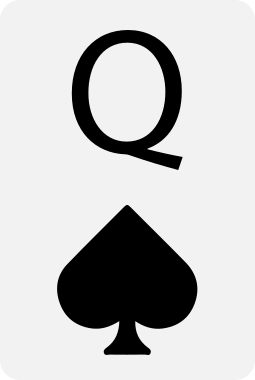
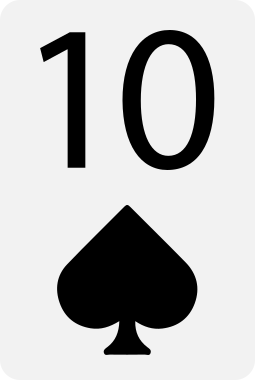
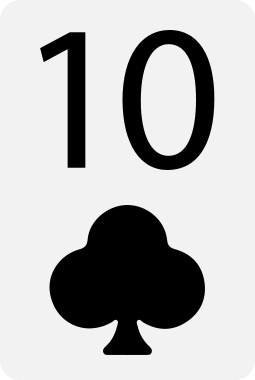
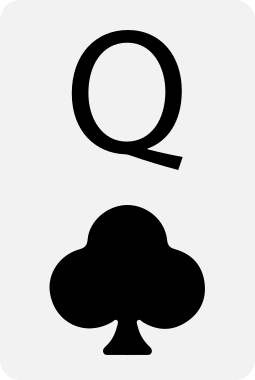
Queen-Ten Suited is a hand that earns its reputation almost entirely through what it can become rather than what it is. Neither card sits at the top of the deck – an Ace or King arriving on any board immediately creates pressure – and top pair of Queens or Tens carries more kicker vulnerability than most players appreciate. Yet QTs makes straights more frequently than any hand covered on this site, and the interaction between its flush draw and that exceptional straight rate produces some of the most powerful semi-bluffing positions available in Texas Hold’em.
It is a hand that rewards understanding deeply, and punishes playing mechanically.
What These Odds Show for QTs
Most of the draw odds for QTs align with those seen for other suited two-card hands. The high card rate of 52.07% on the flop, settling to 16.50% by the river, is consistent with the pattern across all suited hands in this region of the rankings. One pair finishes at 41.38% by the river, two pair at 21.89%, and the flush at 6.43% – all tracking closely with QJs and KTs in the same structural family.
The straight rate is the number that defines this hand. At 7.01% by the river, QTs sets a new high across every hand covered on this site – surpassing QJs at 6.66%, KTs at 5.40%, and every other suited broadway or near-broadway combination:
For the first time across any hand covered on this site, the straight rate (7.01%) exceeds the flush rate (6.43%) by more than a fraction – a gap of 0.58 percentage points. QTs makes straights materially more often than flushes by the river. This is not a marginal statistical quirk – it reflects the structural position of Queen-Ten within the deck’s straight-making geography.
The reason is the same force that made KTs and QJs distinctive, now concentrated in a single hand. Both the Queen and the Ten are deeply embedded within multiple overlapping straight families. A-K-Q-J-T uses the Queen. K-Q-J-T-9 uses the Queen. Q-J-T-9-8 uses both the Queen and the Ten. J-T-9-8-7 uses the Ten. T-9-8-7-6 uses the Ten. QTs participates in five distinct straight families, as opposed to just two or three for hands featuring an Ace or King as the top card. Any board containing K-J, A-J, J-9, J-8, 9-8, or 8-7 gives QTs either an open-ended draw or a meaningful gutshot, making the density of straight-activating board textures genuinely remarkable.
The straight flush rate of 0.15% ties QJs for the highest seen on this site, consistent with the same deep straight connectivity applied to the most powerful drawing outcome in poker.
The overcard table produces a figure of 41.43% on the flop – identical to QQ and QJs. An Ace or King is the only overcard threat to QTs, and by the river that figure rises to 59.85%. Like all Queen-high hands, the majority of runouts will contain at least one card ranking above the Queen before showdown, which means QTs’s made-hand value is regularly under pressure – and its drawing equity is regularly the more important asset.
Hand Strength Summary
- Hand type: Strong suited gapper with the highest straight rate of any hand covered on this site
- Relative strength: Top 20–30 starting hands; the strongest suited two-rank gapper yet covered
- Dominates: Weaker Queen-x and Ten-x combinations, JT, T9s
- Main vulnerabilities: All pocket pairs preflop; Ace and King overcards (41.43% flop rate); wide kicker exposure on Queen-high boards; the flush is not the nut flush
QTs wins primarily through drawing completions rather than made-hand strength. Its two-rank gap creates kicker complexity on most natural connecting boards, but the straight rate of 7.01% and the combined flush-and-straight draw equity on connected board textures make it a genuine and persistent threat.
How Queen-Ten Suited Wins
QTs reaches the best hand through a range of paths, with drawing combinations being overwhelmingly dominant:
- Completes a straight in 7.01% of all runouts – the highest rate of any hand covered on this site
- Hits a flush in 6.43% of hands – strong, though not always the nut flush given the absence of an Ace or King
- Combines flush and straight draws simultaneously on connected boards, producing some of the largest combined equity positions available to any starting hand
- Makes top pair on Queen-high boards against wide ranges where AQ and KQ are unlikely
- Makes top pair on Ten-high boards with a Queen kicker – beaten only by AT in a direct kicker confrontation
- Dominates weaker Queen-x and Ten-x hands when top pair is made
- Forces folds through aggressive semi-bluffing when multiple draws are simultaneously live
The simultaneous draw scenario is where QTs is most dangerous. On a board of J♠ 9♠ 3♦ with Q♠ T♠ in hand, QTs holds both an open-ended straight draw to a King-high or Ace-high straight and a flush draw to a Queen-high flush. With eight outs for the straight and typically nine for the flush – minus any overlap – the combined raw out count can approach or exceed fifteen, representing well over 50% equity going to the next street. Boards that might appear threatening to a one-pair hand are frequently where QTs performs at its absolute best.
Main Weaknesses
The two-rank gap between Queen and Ten creates a more complex kicker landscape than any one-rank suited hand.
On Queen-high boards:
- AQ holds top pair with an Ace kicker – QTs’s Ten kicker is dominated
- KQ holds top pair with a King kicker – QTs is dominated again
- Any Queen with a Jack kicker also beats QTs’s Ten kicker
- Only Q9, Q8, and weaker Queen-x hands are below QTs in a Queen-high kicker confrontation
On Ten-high boards, the situation is considerably more favourable. QTs holds top pair with a Queen kicker – beaten only by AT in a direct kicker confrontation among common Ten-x holdings. KT loses to the Queen kicker, and JT also loses. This makes Ten-high flops with no Ace considerably more playable for QTs than they might superficially appear.
Other weaknesses include:
- Behind all pocket pairs before the flop
- Misses the flop entirely 52.07% of the time
- The flush is not the nut flush – an opponent with an Ace or King in QTs’s suit holds a higher flush draw
- Without drawing equity on a blank flop, the hand has limited profitable continuation paths
Best and Worst Flop Textures
Strong flops
- J-9 boards in the suited suit – open-ended straight draw with both hole cards active, plus a flush draw: peak QTs equity
- K-J or A-J boards in the suited suit – gutshot to the broadway straight alongside a flush draw; combined equity can still be enormous
- 9-8 boards in the suited suit – open-ended straight draw through the middle range, plus flush draw
- J-8 boards – gutshot straight draw, potentially with flush involvement
- Ten-high boards with no Ace – top pair with a Queen kicker, beaten only by AT; a clean, confident spot
- Low, dry boards with two suited cards – flush draw with strong overcards providing semi-bluff fold equity
Dangerous flops
- Queen-high boards against tight ranges – AQ, KQ, and Queen-Jack are all plausible and all dominate QTs’s Ten kicker
- Ace-high boards – both an overcard and, if the Ace is in QTs’s suit, a nut flush draw threat to the hand’s own flush draw
- King-high boards – King provides a second overcard threat and KT causes kicker issues on Ten boards
- Monotone boards in QTs’s suit where an opponent holding an Ace or King-suited has a higher flush draw
- Blank flops with no straight or flush draw – no pair, no draw, no profitable path forward
How It Plays by Position
- Early position: Playable as a raise in many game formats, but QTs benefits more from position than most hands covered so far. The drawing-dominant nature of the hand means that being first to act on multiple streets is a persistent disadvantage. Some tighter strategies treat QTs as a middle-to-late position open.
- Middle position: Standard raise. The straight and flush equity make this a comfortable hand to build pots with against wide calling ranges in position.
- Late position: The natural home of QTs. In position, every drawing combination can be pursued aggressively, pot-control is clean when draws miss, and the hand’s semi-bluffing equity is most fully exploitable when acting last.
- Blinds: Navigate carefully. Top pair with either card is often complicated, and the 41.43% overcard flop rate means boards frequently require drawing-based rather than made-hand-based continuation decisions – which are hardest to execute well out of position.
The Straight Rate in Full Context
With QTs’s 7.01% straight rate, a clear pattern has emerged across all suited hands covered on this site. The progression reflects a general principle: hands whose cards sit furthest from the Ace and closest to the middle of the rank range produce the most straight combinations, because central cards participate in the most overlapping straight families. QTs, with both a Queen and a Ten, represents the peak of this progression among two-rank-gap hands, with only JTs and other one-rank-gap combinations below it likely to push the rate further.
QTs Versus QJs: How Do They Compare?
QJs and QTs share the Queen as their top card and therefore share the identical 41.43% overcard flop rate. Both have the same flush rate of 6.43% and the same straight flush rate of 0.15%. The differences are:
- QJs straight rate: 6.66%; QTs straight rate: 7.01% – QTs makes more straights due to the Ten’s superior centrality over the Jack
- QJs has a cleaner kicker situation on Jack-high boards; QTs is cleaner on Ten-high boards, facing only AT as a kicker domination threat
- QJs is a one-rank-gap hand (closer connectivity for on-flop open-ended draws); QTs is a two-rank-gap hand (more total straight combinations but slightly fewer open-ended draws from a given board, with gutshots more common)
In practice, QTs produces more completed straights over time, but QJs is marginally easier to navigate postflop because of the closer gap. Both hands rely on drawing equity as their primary asset, and both are most dangerous when flush and straight draws activate simultaneously.
Common Mistakes with Queen-Ten Suited
- Playing Queen-high boards too aggressively without recognising the wide kicker domination (AQ, KQ, and Queen-Jack are all plausible)
- Treating Ten-high boards with the same caution as Queen-high boards – QTs holds a Queen kicker on Ten-high boards, which is a considerably cleaner spot beaten only by AT
- Folding to aggression on connected boards where a combined flush and straight draw gives QTs over 50% equity regardless of what an opponent holds
- Treating the flush as equivalent to a nut flush – on boards where an opponent holds Ace-suited or King-suited in QTs’s suit, the flush is at best second-best
- Under-estimating the hand in position as a 3-bet semi-bluff against wide late-position ranges – the drawing equity justifies aggression in many spots where the hand looks speculative on the surface
Comparison to Similar Hands
- Stronger than: JTs, QTo, T9s, and most non-premium non-pair hands
- Behind: All pocket pairs, all Ace-x hands, KQs, KJs, QJs, KTs
- Highest straight rate of any hand covered on this site (7.01%), narrowly surpassing QJs and establishing QTs as the current benchmark for straight-making potential
Examples:
- Against JTs: QTs is a modest favourite – the Queen outranks the Jack as the top card in most pairing situations, and both hands share comparable straight draw territory
- Against KTs: QTs is a moderate underdog – the King outranks the Queen as top card, and on King-high boards the Queen kicker of KTs beats the Jack or lower; approximately 38% for QTs overall
- Against TT: QTs is an underdog at roughly 43%, but with two overcards, a flush draw, and the site’s highest straight rate – a highly dangerous semi-bluffing hand against even a premium pair
How Queen-Ten Suited Performs in Multiway Pots
QTs is among the strongest hands in multiway pots at its tier of the rankings. The 7.01% straight rate and 6.43% flush rate both scale directly with pot size – completed straights and flushes win proportionally larger pots when more opponents are involved. The simultaneous draw combinations that give QTs its postflop power are indifferent to how many players are in the hand; they complete or they do not.
The non-nut flush caveat applies with additional force multiway – more players means a higher probability that someone holds an Ace or King in QTs’s flush suit, making any board where the flush completes one where continued aggression should be calibrated to the possibility of a higher flush.
The overcard rate of 41.43% on the flop means that a meaningful number of multiway flops will contain at least one Ace or King. On those boards, QTs’s response is clear: pursue draws aggressively when they are live, and release made-hand claims without drawing equity promptly.
FAQ: Queen-Ten Suited
Is QTs better than its ranking suggests?
In drawing situations, significantly so. The straight rate of 7.01% is the highest of any hand covered on this site, and on connected boards where flush and straight draws combine, QTs routinely holds the majority of equity regardless of what opponents hold. Its ranking reflects made-hand limitations; its draw rate reflects genuine and recurring postflop power.
How do you handle the two-rank gap in practice?
By leaning entirely into the drawing equity on connected boards and pot-controlling or releasing on boards with no active draw. The gap makes clean top-pair situations rarer than with one-rank-gap hands, but the straight rate payoff more than compensates on the boards where QTs’s draws are live.
Is the QTs flush strong?
It is a strong hand when completed, but it is not the nut flush – any opponent with an Ace or King in the same suit holds a higher flush draw. On boards where an opponent could hold Ace-suited or King-suited, paying off large bets with a completed Queen-high flush requires careful consideration of the specific opponent’s likely range.
How does QTs perform against pocket pairs?
Better than its ranking might suggest. Against a hand like TT, QTs holds roughly 43% equity preflop – already well above a pure bluff – with two overcards, the site’s best straight rate, and a flush draw all providing equity on most flops. Against premium pairs like JJ or QQ, QTs is a more significant underdog, but on connected boards in its suit it remains a persistent threat.
Related Hands