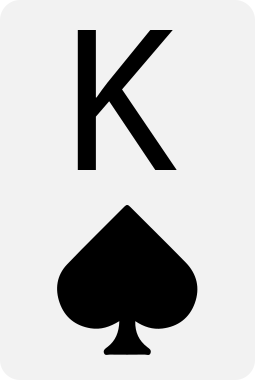
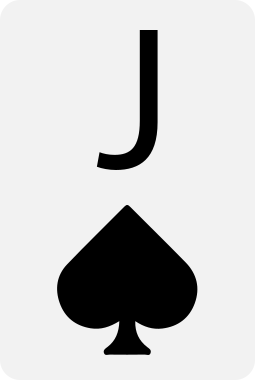
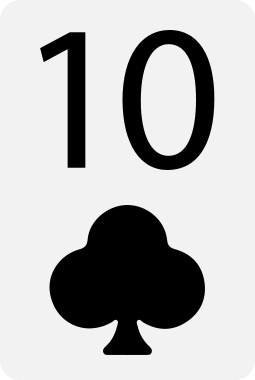
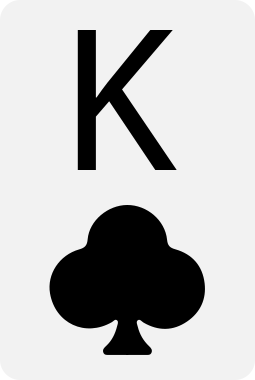
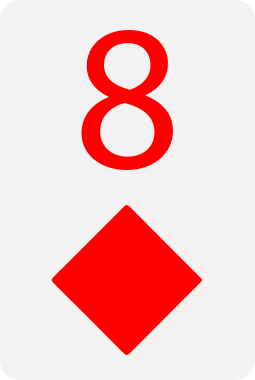
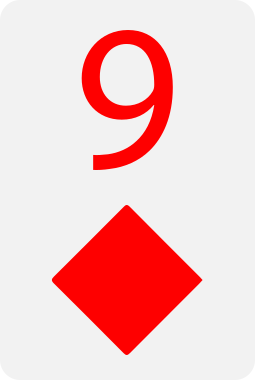
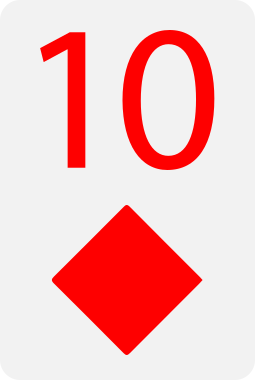
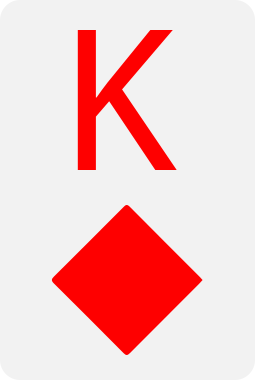
King-Jack Suited is a hand that sits at the boundary between strong and speculative. It carries the prestige of two high broadway cards and the flush draw bonus of being suited, and its straight potential is among the highest of any hand covered so far. But it also lacks the clean top-pair strength of KQs and faces a wider range of kicker problems on its natural connecting boards.
The result is a hand that rewards positional awareness and board-reading more than almost any other in the top tier of non-premium holdings. Played well, KJs punches above its ranking. Played mechanically, it leaks chips in ways that are difficult to identify.
What These Odds Show for KJs
The draw odds for KJs follow the established pattern of suited broadway hands: 52.39% high card on the flop – identical to KQs – dropping to 17.36% by the river. One pair is the most common outcome, settling at 42.33% by the river, with two pair arriving in 22.02% of all runouts and the flush completing in 6.48% of hands.
The straight rate is where KJs distinguishes itself. At 5.05% by the river, it is the one of the highest straight rate of any hand covered on this site. That figure surpasses KQs at 4.70%, AJs at 3.79%, AQs at 3.44%, and AKs at 3.09%. The reason is structural: the King-Jack combination sits at the heart of multiple overlapping straight families. A-K-Q-J-T, K-Q-J-T-9, and Q-J-T-9-8 all involve both hole cards or at least provide two-card connectivity that generates open-ended draws. No other hand in this group is as deeply embedded within the broadway straight range while also having access to the Jack-high straight combinations below it.
The straight flush rate of 0.10% matches KQs, reinforcing how centrally KJs sits within connected straight-making territory.
The overcard table produces a number that deserves attention: 22.55% on the flop, 29.14% by the turn, 35.30% by the river – figures identical to KQs and KK. Only an Ace constitutes an overcard to KJs, which means that despite sitting lower in the rankings than most of the hands discussed previously, KJs shares the same narrow overcard exposure as KQs. This is a genuine and often underappreciated strength of any King-high hand – the board presents an overcard threat on fewer than a quarter of all flops.
Hand Strength Summary
- Hand type: Strong suited broadway hand with premium straight potential
- Relative strength: Top 15–20 starting hands
- Dominates: JT, KT, QJ, J9s, and weaker King-x and Jack-x combinations
- Main vulnerabilities: All pocket pairs preflop; AK and KQ on King-high boards; AJ and KQ on Jack-high boards; the Ace overcard on any board
KJs is a hand that earns its keep through drawing equity and positional play rather than raw made-hand strength. It is not a hand to fall in love with at showdown – it is a hand to leverage aggressively when draws are live.
How King-Jack Suited Wins
KJs reaches the best hand through several routes, with drawing combinations being the most distinctive feature:
- Makes top pair with a reasonable kicker on King-high or Jack-high boards
- Completes straights in 5.05% of all runouts
- Hits a strong, often near-nut flush in 6.48% of hands
- Combines flush and straight draws simultaneously on connected boards, producing extremely powerful semi-bluffing spots
- Dominates weaker King-x and Jack-x hands that share its connecting boards
- Forces folds through aggression when multiple draws are live and fold equity is high
The simultaneous draw scenario is worth emphasising. On a board of T♠ 9♠ 2♣ with K♠ J♠ in hand, KJs holds both an open-ended straight draw to a King-high or Jack-high straight and a flush draw to what may be the near-nut flush. The combined equity of these draws often exceeds 50%, making aggressive semi-bluffing mathematically correct even as a pure drawing hand. This is the same multi-draw strength seen in KQs, but with a slightly broader range of boards that activate it.
Main Weaknesses
KJs’s kicker structure creates problems on both of its natural connecting cards.
On King-high boards:
- AK has top pair with the Ace kicker – KJs is dominated with a Jack kicker
- KQ has top pair with a better Queen kicker – KJs is dominated again
- Only KJ itself produces a chop, and weaker King-x hands are the only ones KJs beats in a top-pair confrontation
On Jack-high boards:
- AJ has top pair with an Ace kicker – KJs is dominated
- QJ has top pair with a Queen kicker – KJs is dominated with the King serving only as an overcard
- KQ has a King overcard and a gutshot straight draw, making it a competitive holding
The result is that KJs faces kicker domination from multiple directions on both of its most natural pairing boards. This is more complex than KQs, where King-high boards are only troubled by AK, and more complex than AJs, where Jack-high boards are only complicated by AK and AQ from above. KJs faces a crowded kicker landscape on both sides.
Other weaknesses include:
- Behind all pocket pairs preflop, including small pairs
- Misses the flop entirely in 52.39% of cases
- Without drawing equity, the hand has limited showdown value when it fails to make top pair with a clean kicker
Best and Worst Flop Textures
Strong flops
- Low, connected boards in the suited suit (e.g. T♠ 9♠ 3♦) – flush draw and open-ended straight draw simultaneously, with significant fold equity through semi-bluffing
- King-high boards against wide ranges where AK and KQ are unlikely – top pair with a Jack kicker can be strong enough
- Jack-high boards against wide ranges where AJ and QJ are less likely – same logic applies
- Q-T or T-9 boards – strong open-ended straight draw to the nuts or near-nuts, even without pairing
- Low, dry boards – two high overcards retain fold equity and the hand can be played as a semi-bluff vehicle
Dangerous flops
- King-high boards against tight ranges – AK and KQ are both plausible and both dominate KJs
- Jack-high boards against ranges that include AJ or QJ prominently
- Ace-high boards – the single overcard risk materialises; both hole cards are now behind the top card, and the hand relies entirely on drawing equity to continue
- Boards in a different suit where KJs’s flush equity is lost and only straight draws remain
How It Plays by Position
- Early position: KJs is playable as a raise in most games, though some tighter strategies treat it as a middle-position open. The hand’s postflop complexity benefits enormously from position, making early-position opens without it carry more risk.
- Middle position: Standard raise. A solid hand to play against wide calling ranges.
- Late position: Where KJs performs at its best. In position, the combined drawing potential can be exploited through multi-street aggression, and pot-control is straightforward when draws miss.
- Blinds: Navigate carefully. The kicker problems on King-high and Jack-high boards are most costly out of position, where check-calling lines allow opponents to define their hand strength on later streets.
The Straight Rate in Context
The 5.05% straight rate by the river is the headline number for KJs, and it is worth placing in context across the broadway hands covered on this site:
The progression is not accidental. As the gap between the Ace anchor and the lower card increases – or as the Ace is removed from the combination entirely – the lower card gains access to more central straight positions. The Jack, sitting between Ten and Queen in the broadway range while also having access to T-9-8 combinations below, produces the widest straight-draw coverage of any hand in this group. On any board containing a Queen and a Ten, a Ten and a Nine, or a Queen and a Nine, KJs has either an open-ended straight draw or a gutshot to a very strong straight. That frequency of draw activation is the hand’s most distinctive feature.
Common Mistakes with King-Jack Suited
- Over-valuing top pair on King-high boards without accounting for the widespread domination from AK and KQ
- Playing the hand passively on connected boards where flush and straight draws combine into powerful semi-bluffing equity
- Treating KJs like KQs and applying the same continuation betting frequency on high boards
- Failing to fold to sustained aggression from tight opponents on top-pair boards where the kicker is likely dominated
- Under-estimating the hand’s strength against wide, loose ranges where the drawing potential genuinely makes it a favourite over time
Comparison to Similar Hands
- Stronger than: QJs, KTo, KJo, and most non-premium non-pair hands
- Behind: All pocket pairs, AKs, AQs, AJs, KQs
- Highest straight rate of any hand covered so far (5.05%), giving it a genuine drawing edge over KQs in connected-board scenarios
Examples:
- Against QJs: KJs is a favourite – the King outranks the Queen as the top card in most straight and pair situations
- Against AJs: KJs is an underdog – dominated on Jack-high boards and behind on Ace-high boards; roughly 38% to win overall
- Against KQs: KJs is dominated on King-high boards where KQ holds the better kicker; approximately 30% to win overall
How King-Jack Suited Performs in Multiway Pots
KJs is one of the better non-premium hands in multiway pots, largely because of its straight equity. A completed straight wins a larger pot when multiple players are involved, and the 5.05% straight rate represents clean, often nut-level hand strength that does not depend on opponents folding. The flush draw also scales well multiway for the same reason.
The kicker problems on King-high and Jack-high boards are more manageable multiway when opponents are less likely to have specifically AK or KQ, though any board where a top pair is contested should be played cautiously. KJs performs best multiway when it is working with draws rather than relying on made top pair to hold.
FAQ: King-Jack Suited
Is KJs a premium hand?
No, but it is a strong one – comfortably in the top 15–20 starting hands and playable as an open raise in most positions. It falls short of premium status because of the widespread kicker vulnerability on its natural connecting boards.
Should you 3-bet KJs?
Selectively. In position against late-position openers with wide ranges, 3-betting KJs as a semi-bluff can be profitable. Against tight ranges from early position where AK, KQ, and AJ are common, calling and playing postflop for drawing value is usually the better approach.
How do you play KJs on a King-high flop?
With caution, particularly against tight opponents. Top pair with a Jack kicker looks strong but is dominated by AK and KQ, both of which are plausible holdings from any opponent who called or raised preflop. A single continuation bet is reasonable; committing to multiple streets without improvement should require a strong read that the opponent does not hold a better King.
What makes KJs better than KJo?
Approximately 3–4% equity in most match-ups, the flush draw, and – critically – the ability to simultaneously combine flush and straight draws on connected boards. This multi-draw semi-bluffing power is largely absent from the offsuit version.
Related Hands