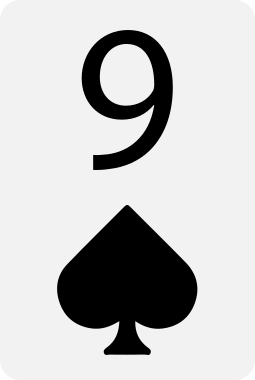
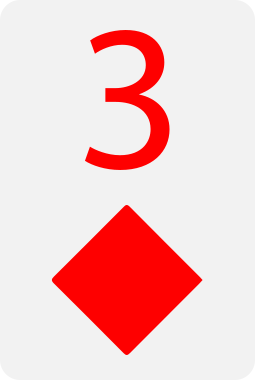
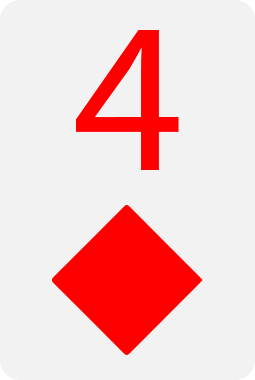
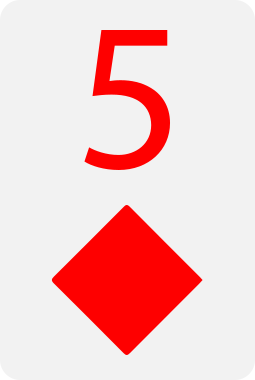
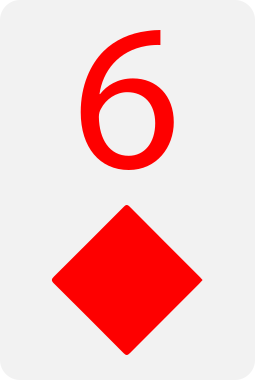
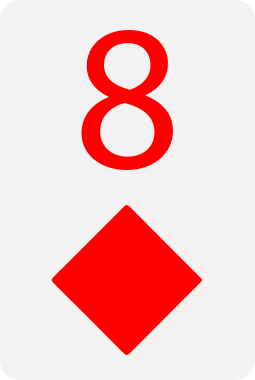
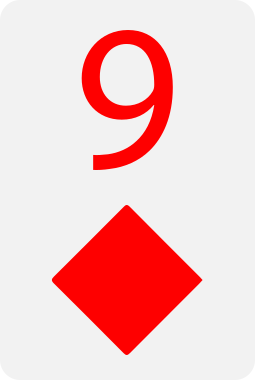
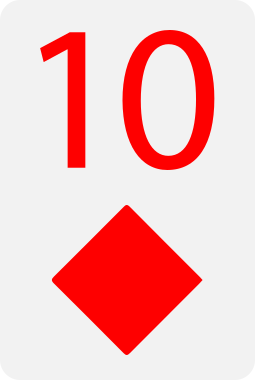
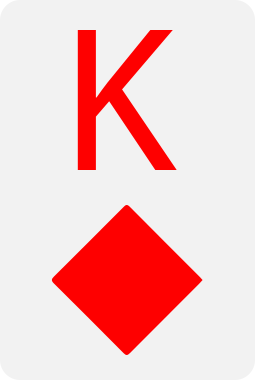
Jack-Nine Suited is one of the most complete speculative hands in Texas Hold’em. It sits at a point in the suited one-gapper family where nearly every element of the hand’s potential reaches a meaningful level simultaneously — straight odds that rival the best connectors, flush odds consistent with the suited family, an overcard rate that is challenging but not prohibitive, and enough high-card strength to make top pair a genuine asset on a wide range of boards. It is not a premium hand, and it should not be played like one, but among the speculative hands it is as well-rounded as the category gets.
Before the flop, J9s is a hand you play for post-flop potential with a clear understanding of where that potential lies. It opens profitably from late position, defends well from the blinds, and occasionally justifies a light 3-bet in position against wide ranges. What it produces after the flop — and the frequency with which it produces something — is what makes it stand out.
What These Odds Show for J9s
The high card flop rate of 52.07% is the second lowest recorded in this series for a non-pair hand, behind only T9s at 51.75%. The gap between J9s and T9s is narrow, and the reason is similar — both hands sit in the connected mid-range of the deck where two-directional straight draw potential and the suited bonus combine to reduce the proportion of flops where nothing at all develops. J9s misses slightly more often than T9s because the Jack reaches further into broadway territory, where boards are less likely to connect in multiple directions simultaneously, but the difference is marginal.
The straight odds are the headline number for J9s and the figure that most clearly defines its character. At 0.96% on the flop, 3.28% by the turn, and 6.97% by the river, J9s produces a higher straight rate than any hand covered in this series except T9s (8.57%). It surpasses Q9s (5.36%), KQo (5.01%), K9s (3.75%), and every other hand at a significant margin. The structural reason is the Jack and Nine’s position in the deck. The Jack connects upward into broadway — Q-K-A combinations — and downward through Ten, giving access to straights including A-K-Q-J-T, K-Q-J-T-9, Q-J-T-9-8, and J-T-9-8-7. The Nine connects downward through Eight, Seven, Six, and Five, adding combinations including T-9-8-7-6, 9-8-7-6-5, and 8-7-6-5-4. Between them, the Jack and Nine cover an exceptional range of straight-completing boards, and the one-gap between them is small enough that many of these combinations involve both cards directly.
The flush odds of 0.83% on the flop, 2.88% by the turn, and 6.43% by the river are consistent with the suited one-gapper family. The Jack-high flush is the fourth-highest possible flush, behind Ace, King, and Queen-high. Three holdings in the same suit can beat it — a consideration that is slightly more significant than Q9s (two) and meaningfully more significant than K9s (one) or suited Aces (zero). In practice the Jack-high flush is a strong made hand in most situations, but the flush vulnerability is real on boards with heavy action in multiway pots.
The straight flush odds of 0.02% on the flop, 0.06% by the turn, and 0.15% by the river sit between Q9s (0.11%) and T9s (0.20%), reflecting the central position of J9s in the suited one-gapper spectrum. Multiple straight flush combinations run through the Jack and Nine in the same suit, and while these are rare outcomes, J9s produces them more consistently than any hand outside the pure suited connector family.
The overcard table places J9s in genuinely new territory within this series. With a Jack as the highest card, any Queen, King, or Ace constitutes an overcard — twelve cards across three ranks. The 56.96% flop rate, 67.95% by the turn, and 76.31% by the river sit between Q9s (41.43% / 51.40% / 59.85%) and T9s (69.47% / 79.86% / 86.87%). This progression through the series — from K9s at 22.55% through Q9s at 41.43% through J9s at 56.96% to T9s at 69.47% — tells a clear story about how overcard exposure scales with the rank of the highest hole card. J9s crosses the 50% threshold on the flop for the first time in this series, meaning the majority of flops will contain at least one card ranked above the Jack. That is a significant shift in how pair value should be assessed — the Jack is a moderate high card, not a dominant one, and this hand’s strength comes primarily from its drawing potential rather than its ability to make top pair and hold.
Hand Strength Summary
- Hand type: Suited one-gap connector, upper mid-range
- Relative strength: Top 15–20% of all starting hands
- Dominates: J8s and below, weaker Jack-x suited and offsuit hands, nine-x hands with weaker kickers
- Vulnerable to: AJ, QJ, KJ (share the Jack, hold better kickers), higher pocket pairs, Ace through Queen-high flushes in its suit
J9s is best understood as a drawing hand that also has meaningful top pair potential on a specific slice of boards — primarily Jack-high or Nine-high textures where opponents are unlikely to be strongly connected. Its equity is concentrated in its draws, but those draws are more numerous and more powerful than almost any hand at its strength level.
How J9s Wins
J9s has an unusually broad range of winning routes for a hand of its rank:
- Completing a straight — at 6.97% by the river, the highest rate in this series outside T9s
- Making a Jack-high flush — 6.43% by the river, a strong if not invincible made hand
- Flopping top pair with the Jack on boards where opponents have not connected
- Making two pair with both the Jack and Nine
- Semi-bluffing with an open-ended straight draw, flush draw, or both simultaneously — the combination draw is J9s at its most dangerous
- Making a straight flush through the overlapping suited combinations of Jack and Nine
The combination draw scenario deserves particular emphasis. When J9s flops both a flush draw and an open-ended straight draw, it can have fifteen or more combined outs depending on overlap. On a board like T♥ 8♥ 3♦ holding J♥ 9♥, J9s has eight straight outs (any Queen or Seven) and nine flush outs (any remaining heart), with some overlap depending on whether the Queen of hearts or Seven of hearts is already accounted for. In clean versions of this scenario, J9s has close to fifteen outs — roughly a 54% chance of improving by the river. That is a favourite over most made hands.
Main Weaknesses
J9s has real vulnerabilities that require careful management:
- The Nine is a weak kicker — on Jack-high boards, AJ, QJ, and KJ all have the kicker covered and those hands appear frequently in opponents’ ranges
- The Jack-high flush loses to Ace, King, and Queen-high flushes — three possible better holdings in the same suit
- The 56.96% overcard rate means the majority of flops contain at least one card above the Jack, limiting top pair reliability
- In 3-bet pots, the kicker weakness and overcard exposure compound — opponents hold stronger holdings at higher frequency in those pots
- Like all drawing hands, J9s loses equity when draws miss — a hand built primarily on drawing potential is occasionally just a high card at showdown
The kicker problem on Jack-high boards is the most consistently costly issue. Top pair Nine kicker against an aggressive opponent in a raised pot is a notoriously difficult spot, and without additional equity — a draw, two pair, or strong read — the correct response is usually caution.
Best and Worst Flop Textures
Strong flops
- Jack-high boards with two cards of your suit — top pair and the Jack-high flush draw simultaneously
- T-8-x or Q-T-x boards — open-ended straight draw with multiple nut combinations; J9s on T-8-x has an open-ended draw that is the nut straight on both ends
- Nine-high low boards (e.g. 9♦ 5♠ 2♣) — top pair with the Nine on a board opponents rarely connect with strongly
- Three cards of your suit — immediate Jack-high flush
- Boards giving both a straight draw and flush draw in your suit — the combination semi-bluff, J9s at maximum equity
Dangerous flops
- Jack-high boards in raised or 3-bet pots — AJ, QJ, and KJ dominate through the kicker and feature heavily in 3-betting ranges
- Three-flush boards with heavy action in multiway pots — Ace, King, and Queen-high flushes are all possible
- High boards (A-K-Q or K-Q-J) — you have missed and the Nine does limited work against opponents connecting with broadway cards; on K-Q-J specifically you have a gutshot but opponents are frequently ahead already
- Dry boards with neither a Jack, a Nine, nor draw cards of your suit — no made hand and no meaningful path to improvement
How It Plays by Position
- Early position: A fold in most formats; the overcard exposure and kicker weakness are most damaging without positional control, and the hand relies on seeing cheap flops rather than navigating 3-bets out of position
- Middle position: A marginal open at most tables; playable behind an open in position as a speculative call
- Late position (CO/BTN): Where J9s performs best — raise or call to see flops cheaply, fold cleanly when you miss without a draw, and apply significant pressure when a straight draw or flush draw is live in position
- Blinds: An excellent defend against late position steals — the combination of pot odds, board coverage, and drawing potential makes J9s one of the stronger big blind defending hands at its price point; in 3-bet pots out of position the hand is harder to play profitably
The position dependency of J9s is similar to T9s and Q9s but slightly more acute than Q9s due to the higher overcard rate crossing the 50% threshold on the flop. Without positional control, the majority of flops will present an overcard, and navigating those spots out of position across multiple streets requires more information than the hand naturally provides.
Common Mistakes with J9s
- Continuing with top pair Nine kicker in raised pots without significant additional equity — the kicker weakness is most expensive in exactly these spots
- Under-betting or slow-playing combination draws — fifteen outs to a strong hand warrants aggressive action, not passive calls
- Overestimating the Jack-high flush — three higher flushes are possible, and heavy action on flush boards from multiple opponents deserves respect
- Playing from early position too frequently — J9s needs cheap flops and positional control to realise its equity
- Treating gutshot straight draws as equivalent to open-ended draws — J9s sometimes picks up partial draws on broadway-heavy boards that look more promising than they are
Comparison to Similar Hands
- Stronger than: J8s, J7s and all lower Jack-x suited hands; J9o by virtue of flush and straight flush equity; Q9s in straight potential
- Slightly weaker than: JTs — one rank higher in the second card gives JTs better straight connectivity at the top of the deck, stronger kicker value, and a marginally lower overcard rate
- Most comparable to: T9s in playing style and draw orientation; Q9s in structure and position in the one-gapper spectrum
Examples:
- Against QJo: J9s is dominated through the kicker on Jack-high boards — the Queen wins the kicker battle — though drawing potential gives J9s more equity than a pure dominated hand
- Against TT: J9s is approximately a 35% underdog preflop — two live overcards to the Ten combined with straight and flush draw outs give J9s more equity than the pair gap suggests
- Against Q9s: J9s is a modest underdog in raw equity — Q9s holds a higher top card — but the straight potential of J9s narrows the gap significantly; the match-up is close
- Against J9o: J9s is a clear favourite — identical ranks, but the flush draw and straight flush potential give J9s a meaningful equity advantage across all runouts
How J9s Performs in Multiway Pots
J9s is one of the hands that genuinely improves in multiway pots, and the draw odds numbers explain why:
- Straight implied odds are at their highest multiway — a 6.97% river straight rate translates to a much larger pot when three or four opponents contribute; straights with J9s are also well disguised, since opponents rarely anticipate the combination
- Combination draws retain full equity regardless of fold equity — fifteen outs is fifteen outs whether opponents fold or not
- The Jack-high flush becomes more vulnerable multiway — three higher flush possibilities mean heavy multiway action on flush boards warrants caution
- Top pair Nine kicker is particularly weak in multiway pots and should rarely be committed to against multiple opponents
The strategic prescription for multiway J9s is clear: draw or fold. Continue with open-ended straight draws, flush draws, and combination draws; fold one pair without meaningful additional equity; never try to win a large multiway pot with Jack-Nine high on an overcard board. The hand’s equity is in its draws, and multiway pots reward completed draws with the largest pots.
FAQ: Jack-Nine Suited
How does J9s compare to T9s?
T9s is the stronger hand by most measures — better straight odds (8.57% versus 6.97%), lower overcard rate (69.47% flop versus 56.96%), and slightly better straight flush odds. However J9s compensates with a stronger top card. The Jack provides better board coverage on Jack-high textures and allows J9s to make the nut straight (A-K-Q-J-T) when the broadway end completes, something T9s cannot do. Both hands play similarly and are among the strongest speculative holdings available.
Why does J9s have higher straight odds than Q9s despite a smaller gap between the cards?
The gap between Jack and Nine is identical to the gap between Queen and Nine — both are one-gappers separated by the Ten and Eight respectively. The difference in straight odds (6.97% versus 5.36%) comes from the Jack’s position in the deck. The Jack connects into the broadway range more cleanly than the Queen does — the Queen needs broadway cards above it to form straights, while the Jack can connect both upward into broadway and downward into mid-range territory through more combinations simultaneously. The Nine enhances this further because it connects into the mid-range zone that the Jack is also approaching from above.
Is J9s a 3-bet hand?
Occasionally, in position against wide late-position openers. The combination of straight and flush draw potential gives J9s enough equity to function as a light 3-bet semi-bluff, and playing it with initiative in position maximises the value of its drawing potential. Against tight ranges, in early position, or out of position, it is better treated as a call or fold.
What is the best straight J9s can make?
The nut straight: Ace-King-Queen-Jack-Ten. When the board completes with Q-K-A or K-Q and the Ten is present, J9s holds the best possible straight with the Jack contributing directly. It can also make King-Queen-Jack-Ten-Nine, the second-nut straight, and several mid-range straights running through the Nine. The breadth of straight combinations available to J9s — from broadway to mid-range — is the defining feature of the hand.
Related Hands