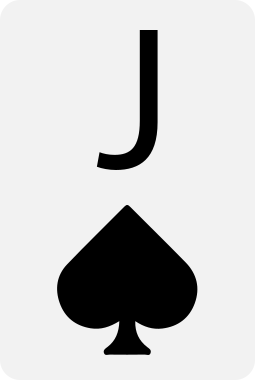
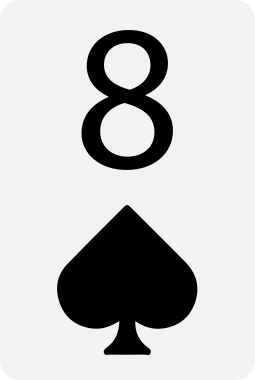
Jack-Eight Suited is a one-gap suited hand that occupies an interesting middle ground between the premium suited connectors and the more speculative lower suited hands. The jack provides meaningful high-card strength and top-pair value on a wide range of boards, while the suited nature and partial connectivity give it flush and straight drawing equity that keeps it competitive beyond simple pair strength.
Before the flop, J8s is not a hand you are building large pots with. It is a positional hand – one that rewards players who see cheap flops, read boards accurately, and understand when its drawing equity justifies continuation and when it does not.
What These Odds Show for J8s
The straight equity of 5.71% by the river is the most distinctive number for J8s relative to its peers. It sits meaningfully below the connected suited hands like 98s (8.53%) and T8s (7.32%), reflecting the one-card gap between the jack and eight that eliminates several straight combinations. Specifically, J8s cannot make straights using both hole cards on boards containing nine and ten without also needing a seven or queen – the gap reduces the number of clean open-ended draw situations available. On the flop, 0.64% of runouts complete a straight, rising to 2.47% by the turn.
The flush equity of 6.47% by the river is consistent with other suited hands and represents the more reliable of the two drawing paths. Unlike the straight equity, the flush draw is unaffected by the gap – J8s has exactly the same flush potential as J9s or JTs, making this the hand’s most dependable source of draw equity.
The overcard table shows a 56.96% chance of an overcard on the flop, rising to 76.31% by the river. With queens, kings and aces all outranking the jack, this is a meaningfully better picture than 98s (79.29%) or T8s (69.47%), but still high enough that top pair of jacks cannot be played carelessly in contested pots. The eight kicker compounds the issue – when an opponent also holds a jack, the eight loses to the majority of realistic kicker combinations.
Hand Strength Summary
- Hand type: One-gap suited hand, moderately speculative
- Relative strength: Middle tier, between suited connectors and suited aces
- Dominates: Weaker jacks, low unpaired hands on jack-high boards
- Main vulnerability: Dominated by AJ, KJ, QJ and any jack with a better kicker; overcard pressure from queens, kings and aces
J8s is stronger than its gap suggests due to the jack’s high-card strength, but weaker than true suited connectors due to the reduced straight combinations.
How Jack-Eight Suited Wins
- Flopping top pair of jacks and holding up in uncontested or low-aggression pots
- Completing a flush and winning at showdown – a jack-high flush is a strong hand that loses only to queen, king or ace-high flushes
- Making a straight on connected boards, particularly those involving nines and tens or sevens and nines
- Building two pair by the river (22.02%) when both the jack and eight connect with the board
- Semi-bluffing effectively on flush draw flops, using the combination of draw equity and fold equity to win pots without showdown
The jack’s high-card strength is the feature that separates J8s from lower one-gap hands like T7s or 96s. Top pair of jacks has genuine showdown value in unraised pots and against single opponents, which gives J8s a more reliable fallback when draws miss.
Main Weaknesses
- The one-card gap meaningfully reduces straight potential compared to connected hands – 5.71% versus 8.53% for 98s is a significant difference
- The eight kicker is weak – top pair of eights or a jack with an eight kicker is vulnerable to a wide range of better holdings
- Overcard exposure of 76.31% by the river means the jack is frequently not the top card on the board
- Non-nut flush potential – a jack-high flush loses to queen, king and ace-high flushes, introducing reverse implied odds on flush-completing runouts
The gap is the defining structural weakness. J8s wants to be a suited connector but the missing nine reduces its straight equity to a point where it cannot lean on that draw as reliably as 98s or JTs can.
Best and Worst Flop Textures
Strong flops
- Jack-high boards with two suited cards of the matching suit (top pair plus flush draw)
- Connected boards giving a straight draw involving the eight (e.g. T♥ 9♦ 2♣, 9♠ 7♦ 3♥)
- Low dry boards where top pair of jacks is likely the best hand and a continuation bet takes the pot cleanly
Dangerous flops
- Queen, king or ace-high boards where top pair is unavailable and only the flush draw or a pair of eights remains
- Jack-high boards in multiway pots where a better kicker is likely (J♠ Q♦ 4♣, J♥ K♠ 7♦)
- Flush-completing boards where opponents may hold a higher flush
How It Plays by Position
- Early position: A fold in most full-ring games – the gap reduces straight equity enough that the hand struggles to justify an open against tight ranges that can 3-bet effectively
- Middle position: Borderline; playable in six-max formats or softer full-ring games where implied odds are available
- Late position (button/cutoff): The natural position for J8s – cheap flops, positional control on draws, and the ability to take free cards or fold cleanly when the board does not connect
- Blinds: A reasonable defend from the big blind given the pot odds and the jack’s top-pair potential; the out-of-position constraint limits draw realisation but the equity is sufficient in many spots
J8s benefits from position more than most hands at its strength level. The combination of kicker weakness and gap-reduced straight equity makes post-flop decisions significantly harder without the ability to act last.
Common Mistakes with Jack-Eight Suited
- Treating J8s like a suited connector and expecting the same straight draw frequency as 98s or JTs – the gap makes a material difference that should adjust continuation decisions
- Overcommitting with top pair of jacks in multiway pots or against significant aggression where the kicker is likely outgunned
- Chasing flush draws without pot odds, particularly on boards where a higher flush is plausible
- Playing the hand out of position in raised pots where neither the made-hand strength nor the drawing equity is sufficient to navigate multiple streets profitably
The most common error is overestimating the straight potential. Players who have experience with true suited connectors sometimes continue too liberally with J8s on boards where 98s would have a clean open-ended draw and J8s does not.
Comparison to Similar Hands
- Stronger than: J8o (flush and straight flush equity are meaningful additions), T7s, 96s (weaker high cards or larger gaps)
- Comparable to: T8s (very similar profile – T8s has slightly better straight combinations but a weaker high card), Q9s (similar gap, higher card)
- Weaker than: JTs, J9s (connected or one-gap with stronger straight equity), QJs (stronger high cards and better kicker)
The most instructive comparison is J9s. That hand has the same jack high card but a smaller gap, producing significantly better straight equity (around 7% by the river versus 5.71% for J8s). The difference is meaningful enough that J9s is a comfortable open in more situations than J8s.
How Jack-Eight Suited Performs in Multiway Pots
J8s has limited multiway value compared to true suited connectors:
- Top pair of jacks with an eight kicker is extremely vulnerable against multiple opponents – at least one is likely to hold a better jack or a higher pair
- Flush draws retain value in multiway pots, but a jack-high flush carries reverse implied odds risk when several players are in the hand
- Straight draws are less frequent than with connected hands, reducing the semi-bluffing options available in large multiway pots
- The hand plays best multiway when it flops a strong combination draw – flush draw plus straight draw simultaneously – where raw equity compensates for the positional and kicker disadvantages
In multiway pots, J8s should be played as a drawing hand exclusively. Single pair holdings are rarely defensible against three or more opponents.
FAQ: Jack-Eight Suited
Is Jack-Eight Suited a good hand?
It is a playable speculative hand in position, but it sits below the top tier of suited hands. Its value comes from a combination of jack high-card strength and suited drawing equity rather than either factor alone.
How does J8s compare to J9s?
J9s is the stronger hand. The smaller gap produces significantly better straight equity – roughly 7% by the river versus 5.71% for J8s – and J9s fits more naturally into the suited connector category. J8s is a step below.
How often does J8s make a flush?
By the river, J8s completes a flush 6.47% of the time. When it does, it will be a jack-high flush – a strong hand, but one that loses to queen, king and ace-high flushes.
Should you call a 3-bet with J8s?
Generally no. J8s does not have the raw equity or the straight draw reliability to call 3-bets comfortably, particularly out of position. Against tight 3-betting ranges it is typically dominated or drawing thin.
Related Hands