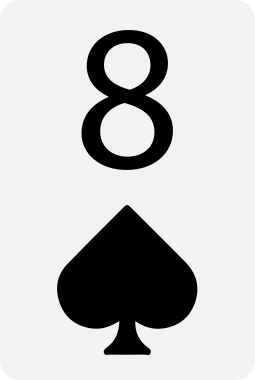
Jack Eight Offsuit is a speculative connector with genuine straight potential but significant vulnerability before and after the flop. It sits in the lower tier of playable hands, offering enough combinatorial upside to be dangerous in the right conditions, but too inconsistent to play aggressively in most spots.
What These Odds Show for J8o
The draw odds table tells an honest story about this hand’s nature. On the flop, J8o still has a high card as its best holding 53.22% of the time, meaning it completely misses the board in the majority of cases. That number falls to 18.36% by the river, but by then you’ve already invested chips across multiple streets without a made hand.
The pair rate on the flop is 40.41%, which sounds reasonable, but a single pair with J8o is often a weak one. Pairing the eight on a jack-high board gives you second pair with a modest kicker, while pairing the jack frequently leaves you vulnerable to better kickers. Neither outcome provides the kind of confidence that invites aggressive betting without a read on your opponent.
Where J8o earns its place in the hand range is the straight column. By the river, there is a 6.09% chance of making a straight, which is one of the higher straight rates among non-connected hands. This stems from the jack and eight covering a wide slice of the straight spectrum. A nine and a ten complete the obvious broadway-adjacent straight, but sevens, nines, tens, and queens all contribute to various wrap-around possibilities. On the right board, this hand can arrive at a very strong made hand that opponents will not see coming.
The overcard odds are worth paying attention to here too. With only a jack as the high card, 56.96% of flops will contain at least one card of higher rank. By the river that rises to 76.31%, meaning in three out of four runouts, there will be a card on the board that beats your top hole card outright. This significantly reduces the reliability of top pair as a strong holding and is a key reason why J8o struggles in contested pots.
Hand Strength Summary
- Hand type: Speculative offsuit connector
- Relative strength: Below average, playable in position
- Dominates: Little preflop, occasional post-flop equity in the right spots
- Main vulnerability: Dominated by most premium and semi-premium hands
Jack Eight Offsuit requires board texture and position to generate value. It is not a hand that wins by sheer card strength.
How J8o Wins
When J8o wins, it tends to do so in one of a few specific ways. Hitting a straight is the cleanest victory, arriving on a board that opponents playing Broadway cards or overpairs will not credit you for. Two pair is another key outcome, particularly on boards that pair both the jack and eight, which can trap opponents holding top pair with a better kicker. Occasionally, J8o wins as a bluffing hand in late position, using its backdoor straight equity as justification for a semi-bluff on drawy boards.
With a 22.53% chance of making two pair by the river and 6.09% for a straight, the hand does have legitimate equity paths. It just rarely arrives at them cheaply.
Main Weaknesses
The offsuit nature of J8o removes one of the primary advantages suited connectors enjoy. With no flush draw potential on the flop, the hand has to rely entirely on pair outs and straight cards. That 0.00% flush rate on the flop reflects this directly, and even by the river the flush probability is just 1.95%, essentially a statistical footnote rather than a genuine draw.
The gap between jack and eight also matters. Unlike a hand such as Jack Ten, J8o requires a more specific set of board cards to complete a straight. The two-gap connector still has meaningful straight outs, but it needs the board to cooperate in a narrower range of ways.
Add in the 76.31% chance of an overcard appearing by the river, and J8o frequently finds itself in situations where even its best pair is outranked by the board.
Best and Worst Flop Textures
Strong flops
- Nine-ten boards that open a straight draw immediately
- Low boards where the jack is the highest card and there are straight-completing middle cards nearby
- Two-pair flops such as jack-eight-x
Dangerous flops
- Ace or king-high boards where the hand has no pair and no realistic draw
- Queen-high boards that reduce straight connectivity
- Paired boards where two pair potential is neutered
The hand lives and dies by how well the flop connects with its middle-card range. When it connects, it can be disguised and powerful. When it misses, which happens the majority of the time, it has very little to fall back on.
How It Plays by Position
- Late position: Where J8o earns most of its value. In a steal situation or in an unopened pot, the combination of straight potential and the ability to see cheap flops makes it a reasonable speculative holding. The hand can be folded quickly on a miss without having committed a large portion of your stack.
- Early position: A clear fold at most table dynamics. The hand needs to see a cheap flop and play aggressively only when it connects, which requires the positional advantage to assess how opponents have reacted to the board first.
- Blinds: Can complete at a good price against a single raiser but requires discipline to get away from marginal one-pair holdings when facing post-flop pressure.
Common Mistakes with J8o
- Overvaluing top pair – a jack on the board with an eight kicker is regularly beaten by opponents holding a jack with a better kicker, and calling down multiple streets in this spot is where J8o becomes a leak
- Chasing a straight draw without the correct pot odds – the two-gap draw has fewer outs than a connected hand, and investing heavily on the turn without the right price compounds the fundamental weakness of the hand
- Playing J8o from out of position – the straight potential rarely materialises versus how often the hand needs to navigate difficult post-flop decisions with mediocre holdings
Comparison to Similar Hands
- Stronger than: J7o, J6o, 9-6 offsuit, other two-gap offsuit hands further down the range
- Weaker than: J8s, J9o, JTo, T8s, any suited connector in a similar range
Against Jack Ten Offsuit, the missing connector reduces straight combinations meaningfully. Against Jack Nine Offsuit, the same applies, though more narrowly. The suited version of this hand, J8 suited, adds the flush draw dimension that makes speculative connectors significantly more valuable, and is a meaningfully stronger hand as a result.
How J8o Performs in Multiway Pots
In multiway pots, J8o’s disguised straight potential is at its most valuable, while its pair strength is at its most vulnerable. Hitting a straight in a three or four-way pot and getting paid by an opponent with a strong one-pair or two-pair hand is one of the most profitable spots this holding creates.
The risk is getting attached to one pair in a multiway pot, where the probability of being beaten by someone with a better kicker or a stronger made hand is substantially higher. The hand rewards players who can fold one pair quickly in multiway spots and stack off efficiently when they arrive at a straight or strong two pair.
FAQ: Jack Eight Offsuit
Is J8o a good starting hand?
It is a speculative hand rather than a good one. In the right position and at the right price, it has genuine value. It is not a hand to build a large pot with preflop.
How does J8o make a straight?
The most natural straight is seven-nine-ten completing J-9-8-7 or T-9-8-7 type boards. The jack-high straight running nine through king is also possible with the right run-out.
Should you call a raise with J8o?
Usually not from early position and not from out of position against a tight raiser. In late position against a wide opener, or in the big blind at a favourable price, it can be a reasonable speculative call.
What is the difference between J8o and J8 suited?
Primarily the flush draw equity, which adds significant value. J8 suited is a notably stronger hand in most contexts because of the additional ways it can win.
Related Hands