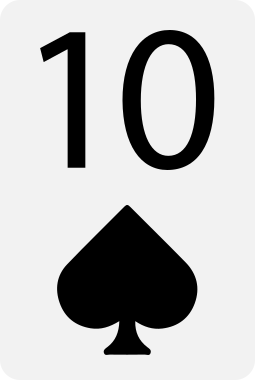
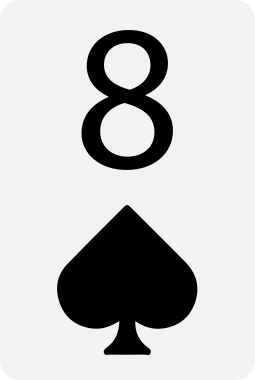
Ten-Eight Suited is a classic suited connector – a hand that trades raw high-card strength for a diverse range of drawing equity. It can make straights, flushes, and straight flushes, and it connects with the board in ways that are genuinely difficult for opponents to read. In the right conditions it is one of the more exciting speculative hands to play.
Before the flop, T8s is not a hand you are looking to build a big pot with. Its strength lies entirely in post-flop potential, and realising that potential requires position, patience, and an ability to fold cleanly when the board does not cooperate.
What These Odds Show for T8s
The first thing that stands out in the draw odds for T8s is the straight equity. At 7.32% by the river, it matches or exceeds most broadway hands despite being a mid-range connector. On the flop, 0.96% of runouts already complete a straight, and this rises to 3.39% by the turn. The hand can connect with a wide variety of board textures – any combination involving nines, sevens, jacks, or queens can create straight opportunities in both directions.
The flush equity is similarly strong. T8s completes a flush 6.43% of the time by the river, and unlike hands built around an ace or king, the flush here will not always be the nut flush. However, what T8s offers that premium suited hands do not is straight flush potential – 0.15% by the river, and 0.02% already on the flop. While rare, straight flushes are the ultimate disguised monster hand.
The high card miss rate of 52.07% on the flop is slightly lower than comparable hands like K8s or A6s, reflecting the ten’s ability to connect with more middle-range boards. The overcard table, however, tells a sobering story – there is a 69.47% chance of an overcard on the flop, rising to 86.87% by the river. With jacks, queens, kings and aces all outranking the ten, unimproved top pair is frequently under pressure and should rarely be the basis for heavy commitment.
Hand Strength Summary
- Hand type: Suited connector, speculative drawing hand
- Relative strength: Middle tier, highly position-dependent
- Dominates: Weaker draws and low unpaired hands on the right boards
- Main vulnerability: High overcard exposure, no strong kicker, draws don’t always complete
T8s wins through board interaction rather than card strength. It is a hand that needs to connect to be dangerous.
How Ten-Eight Suited Wins
- Completing a straight on connected boards and winning large pots against opponents holding top pair or overpairs
- Making a flush and holding up at showdown
- Flopping two pair or trips (21.89% and 4.29% by the river) on coordinated boards
- Taking uncontested pots with well-timed semi-bluffs on draw-heavy flops
- Occasionally making a straight flush – one of the most profitable hands in poker due to its disguised nature
The combination of straight and flush equity means T8s frequently has multiple ways to win on a single flop, even when it has not yet made a hand. A flop of 9♠ 7♠ 2♦ with T8 of spades, for example, gives both an open-ended straight draw and a flush draw simultaneously – a very powerful semi-bluffing position.
Main Weaknesses
- Overcard exposure is severe – 86.87% of rivers will show at least one card higher than a ten
- Top pair with an eight kicker is a weak made hand that is difficult to continue with in contested pots
- Draws only complete a portion of the time – chasing without correct pot odds is costly
- No nut flush potential; the ten-high flush loses to any higher flush, introducing reverse implied odds risk on flush-completing boards
The overcard problem is the defining constraint. T8s needs to be played as a drawing hand on most textures, not as a made hand built around top pair.
Best and Worst Flop Textures
Strong flops
- Connected boards giving open-ended straight draws (e.g. 9♥ 7♦ 2♣, J♠ 9♦ 3♥)
- Suited flops in the matching suit (flush draw with backdoor straight equity)
- Boards where both a flush draw and straight draw are live simultaneously (maximum semi-bluff equity)
Dangerous flops
- High dry boards (A♠ K♦ Q♣) where T8s has no pair, no draw, and no realistic semi-bluff equity
- Boards where the flush completes but an opponent likely holds a higher flush
- Paired boards where straight draw outs are partially cancelled and hand reading becomes difficult
How It Plays by Position
- Early position: A fold in most full-ring games – the hand needs position to realise its equity and is too vulnerable to 3-bets from behind
- Middle position: Borderline; playable in softer games but generally too speculative against tighter ranges
- Late position (button/cutoff): The ideal position – T8s thrives when it can see flops cheaply, control bet sizing, and take free cards on draws
- Blinds: Can be worth defending from the big blind given pot odds, but the out-of-position constraint limits how profitably draws can be played
T8s is more position-sensitive than most hands. The difference between playing it on the button versus under the gun is substantial.
Common Mistakes with Ten-Eight Suited
- Treating top pair as a strong made hand and committing too many chips with a ten or eight on a board full of overcards
- Chasing straight or flush draws without pot odds or implied odds to justify it
- Playing the hand out of position where its drawing equity is difficult to realise efficiently
- Over-bluffing on missed draws without considering opponent tendencies and stack sizes
The most expensive error is continuing with unimproved top pair on boards where the overcard exposure is high and an opponent is representing strength. T8s is a drawing hand first; a made-hand second.
Comparison to Similar Hands
- Stronger than: T7s, 98s (marginally – very similar profiles), T8o (flush and straight flush equity)
- Comparable to: 97s, J9s (similar connector structure, slightly different straight combinations)
- Weaker than: JTs, 98s in some formations (stronger straight combinations or higher card strength)
The natural reference point is JTs, which is widely considered one of the best suited connectors in the game. T8s offers a very similar drawing profile but with a gap that slightly reduces the number of straight combinations available and a weaker high card.
How Ten-Eight Suited Performs in Multiway Pots
Suited connectors like T8s are often cited as hands that benefit from multiway pots, and there is some truth to this – completed draws win larger pots when more players are involved. However, there are important caveats:
- Reverse implied odds increase in multiway pots; a ten-high flush or a non-nut straight can lose to a better hand held by one of several opponents
- Semi-bluffing with draws becomes less effective as more players are in the hand
- Top pair becomes nearly unplayable against multiple opponents given the overcard exposure
T8s is best played multiway when the pot odds to see the flop are excellent and there is a realistic chance of flopping a very strong draw or made hand that is unlikely to be second-best.
FAQ: Ten-Eight Suited
Is Ten-Eight Suited a good hand?
It is a good speculative hand in position, particularly in games where implied odds are high. It is not a hand that wins through raw strength but through post-flop board interaction.
How often does T8s make a straight?
By the river, T8s completes a straight 7.32% of the time – one of the higher straight probabilities for a mid-range suited hand.
What makes T8s better than T8 offsuit?
The suited version adds flush equity (6.43% by the river) and straight flush potential (0.15%), meaningfully increasing the hand’s ability to continue and semi-bluff on suited flops.
Should you open T8s from early position?
In most full-ring games, no. The hand requires position to navigate its drawing equity efficiently, and early position exposes it to 3-bets it cannot comfortably call.
Related Hands