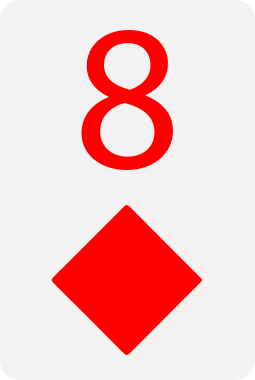
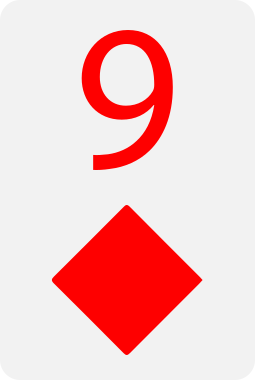
Ten-Eight Offsuit is a one-gap offsuit connector that sits firmly in speculative territory. It has a recognisable straight draw dimension but less connectivity than a one-gap hand centred in the middle of the deck, and no flush equity to fall back on. Like most offsuit gappers of this type, its value is almost entirely conditional on the flop cooperating.
What These Odds Show for T8o
The high card rate of 52.90% on the flop is consistent with most weak offsuit holdings – over half the time, nothing useful happens on the first three community cards. By the river that drops to 17.66%, though reaching the river cheaply with an unimproved T8o is rarely a realistic proposition against any meaningful resistance.
The pair rate of 43.44% by the river is the most common outcome, as it is for most non-premium hands. Pairing the ten gives a middling top pair with a weak kicker, while pairing the eight produces a vulnerable middle or bottom pair. Neither is a strong holding in a contested pot.
The straight draw numbers are where T8o has something to offer, but they tell a nuanced story. The 0.98% flop straight rate is lower than 98o’s 1.31%, reflecting the one-gap nature of the hand – T8o needs a nine and one other connecting card to complete a straight on the flop, whereas 98o has more combinations available in the middle of the deck. By the river, the straight rate reaches 7.80% compared to 9.08% for 98o. That difference matters. The gap between ten and eight means the hand has fewer straight-completing combinations than a pure connector, and the straights it can make tend to require more specific board configurations.
The overcard picture is notably more forgiving than for 98o. There is a 69.47% chance of an overcard appearing on the flop, compared to 79.29% for Nine-Eight. That gap exists because the ten is a higher card – it outranks everything except jacks, queens, kings, and aces, whereas the nine is also outranked by tens. By the river, the overcard rate for T8o reaches 86.87%, still high but a measurable improvement over 98o’s 93.27%. In practical terms, a paired ten has a better chance of holding up than a paired nine.
Hand Strength Summary
- Hand type: Offsuit one-gap connector
- Relative strength: Marginal / speculative
- Potential: Straight draws, top pair with ten, occasional two pair
- Main vulnerability: Weak kicker, limited straight combinations, no flush equity
T8o occupies a similar space to 98o but with a slightly higher top card and slightly reduced straight potential. The trade-off is real – the ten helps in overcard resilience but hurts in straight equity.
How T8o Can Win
The primary route to a pot is completing a straight draw, particularly on boards containing a nine and either a jack or a seven, which give T8o an open-ended draw. Flopping top pair with the ten on a low board is occasionally viable, though the eight kicker is a liability. Two pair – tens and eights – is a strong made hand when it arrives, though at 22.40% by the river it requires patience. As with most late-position speculative hands, stealing blinds in unopened pots is a legitimate use of T8o regardless of its card value.
Main Weaknesses
The one-gap nature of the hand reduces its straight combinations relative to a pure connector. Nine-Eight, Seven-Six, and other connected hands in the same tier all have more ways to make straights than T8o. The offsuit nature eliminates flush equity entirely, leaving the hand with no secondary draw on boards where the straight draw is unavailable. The eight kicker is particularly problematic – pairing the ten with an eight kicker is a holding that loses to any ten with a better kicker, which covers a wide range of hands opponents might play.
Best and Worst Flop Textures
Strong flops:
Boards like 9♣ 7♦ 2♠ give T8o an open-ended straight draw with minimal overcard pressure. A J♥ 9♦ 7♣ flop completes the straight outright. Low boards where the ten is genuinely the top card are also workable, though the eight kicker demands caution.
Dangerous flops:
High-card boards dominated by aces, kings, queens, or jacks leave both hole cards outranked and the straight draw unavailable. Paired boards that do not involve a nine or seven offer nothing. Monotone boards give opponents flush draws that T8o cannot compete with or benefit from.
How It Plays by Position
- Early position: Fold. There is no scenario in which T8o is a sound early-position open against competent opposition.
- Middle position: Still generally a fold, though in very loose passive games the implied odds on straight draws can occasionally justify a limp.
- Late position: The hand’s natural home. An unopened pot on the button or cutoff gives T8o a reasonable steal opportunity, and the postflop potential justifies calling a single small raise with position and deep stacks.
- Blinds: From the big blind, a cheap call against a single raiser is defensible. The ten provides enough top-card equity and the straight draw enough postflop interest to see a flop without significant regret.
Common Mistakes with Ten-Eight Offsuit
Overestimating straight draw frequency is the most common error. The gap between ten and eight means fewer combinations complete a straight compared to connected hands, and players accustomed to suited connector logic sometimes treat T8o as more of a drawing hand than it actually is. Continuing past the flop on boards with no draw and no strong pair is a leak that compounds quickly. The 86.87% river overcard rate is a reminder that unless the ten is genuinely top pair or a draw is present, the hand has little to stand on.
Comparison to Similar Hands
- Stronger than: T7o and lower offsuit gappers, which have even fewer straight combinations and no improvement in top-card strength. Also stronger than weak offsuit holdings like 82o or 93o that share the kicker problem without any straight potential.
- Weaker than: Ten-Eight Suited, which adds flush equity to identical straight draw potential. Also weaker than T9o, which has full one-gap connectivity and one more straight combination available. Nine-Eight Offsuit, counterintuitively, has slightly better straight equity despite the lower top card, because the nine sits more centrally in the deck.
How T8o Performs in Multiway Pots
In multiway pots, the straight draw implied odds improve – completing a ten-high straight against multiple opponents is likely to be well-paid. However, pair equity with either card becomes nearly worthless in a contested multiway pot, and any made straight needs to be evaluated carefully on boards that also offer flush draw possibilities to opponents. The hand performs best in multiway pots when a strong draw is present and worst when it has only a vulnerable pair.
FAQ: Ten-Eight Offsuit
How does T8o compare to T8s?
The suited version is meaningfully stronger. T8s adds flush draw equity across a wide range of boards, giving it a secondary route to strong hands that T8o entirely lacks. Where T8s might have both a straight draw and a flush draw on a given board, T8o has only the straight draw.
Is the ten a meaningful advantage over 98o?
In terms of overcard resilience, yes. The 69.47% flop overcard rate for T8o versus 79.29% for 98o is a genuine difference – a paired ten is a stronger holding than a paired nine. The trade-off is lower straight equity, which is the more important factor for a speculative hand.
When should T8o ever be played?
In late position in an unopened pot, or from the big blind against a single small raise with favourable implied odds. Outside of those conditions, folding is the default.
What straight combinations does T8o have?
The hand can make straights using the ten, eight, and combinations including sevens, nines, jacks, and queens in various arrangements. The most common open-ended draws come on boards containing a nine and a jack, or a seven and a nine.
Related Hands