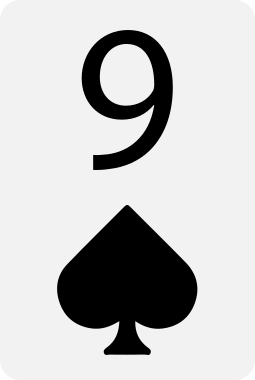
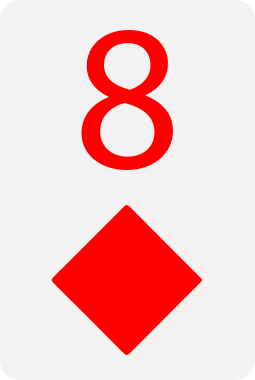
Nine-Eight Offsuit is a speculative hand sitting in an interesting middle ground. It carries genuine straight draw potential thanks to its single-gap connectivity, but lacks the flush equity that its suited counterpart enjoys and is routinely outranked by the cards that land on the board. It is not a hand to play for its raw strength – it is a hand to play for its ability to make the nuts on the right board.
What These Odds Show for 98o
The high card rate on the flop of 52.57% tells a familiar story for unimproved offsuit hands – more than half the time, the board does not connect in any meaningful way. That figure falls to 17.24% by the river as the hand accumulates equity through additional streets, but by that point the pot is often too expensive to reach cheaply.
The pair rate settles at 42.73% by the river, which is consistent with most non-premium holdings. The problem for 98o, as with many mid-range hands, is that pairing either the nine or the eight puts you in marginal territory – a mid-pair with a middling kicker, vulnerable to overcards and better two-pair combinations.
Where 98o genuinely earns its place is the straight column. A 1.31% chance of flopping a straight is modest but real, and that grows to 9.08% by the river. For context, that is a meaningfully higher straight rate than disconnected hands or weak kicker combinations. Nine-Eight has four cards that can complete an open-ended straight draw on the right flop – fives, sixes, sevens, and tens all work in various combinations – and that connectivity is the hand’s primary selling point.
The overcard picture is stark, however. There is a 79.29% chance of an overcard appearing on the flop, climbing to 93.27% by the river. That means in the vast majority of runouts, at least one card on the board will rank above both the nine and eight, putting any pair made with either card under immediate pressure.
Hand Strength Summary
- Hand type: Offsuit one-gap connector
- Relative strength: Marginal / speculative
- Potential: Straight draws, occasional two pair
- Main vulnerability: Overcards, dominated pairs, no flush equity
98o is a hand whose value is almost entirely dependent on flop texture. On the right board it can be a powerful drawing hand or even a flopped straight. On most boards it is an underdog with limited recourse.
How 98o Can Win
The cleanest paths to winning with Nine-Eight Offsuit are flopping a straight or a strong straight draw and getting there by the river. A flopped two pair – nine and eight – is also a legitimate made hand, though it can be outdrawn. Stealing the blinds in late position is a viable play when the pot is unopened, since the hand has enough postflop potential to justify the occasional continuation. Winning unimproved at showdown is rarely on the menu given the overcard exposure.
Main Weaknesses
The absence of flush equity is the defining difference between 98o and its suited counterpart. Nine-Eight Suited adds a flush draw dimension that provides extra outs on a wide range of boards. Offsuit, the hand is entirely dependent on pair and straight equity. On top of that, the 79.29% flop overcard rate means pairing the nine or eight almost always leaves a vulnerable top card, and the kickers on both cards are mediocre in isolation. Multiway pots amplify all of these issues.
Best and Worst Flop Textures
Strong flops:
Boards like 7♦ 6♣ 2♠ or T♥ 7♦ 6♣ where the hand either flops a straight or picks up an open-ended straight draw with little overcard pressure. Low, disconnected boards that happen to include cards the nine and eight can work with.
Dangerous flops:
High-card boards (A-K-x, K-Q-x, Q-J-x) where both hole cards are immediately outranked. Monotone boards, where flush draws are possible for opponents and 98o has no piece of them. Boards that pair a middle card without giving a draw, leaving a vulnerable pair with no clean outs.
How It Plays by Position
- Early position: Generally a fold. The hand needs to navigate the flop well, and doing that out of position against multiple players is difficult.
- Middle position: Marginal. In a loose game with implied odds, it can be viable, but it is not a standard open from middle position.
- Late position: This is where 98o has its best case. Stealing an unopened pot on the button or cutoff, or calling a single raise with position and implied odds, are the scenarios where the hand finds value.
- Blinds: From the big blind, worth a call against a single raiser if the price is reasonable. The straight potential provides enough postflop playability to justify seeing a flop cheaply.
Common Mistakes with Nine-Eight Offsuit
The most common error is treating 98o like a suited connector and calling raises it does not warrant. Without flush equity, the hand’s overall equity is meaningfully lower, and it needs board-specific conditions to realise its potential. Over-continuing on high-card boards – where both cards are outranked and the straight draw is dead – is another frequent leak. The 93.27% river overcard rate is a useful reminder that the hand operates under overcard pressure almost constantly.
Comparison to Similar Hands
- Stronger than: 97o, 86o, and lower offsuit connectors with fewer straight combinations. Also stronger than any offsuit hand with a weak kicker that lacks connectivity.
- Weaker than: Nine-Eight Suited, which adds flush equity on top of identical straight draw potential. Also weaker than T9o and T8o, which have a higher top card and better overcard resilience.
The gap between 98s and 98o is more significant than it might appear. The suited version can draw to flushes on boards where the straight draw is compromised, giving it a secondary equity source that the offsuit version simply does not have.
How 98o Performs in Multiway Pots
In multiway pots, 98o’s straight potential becomes more attractive in terms of implied odds – if you complete the straight, you are more likely to get paid. However, the hand’s pair equity becomes nearly worthless against multiple opponents, since mid-pair with a middling kicker loses value quickly as the field widens. Discipline about when to continue and when to let go is essential.
FAQ: Nine-Eight Offsuit
Is 98o worth playing at all?
In position, with the right implied odds and against the right opponents, yes. It is not a hand to build a pot with preflop, but it can be a profitable speculative holding in the right circumstances.
How much does being offsuit hurt 98?
Significantly. The flush equity in 98s is a consistent secondary draw that adds several percentage points of equity across a wide range of boards. Without it, 98o is relying almost entirely on pair and straight outs.
What is the best case scenario with 98o?
Flopping an open-ended straight draw on a low board, ideally in position with multiple players in the pot providing implied odds. Or flopping the straight outright – which happens rarely but is the hand’s highest-value outcome.
Does the straight draw justify limping into pots?
Limping invites multiway action, which can be fine for implied odds but harmful for pair equity. A disciplined approach is usually to either fold or raise with a plan, rather than limp and hope.
Related Hands