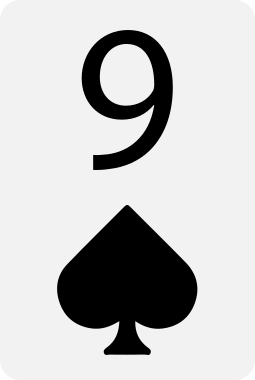
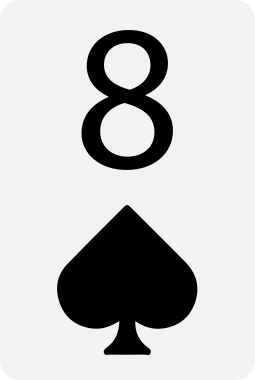
Nine-Eight Suited is one of the most well-rounded suited connectors in Texas Hold’em. It sits in the sweet spot of the connector range – high enough to make strong straights involving broadway cards, low enough to connect with middle-board textures that miss opponent ranges entirely. Combined with flush equity and genuine straight flush potential, it is a hand that experienced players consistently include in their opening ranges.
Before the flop, 98s is purely a speculative hand. It has no ambitions of winning without board interaction, but when it connects, it does so in ways that are powerful, varied, and frequently disguised.
What These Odds Show for 98s
The straight equity is the standout figure. At 8.53% by the river, 98s has one of the highest straight probabilities of any starting hand in the game. On the flop, 1.29% of runouts already complete a straight, rising to 4.20% by the turn. The hand connects on both ends – straights can be made with five, six and seven on the low side, or with ten, jack and queen on the high side, giving it an unusually wide range of straight-completing boards.
The flush equity of 6.38% by the river sits comfortably in line with other suited hands. The straight flush probability of 0.20% by the river is notably higher than less connected suited hands – reflecting the fact that 98s has genuine two-way connectivity that creates overlapping straight and flush draws on the right boards. When a straight flush does arrive, it is almost always the product of a well-disguised combination draw that opponents had little chance of reading.
The high card miss rate drops to 51.75% on the flop and 15.94% by the river – slightly better than higher-gap suited hands, confirming that 98s connects with the board more frequently. The overcard table, however, is a stark reminder of the hand’s limitations as a made-hand. There is a 79.29% chance of an overcard on the flop, rising to 93.27% by the river. With jacks, queens, kings and aces all outranking the nine, top pair is rarely a hand to build a large pot around.
Hand Strength Summary
- Hand type: Suited connector, premium speculative hand
- Relative strength: Upper-middle tier among speculative hands
- Dominates: Weaker draws and low unpaired hands on connected boards
- Main vulnerability: High overcard exposure, non-nut flush, draws that miss
98s is one of the strongest suited connectors available, but its value is almost entirely post-flop and position-dependent.
How Nine-Eight Suited Wins
- Completing a straight on connected boards – with 8.53% river equity and wide board coverage, this is the primary high-value outcome
- Making a flush and winning at showdown
- Flopping combination draws (open-ended straight draw plus flush draw simultaneously) and semi-bluffing aggressively with massive equity
- Building two pair or trips by the river (21.77% and 4.26% respectively) on boards where both hole cards connect
- Occasionally making a straight flush – one of poker’s most profitable hands given how effectively it hides its strength
The combination draw is where 98s truly shines. A flop of 7♠ T♠ 2♦ with 9♠ 8♠ in hand produces both an open-ended straight draw and a flush draw – roughly 54% equity against a single opponent holding top pair. That kind of flop transforms a speculative hand into a semi-bluffing powerhouse.
Main Weaknesses
- Overcard exposure reaches 93.27% by the river – top pair with a nine is almost never safe in a contested pot
- The eight kicker compounds the problem – even pairing both cards produces holdings that are difficult to continue with under pressure
- Non-nut flush potential introduces reverse implied odds on flush-completing boards
- Draws miss the majority of the time – discipline is required to fold when equity does not materialise
The overcard problem is more severe than for T8s or J9s. With four ranks above the nine, 98s will almost always be playing as a drawing hand rather than a made-hand, and must be approached accordingly.
Best and Worst Flop Textures
Strong flops
- Connected middle boards giving open-ended straight draws (e.g. T♥ 7♦ 2♣, J♠ 6♦ 3♥)
- Suited flops in the matching suit with straight draw potential (combination draw – maximum equity)
- Low boards where 98s has top pair or an overpair to the board with draw equity behind it
Dangerous flops
- High dry boards (A♠ K♦ Q♣) where 98s has no pair, no realistic draw, and no semi-bluff equity
- Flush-completing boards where an opponent likely holds a higher flush
- Paired high boards where straight draw potential is reduced and the hand has little to work with
How It Plays by Position
- Early position: A fold in most full-ring games – the post-flop complexity and overcard exposure make it difficult to navigate without the protection of position
- Middle position: Borderline in full-ring; increasingly viable in six-max formats where ranges are wider
- Late position (button/cutoff): The ideal spot – 98s thrives with position, cheap flops, and the ability to take free cards or fold cleanly on missed draws
- Blinds: A solid defend from the big blind given pot odds and the hand’s board coverage; the out-of-position constraint limits draw realisation but the equity justifies calling in many spots
98s is among the most position-sensitive hands in the game. On the button it is a consistently profitable open; under the gun in a full ring it is a clear fold.
Common Mistakes with Nine-Eight Suited
- Continuing with top pair of nines or eights on boards with multiple overcards – the overcard exposure of 93.27% by the river makes this almost always a losing play
- Calling raises and 3-bets without the implied odds or position to justify the speculative nature of the hand
- Over-bluffing missed draws in spots where opponents are unlikely to fold
- Underestimating reverse implied odds on flush-completing boards when holding a nine-high flush
The defining error is treating 98s as a made-hand. It is not. It is a drawing hand that occasionally makes top pair as a secondary benefit, and should be played exclusively as such in most post-flop spots.
Comparison to Similar Hands
- Stronger than: 97s, 86s (one-gappers with reduced straight combinations), 98o (loses flush and straight flush equity)
- Comparable to: T8s, J9s (similar connector profiles with slightly different straight combinations and high-card strength)
- Weaker than: JTs (the strongest suited connector – higher cards give better straight combinations and more top-pair value), T9s (marginally stronger high card)
98s and JTs are the two benchmarks of the suited connector range. JTs is the premium version, but 98s is a close second – it hits more middle-board textures that miss typical opening ranges, which gives it genuine deceptive value that JTs sometimes lacks.
How Nine-Eight Suited Performs in Multiway Pots
98s has a more complex multiway dynamic than premium hands:
- Completed straights and flushes win larger pots in multiway scenarios, improving implied odds significantly
- Combination draws retain strong equity even against multiple opponents – 15 outs with an open-ended straight draw and flush draw is competitive against several players
- Non-nut flushes carry meaningful reverse implied odds risk when multiple opponents are in the hand
- Top pair becomes completely unplayable in multiway pots given the 93.27% river overcard exposure
In multiway pots, 98s should be played exclusively as a drawing hand. The implied odds when draws complete are the best argument for seeing cheap flops with multiple opponents involved.
FAQ: Nine-Eight Suited
Is Nine-Eight Suited a strong hand?
It is one of the stronger speculative hands in Texas Hold’em. Its straight equity of 8.53% by the river is among the highest for any starting hand, and its combination draw potential makes it a powerful semi-bluffing tool in the right spots.
How does 98s compare to JTs?
JTs is generally considered the superior suited connector due to its higher cards and stronger straight combinations. However, 98s connects with middle-board textures that JTs misses, giving it unique value in certain game contexts.
How often does 98s make a straight flush?
By the river, 98s makes a straight flush 0.20% of the time – higher than most suited hands due to its two-way straight connectivity.
Should you open 98s from early position?
In most full-ring games, no. The hand is too reliant on post-flop position to justify an early open, and it is vulnerable to 3-bets from stronger hands behind.
Related Hands