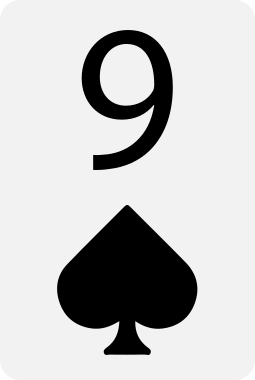
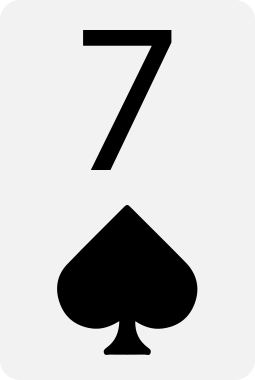
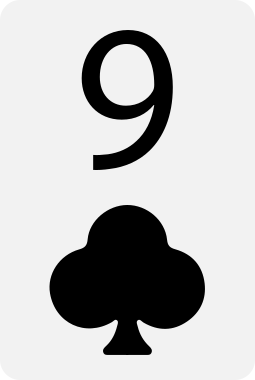
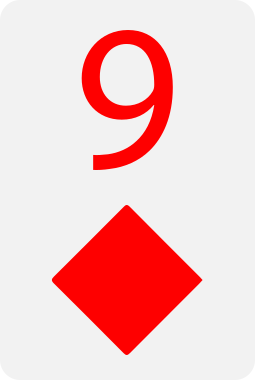
Nine Seven Suited is one of the more complete speculative hands in Texas Hold’em. It is not a premium hand by any measure, but it combines three distinct sources of equity — straight draws, flush draws, and pair potential — in a way that few hands at this rank can match. When the board cooperates, 97s can produce powerful disguised holdings that are extremely difficult for opponents to read accurately.
It is a hand built for post-flop play, and it rewards players who understand board texture and implied odds.
What These Odds Show for 97s
The draw odds reflect a hand with genuine multi-directional potential. On the flop, 97s has high card as its best holding 52.07% of the time, which is broadly in line with other unpaired hands. That figure falls to 16.37% by the river — one of the lower high card river figures for hands in this category, suggesting the hand connects with the board relatively often across all runouts.
The straight odds are the headline figure for this hand. At 0.96% on the flop, rising to 7.27% by the river, 97s sits among the most straight-capable hands in the deck. The Nine-Seven combination creates natural draws in multiple directions — a board of 8-6, 8-10, 6-8-10, or T-J all give 97s strong straight draw equity. Many of these draws are open-ended, giving eight outs to complete, and some board textures produce wrap-around draws with even more.
The flush odds add a further 6.43% by the river, and critically, 97s is one of the few hands where the straight flush odds become worth noting — 0.15% by the river, the highest of any hand seen so far in this series. That figure is small in absolute terms but reflects the genuine connectivity of the hand across both dimensions simultaneously.
The overcard table shows 79.29% on the flop, rising to 93.27% by the river. This is meaningfully lower than small pocket pairs but still high, reflecting the fact that Nines and Sevens are mid-range cards. Any Ten through Ace on the board is an overcard to the Seven, and any card above a Nine threatens the top pair value of the Nine itself. Pair equity with this hand requires care, but unlike small pairs, 97s is not entirely reliant on one specific improvement — the draws provide alternative routes to winning.
Hand Strength Summary
- Hand type: Suited connector — mid-range
- Relative strength: Strong speculative hand with multiple equity sources; best in position with implied odds
- Strengths: Straight draw potential, flush draw potential, straight flush possibility, disguised when hitting
- Main vulnerability: No high card strength, vulnerable to domination when pairing, overcards present in most runouts
How Nine Seven Suited Wins
97s has more winning paths than most hands in its tier:
- Completing a straight, often in a disguised way that opponents cannot read against a Nine or Seven on the board
- Completing a flush with Nine-high or better
- Flopping a straight flush draw and either semi-bluffing profitably or completing the draw
- Making two pair or a set in situations where implied odds produce a large pot
- Taking down pots with semi-bluffs when holding open-ended straight draws or flush draws that give significant fold equity
The hand’s greatest strength is how rarely opponents can put it on a strong holding — a completed straight or flush with 97s is frequently paid off in full.
Main Weaknesses
- No inherent high card strength — 97s relies on improving to win at showdown against most hands
- Pairing the Nine or Seven is often a vulnerable holding, particularly in multiway pots where overcards are likely
- The 93.27% overcard rate by the river means pair-based holdings with this hand are regularly outranked by board cards opponents may have connected with
- Draws do not always complete, and chasing too aggressively without the right pot odds is a common leak with suited connectors
Best and Worst Flop Textures
Strong flops
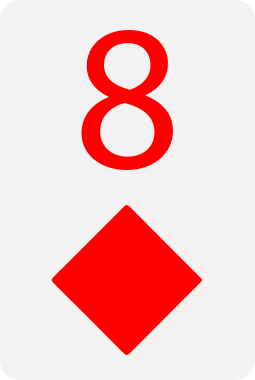
- 6♠ 8♦ x — open-ended straight draw with multiple completion cards
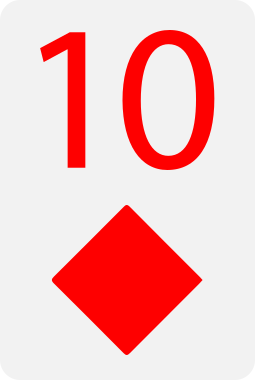
- 8♠ T♠ x — straight draw combined with flush draw potential on a connected board
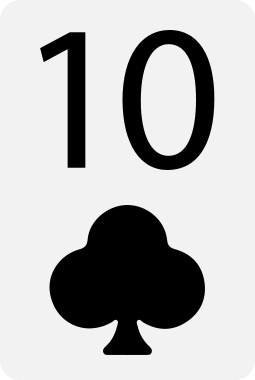
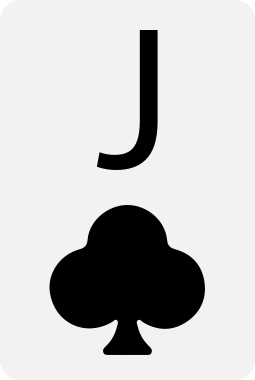
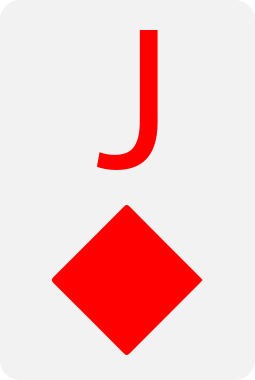
- T♣ J♣ x — gutshot or open-ended draw with flush draw equity in the same suit
- Any two-card flush board in your suit with a connected middle card
Dangerous flops
- Ace or King high dry boards where the hand has no draw equity and no pair value
- Monotone boards in a different suit where opponents hold the flush draw and 97s is left with straight draws only
- Boards that pair a high card where continuation becomes expensive without meaningful equity
How It Plays by Position
- Early position: Generally a fold — suited connectors need position and implied odds to realise their equity profitably, and both are harder to guarantee from early spots
- Middle position: Marginal open in later middle positions in looser games; more commonly played as a call against an open
- Late position / Button: The natural home for this hand — maximum fold equity on semi-bluffs, maximum implied odds when draws complete, and full control of pot size post-flop
- Blinds: A reasonable defend from the big blind given the hand’s multi-directional equity, but out-of-position play with 97s is more difficult and requires precise decision-making
Common Mistakes with Nine Seven Suited
- Chasing draws without the correct pot odds or implied odds to justify the call
- Overvaluing a single pair on an overcard-heavy board where the hand has not improved meaningfully
- Playing the hand too passively when holding a strong draw — semi-bluffing is often more profitable than calling and hoping
- Underestimating the hand’s value and folding in spots where the draw equity and implied odds justify continued investment
Comparison to Similar Hands
- Stronger than: 97o by a meaningful margin — the suited nature adds flush draw equity and straight flush potential that transforms the hand’s ceiling
- Weaker than: T8s, 86s in some respects due to those hands’ ability to produce nut-straight combinations more frequently; JTs and higher suited connectors have more high card strength alongside the drawing potential
- Among mid-suited connectors, 97s is one of the stronger examples — the Nine provides reasonable top pair value on mid-range boards and the Seven creates draws in both directions
- 97s compares favourably to hands like K6s because it trades high card dominance for drawing equity and deception
How Nine Seven Suited Performs in Multiway Pots
Suited connectors like 97s are among the better hands in multiway pots relative to their preflop ranking. The implied odds when completing a straight or flush are maximised with more players in the pot, and the disguised nature of the hand means opponents are unlikely to correctly assess its strength when it arrives. The risk is that more players also means more chances of being outdrawn even on made hands — a completed straight on a flush board in a five-way pot is a far more dangerous holding than it appears. Managing that risk through bet sizing and board awareness is central to playing 97s well in multiway situations.
FAQ: Nine Seven Suited
Is Nine Seven Suited a strong hand?
It is a strong speculative hand with genuine multi-directional equity. It is not a premium hand and should not be played as one, but in the right conditions — position, implied odds, and the right opponents — it is one of the more dangerous hands in the mid-range tier.
What makes 97s different from other suited connectors?
Its combination of straight draw potential in multiple directions and flush draw equity gives it one of the higher straight flush probabilities in the deck at 0.15% by the river. The hand also produces open-ended straight draws on a wide variety of board textures, making it unusually flexible.
Why do overcards matter less for 97s than for small pairs?
Because 97s does not rely solely on its pair value to win. The straight and flush draw potential provide alternative routes to the best hand that are unaffected by overcards on the board, unlike a small pair which is simply beaten when any overcard arrives and connects with an opponent.
When should you fold Nine Seven Suited?
When the pot odds do not justify continuing a draw, when the board has produced no useful equity and a pot-sized bet is facing you, or when position and stack depth make realising the hand’s equity impractical. The hand requires conditions to thrive — in the wrong spot, folding early is the correct play.
Related Hands