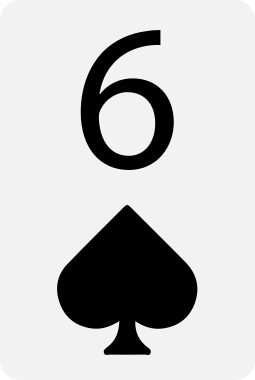
Eight-Six Suited is a speculative drawing hand that sits in the middle of the suited connector family. It is not a hand you play for its raw high-card strength – it has none worth speaking of – but for its ability to make disguised straights, flushes, and combination draws that can win big pots when they connect.
At 86s, you are holding two mid-range cards with one gap between them, giving you strong straight potential in both directions. Combined with the flush draw that comes with being suited, this hand has genuine multiway value and is a favourite among players who thrive in post-flop situations.
What These Odds Show for 86s
The draw odds table tells the story of a hand that starts behind and draws into its value. On the flop, 86s still has a high card as its best hand over half the time – 52.07% – which underlines how dependent it is on board texture. The flip side is that when the board does connect, it tends to connect well.
The straight odds are particularly notable. From nothing preflop, 86s reaches a 7.27% chance of making a straight by the river, and the 0.96% on the flop represents flopped straights – rare but meaningful given the hand’s connectivity. Flush equity follows a similar path, reaching 6.43% by the river.
The overcard table is essentially a constant here. At 86.73% on the flop, 93.51% by the turn, and 96.90% by the river, overcards are almost always present. This is expected for a mid-range hand and reinforces why 86s does not rely on top pair – its winning hands are straights, flushes, and two pair made from connected board cards, not high-card dominance.
Hand Strength Summary
- Hand type: Suited connector (one-gap)
- Relative strength: Speculative, lower tier of playable hands
- Main draws: Straights, flushes, straight flush combinations
- Main vulnerability: High-card strength is minimal; heavily board-dependent
How 86s Wins
- Completing a flush draw
- Making an open-ended or gutshot straight
- Flopping two pair with both hole cards
- Combination draws that apply significant pressure even before completion
- Disguised straights that opponents do not see coming
Because of its concealment, 86s can win very large pots when it hits. Opponents holding top pair or an overpair rarely put you on a straight when the board runs out connected.
Main Weaknesses
- Almost always dominated by high cards before the flop
- Relies entirely on the board to connect
- Vulnerable to being out-flushed by higher suited hands
- Frequently faces overcards on every street, as the odds confirm
- Straight draws can be counterfeited when opponents hold the same connecting cards
Best and Worst Flop Textures
Strong flops
- Connected mid-range boards that give open-ended straight draws (7♣ 5♦ 2♠ or 9♥ 7♦ 4♣)
- Two-tone or monotone boards in your suit for flush draws
- Boards where both hole cards pair (8♦ 6♣ K♥ gives two pair immediately)
Dangerous flops
- High dry boards (A♣ K♦ J♣) – no draw equity and no pair
- Boards that complete straights for higher connectors
- Monotone flops in a suit you do not hold
How It Plays by Position
- Early position: Generally too speculative to open; best folded in tight games
- Middle position: Borderline open in looser games; better as a call behind a limper
- Late position / button: Strong steal candidate and an excellent hand to see cheap flops with
- Blinds: Reasonable defend from the big blind given the implied odds against a single raiser
Position is everything with 86s. Its value multiplies dramatically when you can see what opponents do before you act post-flop.
Common Mistakes
- Overvaluing the hand preflop and calling large raises out of position
- Chasing draws without the correct pot odds or implied odds
- Continuing on flops where neither card connects and no draw exists
- Failing to fold on the turn when a draw misses and the pot is already large
- Playing it like a pair hand rather than a drawing hand
Comparison to Similar Hands
- Stronger than: 86o (significantly – the flush draw adds substantial equity), 75s (slightly better high-card ceiling)
- Weaker than: 98s, 76s (better connectivity), T9s (stronger high cards)
- Similar in character to: Other one-gap suited connectors but slightly harder to play than zero-gap equivalents due to the reduced straight combinations
How 86s Performs in Multiway Pots
Unlike premium pairs, 86s actually improves in multiway pots in certain respects. More players mean larger pots when you do connect, and your implied odds increase substantially. The downside is that flush draws become riskier – someone else may be drawing to a higher flush – and straight draws can be split or counterfeited.
In general, 86s prefers multiway pots where the price to see the flop is cheap, but it prefers heads-up situations on later streets once a strong draw or made hand is in play.
FAQ: Eight-Six Suited
Is 86s a profitable hand to play?
It can be, but only in the right conditions. It needs position, reasonable pot odds, and opponents whose stacks justify the implied odds when it hits.
Should you raise with 86s preflop?
In late position or as a steal from the cutoff or button, yes. From early position, it is generally not strong enough to build a pot.
How often does 86s make a straight or flush by the river?
The draw odds show a 7.27% chance of a straight and a 6.43% chance of a flush by the river. Combined with straight flush possibilities (0.15%), the hand completes a premium draw roughly one time in seven by the river when starting from scratch.
Why does 86s play better in position?
Because its value is almost entirely post-flop. In position you can see how opponents react to the board before deciding whether to continue a draw, take a free card, or fold cheaply when the flop misses entirely.
Related Hands