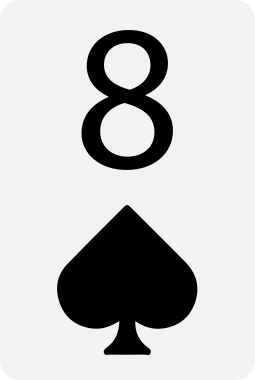
Eight-Six offsuit is a classic low connector with a one-gap structure that sits just outside the range most players consider for regular play. It has no high-card strength to fall back on, no flush potential, and both cards sit in a range where overcards dominate almost every board it sees. What it does have – and the only real reason to give it any attention – is straight potential. Understanding exactly how much that is worth, and when, is what separates disciplined play from spewy chip-bleeding with this hand.
What These Odds Show for 86o
The headline number for 86o is the overcard rate. At 86.73% on the flop, rising to 93.51% by the turn and 96.90% by the river, this hand plays in overcard territory on virtually every board it sees. By the river, fewer than one in twenty runouts will contain no card higher than an eight. That is not a small problem – it is the defining feature of playing this hand, and it means that a pair of eights or sixes rarely holds up without improvement.
The high card rate on the flop is 52.90%, similar to other offsuit hands in this range. By the river it falls to 17.71%, but as with K6o and T7o, the improvement story is more complicated than those numbers suggest. A pair here – arriving at 43.44% by the river – is almost always vulnerable given the overcard exposure.
Where 86o distinguishes itself from K6o is in the straight column. The straight rate on the flop is 0.98%, already ahead of many offsuit hands, and it climbs to 3.52% by the turn and 7.75% by the river. That 7.75% is the highest straight rate of the three hands covered so far, and it reflects 86o’s genuine connectivity. The hand can make straights running five through nine, six through ten, seven through jack, and four through eight – four distinct straight combinations, which is a meaningful structural advantage for a hand with no other path to a strong made hand.
Two pair arrives 22.40% of the time by the river, in line with other offsuit hands in this range, and three of a kind at 4.37%.
Hand Strength Summary
- Hand type: Low offsuit one-gap connector
- Relative strength: Below average – drawing hand only
- Best case: Open-ended straight draw on a coordinated low board
- Main vulnerability: Overcard pressure on nearly every board, no flush equity, weak made hands
86o is purely a drawing hand. When it does not connect with a straight draw or better, there is almost no scenario where continuing for significant money makes sense.
How Eight-Six Offsuit Wins
86o wins almost exclusively through hitting its straight or making a well-disguised two pair. Its routes to winning a pot are narrow but occasionally powerful:
- Completing a straight, particularly one that is not obvious to opponents on a busy board
- Flopping two pair on a low board (e.g. 8-6-x) where opponents with overcards are drawing
- Semi-bluffing with an open-ended straight draw and either getting there or taking the pot with fold equity
- Stealing uncontested pots preflop from late position where the hand’s equity, while modest, is sufficient
The hand has very little passive showdown value. If 86o is winning at showdown in a multi-street pot, it has almost certainly made a straight or two pair at minimum.
Main Weaknesses
The overcard problem is acute and unavoidable. A 96.90% chance of at least one overcard by the river means 86o is playing from behind on nearly every board against anyone with a reasonable starting hand. Specific structural weaknesses include:
- Both cards sit below the median hand rank, leaving no fallback high-card value
- Offsuit, so flush draws are not available – the 1.95% flush rate by the river belongs to the board
- A one-gap structure means the straight draw range is slightly narrower than a true connector like 8-7 or 7-6, where both ends are open more often
- Pairing either card produces a low, vulnerable pair with minimal kicker strength
- In multiway pots, straight outs are frequently shared or counterfeited by opponents holding parts of the same draw
Best and Worst Flop Textures
Strong flops
- 5-7 or 7-9 boards giving an open-ended straight draw – the hand’s primary objective
- 4-7 boards creating a double-belly-buster in the right configuration
- Low boards where 8-6 makes two pair and faces limited competition
- Dry, uncontested low boards where a pair of eights has a realistic chance of being best
Dangerous flops
- Any board with two or more cards above an eight – which, given the 86.73% overcard rate, is most of them
- Ace or king-high boards where the hand has no pair equity and no straight draw of note
- Boards with flush draws in play where opponents have equity 86o completely lacks
- High coordinated boards where the straight outs do not connect with this hand’s range
How It Plays by Position
- Early position: A fold in virtually all standard circumstances. The hand needs too much help from the board to justify entering a pot with players left to act.
- Middle position: Remains a fold at a full ring table. At a short-handed table or in a very loose passive game, it becomes a marginal limp candidate.
- Late position: The hand’s natural habitat. From the cutoff or button in an unopened pot, 86o can be played as a steal or a speculative hand looking to see a cheap flop. The straight potential justifies a single raise in the right conditions.
- Blinds: In the big blind with pot odds against a single raise, 86o is a reasonable defend given its straight connectivity. From the small blind it is more marginal, particularly out of position against an aggressive opponent.
Common Mistakes with Eight-Six Offsuit
The straight potential is real but frequently overvalued by players who forget it only materialises 7.75% of the time by the river. Common errors include:
- Calling raises from early or middle position where the implied odds do not justify the investment
- Continuing on the flop with nothing but a pair of sixes or eights against significant resistance
- Overplaying a gutshot straight draw that only has four outs rather than an open-ended draw with eight
- Failing to account for how visible the straight is – on a 5-7-9 board, experienced opponents will often give credit for exactly this hand, reducing its deception value
- Bluffing too frequently with the hand when it completely misses, burning chips on boards where nothing in the hand connects
Comparison to Similar Hands
- Stronger than: 8-5o and 8-4o, which have worse straight connectivity; 6-4o, which sits even lower in the range with similar structural issues
- Weaker than: 8-6 suited, which adds flush equity and makes this a notably more playable hand; 8-7o, which has better connectivity with no gap; 9-7o, which has a higher top card
- Similar to: 7-5 offsuit – comparable structure, similar straight potential, similar overcard exposure
The gap between 86o and 86s is significant in practice. The suited version introduces flush draw equity that gives the hand a second avenue to a strong made hand, transforms its playability on wet boards, and adds fold equity on bluffs in a way the offsuit version simply cannot replicate.
How Eight-Six Offsuit Performs in Multiway Pots
86o’s performance in multiway pots is a mixed picture. On one hand, its disguised straight potential gains implied value when multiple opponents are in the hand – if you complete a straight that opponents do not see coming, you can win a large pot. On the other hand:
- The near-certain overcard exposure means pair hands have almost no value multiway
- Straight outs are frequently shared in multiway pots involving players with connectors or suited cards
- The lack of flush equity means opponents drawing to flushes have clean outs against you even when you are ahead
- Any two pair or set made by opponents often has 86o drawing thin or dead
The ideal scenario for 86o in a multiway pot is a cheap flop, a strong draw, and a board that allows a well-sized bet to clear out the field before the draw gets there.
FAQ: Eight-Six Offsuit
How does 86o compare to suited connectors?
Significantly weaker. Suited connectors in this range add flush equity that nearly doubles the hand’s path to a strong hand. 86o is dependent entirely on the straight.
Is the straight potential enough to justify playing this hand regularly?
Only in position, at a low cost. A 7.75% completion rate by the river means you miss the straight more than nine times out of ten. The implied odds need to be substantial to make regular play profitable.
When does 86o play well?
In late position against passive opponents who will pay off a completed straight. In limped pots where you see a cheap flop and hit a draw. Almost never in a raised pot out of position.
Does the one-gap matter much compared to a true connector?
Yes. A true connector like 8-7 or 7-6 has slightly better straight connectivity because both ends of the draw are open more often. The one-gap in 8-6 means some draw configurations are gutshots rather than open-enders, reducing the out count significantly.
Related Hands