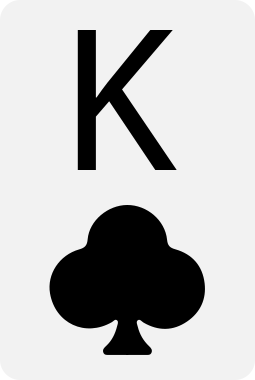
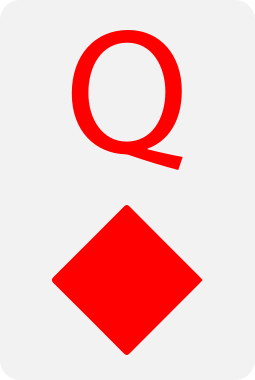
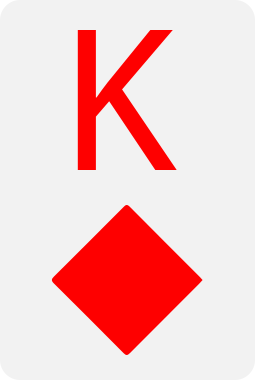
King-Six offsuit is a weak king. It carries the prestige of the highest unpaired card in the deck but pairs it with a kicker so poor that flopping top pair often creates more problems than it solves. K6o sits in the category of hands that feel playable because of the king but perform like a trash hand in most situations – and understanding why is the key to playing it correctly.
What These Odds Show for K6o
The draw odds for K6o paint a familiar picture for unpaired offsuit hands. On the flop, 53.88% of runouts leave you with high card only, and that number only falls to 19.53% by the river. The pair rate peaks at 48.00% by the turn before settling at 45.86% by the river – a rate that looks decent until you account for how often that pair is a vulnerable king with a six kicker, or a pair of sixes that has no realistic claim to the best hand.
Two pair arrives by the river 22.79% of the time, and that is the hand’s best realistic destination in a contested pot. Three of a kind comes in at 4.45% by the river, and a full house at 2.22%. These are achievable but uncommon outcomes.
The straight odds are where K6o shows its structural limitations most clearly. With a gap of seven between king and six, the hand produces almost no straight connectivity. The straight rate is 0.00% on the flop, 0.77% by the turn, and only 3.05% by the river. Compare that to T7o’s 6.46% and the difference illustrates just how much straight potential is sacrificed by holding a king with a low disconnected kicker. The flush rate by the river sits at 1.96%, which is the board flushing, not this hand – K6o is offsuit.
The overcard table tells a very different story to most hands at this level. With a king as the top card, there is only one rank that can appear as an overcard on the board, and that is the ace. As a result, the overcard odds on the flop are just 22.55%, rising to 29.14% by the turn and 35.30% by the river. These are identical to the figures for Pocket Kings, which makes sense – both hands share the same overcard exposure to aces. This is one of the few genuine structural advantages K6o has: when no ace appears, your king is the highest card on the board.
Hand Strength Summary
- Hand type: Weak offsuit king
- Relative strength: Below average – playable only in specific circumstances
- Best case: King-high board with no ace, heads-up, late position
- Main vulnerability: Dominated by any other king, no straight potential, poor kicker
K6o is not a hand you build a pot with. When it performs, it is usually because the board ran out well by coincidence, not because the hand had structural advantages going in.
How King-Six Offsuit Wins
K6o wins through a narrow set of routes:
- Flopping top pair on a king-high board with no ace and getting to showdown before the kicker is tested
- Making two pair on a coordinated king-six board – a rare but decisive outcome
- Winning uncontested pots with a preflop or flop steal attempt
- Having king-high hold up on a board where no opponent pairs
The hand almost never wins a big pot through legitimate hand strength. Its most common winning scenario is a small pot where opponents fold or a king-high board discourages action.
Main Weaknesses
The six kicker is the defining problem. If you flop a pair of kings, you are outkicked by any opponent holding K7 through KA – which covers an enormous range of hands that players routinely open and call with. In practice, flopping top pair with K6o often puts you in a position where you cannot comfortably call three streets without risking significant chips on a hand that loses to most of the range that would put money in.
Beyond the kicker issue, K6o suffers from:
- No straight potential worth considering, at just 3.05% by the river
- No flush equity
- High card only on 53.88% of flops, leaving frequent dead hands with no path to improvement
- The six is a weak independent holding – a pair of sixes has almost no showdown value without significant board context
Best and Worst Flop Textures
Strong flops
- King-high boards with no ace and low, disconnected side cards (e.g. K-4-2 rainbow)
- Six-high boards on a dry texture where bottom pair has a chance to hold
- K-6-x boards giving two pair immediately
Dangerous flops
- Any ace-high board, which occurs on roughly 22.55% of flops and immediately puts your king-high in second place
- King-high boards with an ace kicker in play – an opponent with AK has your top pair crushed
- Coordinated boards where your six-low straight potential is non-existent and draws are live against you
- Multiway pots on almost any board texture
How It Plays by Position
- Early position: A straightforward fold. The combination of a weak kicker and no drawing potential makes it indefensible against the wide ranges still to act.
- Middle position: Still a fold at a full ring table. In a short-handed game, the calculus shifts slightly, but K6o remains marginal.
- Late position: Its most viable home. An unopened pot from the cutoff or button gives K6o a chance as a steal hand, leveraging the king’s blocker effect on ace-king and king-queen holdings in opponent ranges.
- Blinds: In the big blind facing a single limper or a small steal raise with good pot odds, K6o can be defended passively. From the small blind, it remains a fold against most raises.
The king gives K6o more positional value than a hand like T7o, because the blocker effect is real – holding a king reduces the probability that opponents hold premium king combinations. But that effect is slim and should not be overstated.
Common Mistakes with King-Six Offsuit
The most common error is treating the king as a licence to play. Players see a face card and loosen their standards, ignoring the fact that the six alongside it turns most king-pair scenarios into a kicker trap. Specific mistakes include:
- Continuing on king-high flops without considering the kicker disadvantage
- Three-betting or building large pots preflop with a hand that has no secondary value
- Calling raises out of position, where the hand’s already limited upside shrinks further
- Chasing the pair of kings through multiple streets against an opponent who is unlikely to be bluffing
- Misreading the overcard table as a sign of strength – low overcard exposure is only valuable if you can comfortably play top pair, which K6o often cannot
Comparison to Similar Hands
- Stronger than: K2o, K3o, K4o, K5o – K6o has a marginally better kicker but the practical difference is small
- Weaker than: K7o and above, where the kicker starts to hold its own more often; K6 suited, which adds flush potential that transforms the hand’s value
- Similar to: Q5o – a high card paired with a weak kicker, limited drawing potential, positional value only
The suited version of this hand is genuinely better. K6 suited introduces flush draw equity that can justify seeing flops from position and occasionally continue on boards where K6o has no business doing so. If you are going to play a weak king, the suited version is meaningfully preferable.
How King-Six Offsuit Performs in Multiway Pots
K6o performs poorly in multiway pots. Against multiple opponents:
- The kicker problem becomes acute – it is nearly certain that at least one other player holds a better king
- The hand has no drawing equity to compensate for being behind
- Any pair of kings in a multiway pot is likely to be second-best at showdown
- The low overcard rate offers false comfort – an ace appearing simply makes things worse, while no ace appearing still leaves the kicker exposed
There is very little scenario in which K6o should voluntarily build a pot multiway. The hand’s modest value is almost entirely concentrated in heads-up, late position, low-pressure situations.
FAQ: King-Six Offsuit
Is it ever right to 3-bet with K6o?
Very rarely, and only as a pure bluff in specific positional spots against an opponent who folds too frequently to 3-bets. Never as a value hand.
What if I flop top pair? Should I continue?
It depends on the board and opponent. On a dry, king-high board heads-up, a single bet for value is reasonable. Multiple streets of significant money are hard to justify given the kicker vulnerability.
Why does K6o have the same overcard odds as Pocket Kings?
Because both hands are only vulnerable to an ace appearing on the board. The overcard table measures exposure to cards higher than your highest card, and for any king-high holding that is exclusively the ace.
Is K6o ever a profitable hand?
Over large samples against weak opposition, a well-timed steal with K6o from late position adds small amounts of value. As a hand played for made-hand value, it is a net loser in most player pools.
Related Hands