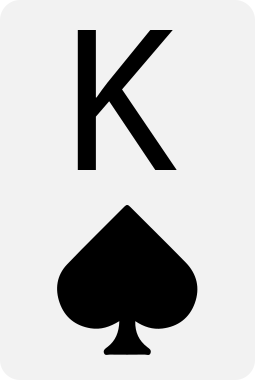
King-Five offsuit is structurally almost identical to King-Six offsuit, and that similarity is itself instructive. Moving one step down the kicker ladder from six to five produces virtually no change in the draw odds – the pair rates, two pair rates, and overcard exposure are identical to K6o to two decimal places across nearly every category. What does change, marginally, is the straight potential, which ticks up from 3.05% to 3.10% by the river. That single difference tells you something important: at this end of the kicker range, the identity of the low card barely matters. K5o and K6o are functionally the same hand, and both are defined almost entirely by the king.
What These Odds Show for K5o
The draw odds table for K5o is a near-exact replica of K6o. High card on the flop at 53.88%, pair by the river at 45.86%, two pair at 22.79%, three of a kind at 4.45% – these figures are identical. The straight rate is 3.10% by the river, a negligible improvement over K6o’s 3.05%, and one that carries no practical significance at the table.
The overcard table is also unchanged: 22.55% on the flop, 29.14% by the turn, 35.30% by the river. As with any king-high hand, the only overcard that can appear is an ace, which is why this figure sits so much lower than the 86.73% seen with 86o or the 98.14% seen with 54o. The king dominates the board in terms of rank more often than almost any other starting card, and that low overcard exposure is the hand’s one legitimate structural advantage.
The problem, as with K6o, is that the advantage only matters when you can comfortably play top pair – and with a five kicker, you almost never can.
Hand Strength Summary
- Hand type: Weak offsuit king
- Relative strength: Below average – marginally weaker than K6o in practical kicker scenarios
- Best case: King-high board with no ace, heads-up, uncontested
- Main vulnerability: Dominated by any king with a six or higher kicker, no straight potential, no flush equity
K5o belongs in the same conversation as K6o, K4o, and K3o – a family of hands that carry a strong card paired with a kicker so weak that flopping top pair is more of a dilemma than a reward.
How King-Five Offsuit Wins
The routes to winning with K5o are narrow and largely depend on opponents either folding or missing entirely:
- Pairing the king on a board with no ace, heads-up, against an opponent who cannot continue
- Making two pair on a king-five board and getting action from someone holding a single pair
- Winning an uncontested pot preflop or on the flop with a positional steal
- King-high holding up on a board where no opponent pairs any of their cards
What K5o almost never does is win a meaningful pot at showdown through legitimate hand strength. Top pair with a five kicker loses to top pair with any higher kicker, which covers the overwhelming majority of hands that would enter a pot against a king-high range.
Main Weaknesses
The five kicker is the structural problem, and it is worse here than in K6o in one specific way: a five is low enough that even pairing the kicker produces an almost valueless hand. A pair of sixes at least occupies a slightly stronger position on a low board. A pair of fives sits at the very bottom of middle pair territory and is beaten by any pair of sixes through aces.
The full list of structural problems mirrors K6o closely:
- Outkicked by any opponent holding K6 through KA – a vast portion of any reasonable range
- Straight rate of 3.10% by the river offers no meaningful drawing alternative
- No flush equity whatsoever
- High card only on 53.88% of flops, with no draw to fall back on in most cases
- The five as an independent card has almost no board presence – it rarely pairs on relevant boards and contributes nothing to straights at normal stack depths
Best and Worst Flop Textures
Strong flops
- King-high boards with no ace and low, dry side cards – K-3-2 rainbow being close to ideal
- King-five boards giving immediate two pair on a texture where opponents with overcards are drawing thin
- Low boards where the king serves as an effective bluff card and opponents are unlikely to have connected
Dangerous flops
- Ace-high boards, which appear on roughly 22.55% of flops and immediately reduce the king to second-best high card
- King-high boards with a strong side card in play – a board of K-J-T puts top pair fifth kicker in an almost unplayable position
- Any board where an opponent is likely to have a king with a better kicker, which in practice means most boards in a raised pot
- Coordinated boards where the five offers no straight draw contribution and opponents are drawing to stronger hands
How It Plays by Position
- Early position: A clear fold at any table format. There is no version of the game where K5o should be opened from under the gun or early middle position in a standard setting.
- Middle position: Still a fold at a full ring table. The combination of weak kicker and no drawing equity cannot withstand the pressure of multiple players left to act.
- Late position: The only circumstance where K5o has any legitimate claim to a raise. From the button or cutoff in an unopened pot, the king acts as a blocker to premium king holdings in opponent ranges, and the fold equity of a late-position steal justifies a single raise. The hand should not be taken much further without significant board improvement.
- Blinds: In the big blind against a single late-position raise with the right pot odds, a passive call is defensible. The key is not investing further without connecting well. From the small blind, the out-of-position disadvantage makes even a discounted call marginal.
The positional argument for K5o is essentially identical to K6o. The king provides a modest blocker effect and enough high-card credibility to make a fold-or-steal approach viable from late position. Nothing about the five versus the six changes that calculus in a meaningful way.
Common Mistakes with King-Five Offsuit
The errors players make with K5o are largely the same as with K6o, with one addition that is specific to the weaker kicker:
- Continuing on king-high flops without recognising that the five kicker makes calling multiple streets almost indefensible – any bet from an opponent who has a king almost certainly has you outkicked
- Playing the hand as if it were K9o or better, where the kicker at least has some competitive value
- Calling 3-bets or raising wars with a hand that cannot withstand pressure
- Treating the low overcard rate as a sign that the hand plays well postflop – it does not, because the kicker problem exists regardless of whether an ace appears
- Limping from early or middle position to see a cheap flop, then finding themselves pot-committed with top pair fifth kicker against a player who raised preflop
Comparison to Similar Hands
- Stronger than: K4o, K3o, K2o – K5o sits near the bottom of the weak king family but is not the weakest member
- Weaker than: K6o, where the kicker has marginally more competitive value; K5 suited, which transforms the hand with flush equity; K9o and above, where the kicker genuinely competes
- Similar to: Q4o – a high card paired with a near-irrelevant kicker, positional steal value only, no drawing equity
The comparison between K5o and K5 suited deserves particular emphasis. Unlike the transition from K6o to K6s, which adds flush equity to a kicker that already had some marginal value, the jump from K5o to K5s is arguably more significant in relative terms – because the flush draw gives K5s a completely independent way to win that has nothing to do with the kicker. K5o has no such alternative.
How King-Five Offsuit Performs in Multiway Pots
K5o in multiway pots faces all the same problems as K6o, with the kicker issue amplified. In a three-way or four-way pot:
- The probability that at least one opponent holds a better king is substantially higher than heads-up
- A pair of fives in a multiway pot has essentially no showdown value
- The low overcard rate provides false reassurance – a board with no ace still has the king frequently dominated by a better kicker
- The straight rate of 3.10% means straight draws are almost never in play, removing any drawing equity to offset being behind on the pair
There is no standard multiway scenario where K5o should be building a large pot. Its value, such as it is, is confined entirely to heads-up situations with positional advantage and limited stack depth.
FAQ: King-Five Offsuit
How does K5o differ from K6o in practice?
In most hands, it does not. The draw odds are nearly identical. The kicker is one step lower, which matters only in the specific scenario where both players pair the king and the side cards determine the winner – in which case K5o loses to K6o through KA.
Is there ever a spot to value bet three streets with K5o?
Almost never. Top pair with a five kicker cannot comfortably call three streets of bets, let alone lead them. If the board is king-high with no ace and no draws, a single bet for thin value is the maximum reasonable investment.
Does holding a king preflop have blocker value?
Yes, modestly. Holding a king removes one of the four kings from the deck, slightly reducing the probability that opponents hold AK, KK, KQ, or KJ. This blocker effect is the primary strategic justification for stealing with weak kings from late position.
Why is K5o considered weaker than K6o if the stats are almost the same?
The practical difference emerges only in kicker confrontations. When both players flop top pair, K5o loses to K6o and above. As the kicker decreases below nine or so, the hand enters the zone where it is dominated by almost every king in an opponent’s range, and five sits near the bottom of that zone.
Related Hands