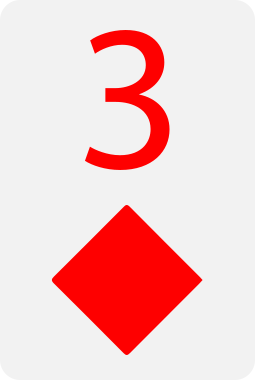
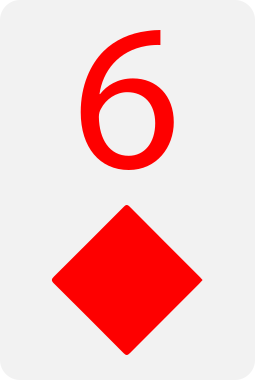
Queen–Five offsuit continues the weak queen sequence in the same direction the weak king sequence travelled — each step down the kicker ladder producing negligible changes in the draw odds profile while confirming, one more time, that the strategic framework for the entire family has been established and does not require rebuilding for each individual hand. Q5o and Q6o share an identical overcard table, near-identical pair and two pair rates, and a straight rate that differs by a fraction of a percentage point. The hand is Q6o with a five instead of a six, and the practical difference between them is smaller than the difference between most hands that share a common top card in this range.
What These Odds Show for Q5o
The draw odds table for Q5o produces the same pattern seen across the weak queen family. High card on the flop at 53.88%, pair by the river at 45.71%, two pair at 22.79%, three of a kind at 4.45% — all identical to Q6o or within rounding distance. The full house rate at 2.22% and four of a kind at 0.13% are unchanged.
The straight rate is 0.00% on the flop, 0.88% by the turn, and 3.47% by the river. This represents a marginal increase from Q6o’s 3.43% — the same counterintuitive pattern seen when moving from Q7o to Q6o, where the lower kicker produced a marginally higher straight rate due to the specific combination of board cards required for each hand’s straight configurations. Q5o can form straights running six–to–ten, seven–to–jack, eight–to–queen, and — through the five — potentially contributing to a nine–to–king combination depending on board configuration. The 3.47% figure remains negligible for strategic purposes, but the marginal uptick from Q6o is consistent with the pattern established earlier in this series.
The overcard table is unchanged at 41.43% on the flop, 51.40% by the turn, and 59.85% by the river — identical to Q6o and Q7o. As with the entire weak king series, the overcard table for any queen–high hand is a property of holding a queen, not of the kicker accompanying it, and it does not change until the top card changes.
Hand Strength Summary
- Hand type: Weak offsuit queen
- Relative strength: Below average — functionally equivalent to Q6o and Q7o for all practical purposes
- Best case: Queen–high board with no king or ace, heads–up, late position, unopened pot
- Main vulnerability: Dominated by any queen with a six kicker or higher, negligible straight potential, no flush equity
Q5o has arrived at the same point in the weak queen family that K4o represented in the weak king family — the kicker has declined far enough that the hand is defined entirely by the queen, and the specific low card occupying the second slot is strategically irrelevant except in the narrow scenario where both cards pair simultaneously on the board.
How Queen–Five Offsuit Wins
The winning routes for Q5o are identical to Q6o and Q7o, with the five substituted for the six or seven in the two pair scenario:
- Pairing the queen on a board with no king or ace, heads–up, against an opponent who has missed entirely
- Making two pair on a specific queen–five board on a dry, low–pressure texture
- Winning uncontested pots preflop through a late–position steal where the queen’s rank credibility carries the raise
- Queen–high holding up in a passive, checked–down pot where no opponent has connected
The five contributes only in the two pair scenario, and a queen–five board requires two specific cards to appear simultaneously. Outside of that narrow configuration, the five is the hand’s placeholder — present, but strategically inert.
Main Weaknesses
Q5o’s weaknesses are the weak queen family’s problems applied to a kicker that has now fallen below the point where any competitive value remains in kicker confrontations:
- Dominated by Q6o through QA — every queen–containing hand a reasonable opponent would voluntarily play has Q5o outkicked
- The five as an independent card produces a pair of fives with almost no showdown value on any board containing overcards, which happens on 59.85% of boards by the river
- Straight rate of 3.47% by the river is negligible for planning purposes
- No flush equity in the offsuit version
- High card only on 53.88% of flops with no compensating draw available in the vast majority of cases
- In any contested pot where both players have paired the queen, Q5o loses to the complete range of queen–containing hands except Q4o, Q3o, and Q2o — the narrowest possible range of hands it has covered
Best and Worst Flop Textures
Strong Flops
- Queen–high boards with no king or ace and completely disconnected low side cards — Q–3–2 or Q–4–2 rainbow textures where the hand holds the top card uncontested
- Queen–five boards giving immediate two pair on a dry, uncontested texture where no draws are active
- Low boards in late position where a single continuation bet ends the hand without requiring legitimate connection
Dangerous Flops
- Any board with a king or ace — occurring on 41.43% of flops and immediately making the queen second–best high card
- Queen–high boards with a meaningful side card, where top pair with a five kicker is unplayable for multiple streets against any resistance
- Any board in a multiway pot where the kicker problem and absence of draw equity compound across opponents
- Boards with active flush draws or straight draws where opponents carry equity Q5o cannot match or challenge
How It Plays by Position
- Early position: A clear fold without exception. Q5o has no compensating equity for early–position exposure to multiple players yet to act.
- Middle position: A fold at any full ring table. The hand cannot justify middle–position entry under standard conditions.
- Late position: The only position where Q5o earns any strategic consideration, and on identical terms to Q6o and Q7o. From the button or cutoff in an unopened pot, the queen carries the credibility of a steal raise regardless of what the second card is. The five is irrelevant to the fold equity generated by the queen’s high–card strength in that context.
- Blinds: In the big blind with pot odds against a single steal raise, Q5o sits at the outer edge of a defensible call — one street of investment, check–fold on most flops, continue only when the board produces two pair or better. From the small blind, folding is correct against most raises. These answers are identical to Q6o and Q7o.
Common Mistakes with Queen–Five Offsuit
The pattern of mistakes with Q5o mirrors the weak queen family throughout, with the kicker problem now at a point where certain errors become even more acute:
- Continuing after flopping top pair in any contested scenario where the opponent has put money in — the five kicker now loses to Q6 through QA without exception, covering virtually the entire range of queen–containing hands that enter pots
- Treating Q5o as meaningfully different from Q6o or Q7o in strategic terms, when the draw odds confirm the three hands are functionally equivalent across every practical scenario
- Playing the hand from early or middle position because the queen looks like a legitimate starting card, without accounting for the complete inability of the five to support any multi–street play
- Slow playing a flopped two pair — Q5o’s two pair on a queen–five board is strong relative to this hand’s usual outcomes but vulnerable enough that extracting value quickly is almost always better than allowing draws or overcards free cards
- Misreading the overcard table as a board–protection advantage without recognising that the kicker problem persists on all boards regardless of whether a king or ace appears
Comparison to Similar Hands
- Stronger than: Q4o, Q3o, Q2o — Q5o is not quite at the bottom of the weak queen family but sits near it
- Weaker than: Q6o, where the kicker has fractionally more competitive value; Q5 suited, which transforms the hand with flush equity that makes it a genuinely different strategic proposition; Q8o and above, where the kicker begins to compete in a meaningful range of queen–pair confrontations
- Similar to: Q6o and Q7o — the most direct comparisons, sharing an identical overcard table and near–identical draw odds across every category, with no practical strategic distinction between the three hands
The comparison between Q5o and K5o is instructive for the same reason the Q7o versus K7o comparison was earlier in the series. Both hands share a five kicker, producing similar pair and two pair rates. The primary difference is the overcard table: K5o sees an overcard on 22.55% of flops, Q5o on 41.43%. The king’s higher rank provides nearly double the board protection of the queen in terms of overcard exposure, which translates directly into more scenarios where top pair with a five kicker is a viable holding. Q5o is a weaker hand than K5o not because of the five — they share the same kicker — but because the queen is outranked more often on the board, leaving top pair in a weaker relative position more frequently.
How Queen–Five Offsuit Performs in Multiway Pots
Q5o’s multiway performance is as limited as Q6o’s and Q7o’s, and the argument does not change with the kicker:
- The probability of at least one opponent holding a better queen increases with each additional player, and Q5o is now dominated by Q6 through QA — the full range of queens that enter pots voluntarily
- A pair of fives multiway has essentially no showdown value under any standard board conditions
- The 3.47% straight rate by the river means drawing equity is absent as a compensating factor
- Without flush equity, wet boards give opponents advantages Q5o cannot contest
There is no standard multiway scenario where Q5o should be building a pot. The hand’s value is confined to heads–up, positional, late–position dynamics where the fold equity of a steal raise does the work, and those dynamics do not survive multiple callers.
FAQ: Queen–Five Offsuit
Is there any practical difference between Q5o, Q6o, and Q7o?
At the table, almost none. The overcard table is identical across all three. The pair rates, two pair rates, and most draw odds are within rounding distance of each other. The straight rate varies marginally — Q7o at 3.05%, Q6o at 3.43%, Q5o at 3.47% — differences too small to influence any decision. All three hands are played identically across every standard position and scenario.
Why does Q5o have a marginally higher straight rate than Q6o?
Because the specific straight combinations available to a queen–five differ from those available to a queen–six in ways that produce slightly different completion rates across all possible board textures. The five connects to a different window of board cards than the six does alongside a queen, and those configurations happen to complete marginally more often. The difference of 0.04 percentage points has no strategic significance.
At what point does the weak queen family become unplayable even from late position?
The case for a late–position steal weakens gradually as the kicker drops. Q7o through Q5o retain sufficient queen credibility to justify a steal raise in unopened pots. Below Q4o, the hand approaches the point where even the late–position case becomes increasingly difficult to construct, particularly in games where opponents are observant enough to recognise that very weak queens are being over–represented in steal spots.
Does Q5o have any value as a bluff–catching hand?
Only in the specific scenario where an opponent is bluffing on a board where queen–high is the best hand possible, typically in checked–down pots on boards where no player has connected. This is incidental value rather than planned use of the hand’s strength.
Related Hands