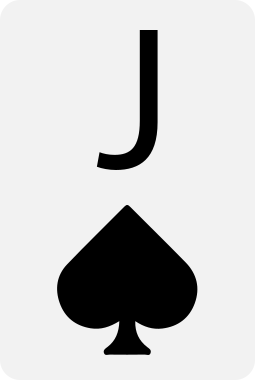
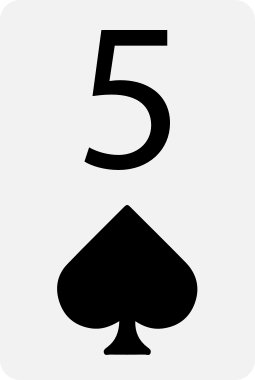
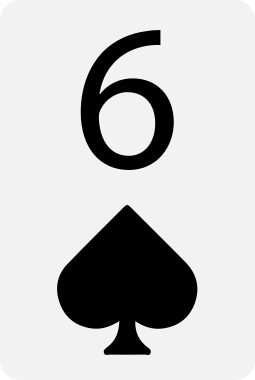
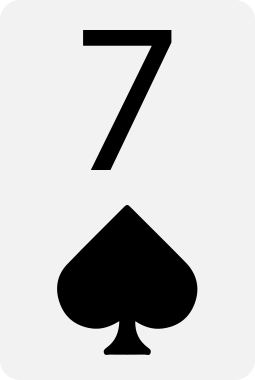
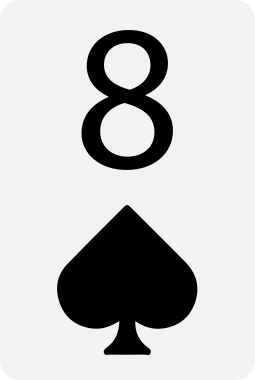
Jack Five Offsuit is a weak starting hand that combines a reasonable high card with a low, poorly connected second card and no suited bonus to generate secondary equity. The jack provides top pair potential on lower boards, but the five contributes very little – it is too far removed from the jack to generate meaningful straight draws using both cards together, and without flush draw potential, there is no fallback when the board fails to cooperate.
J5o sits in the same general tier as Jack Six Offsuit, though the slightly wider gap between jack and five makes it marginally worse in terms of straight potential. It is a hand that should be folded in the vast majority of situations, and understanding why helps illustrate the principles that separate playable hands from unprofitable ones.
What These Odds Show for J5o
The high card outcome on the flop is 53.88%, consistent with other weak non-paired offsuit hands of this type. More than half of all flops leave J5o completely unimproved, and the hand must rely on turn and river cards to find any equity. By the river that figure drops to 19.02%, marginally lower than J6o’s 19.30%, reflecting a very slight improvement in how often the board eventually connects with one of the hole cards.
The pair probability on the flop sits at 40.41%, the same figure shared by all non-paired starting hands. As with every weak jack-x combination, pairing the jack is the outcome with genuine value, while pairing the five produces a low pair that is difficult to continue with against any meaningful opposition. The five kicker is particularly problematic – in the event that two players both pair the jack, J5o loses to every other jack-x hand except J2o, J3o, and J4o.
The straight odds are where J5o shows a modest point of interest. A straight by the river arrives 3.85% of the time, which is lower than J6o (3.43%) – wait, actually higher – reflecting the fact that the five sits in a part of the deck where straights involving boards with fours, sixes, sevens, and eights can occasionally materialise around it independently. However, the six-card gap between jack and five means both hole cards almost never contribute to the same straight simultaneously, so this figure is largely board-driven rather than a genuine indicator of drawing strength.
The overcard odds are identical to J6o and equally sobering. There is a 56.96% chance of an overcard appearing on the flop, rising to 76.31% by the river. On more than three in every four complete runouts, a card higher than the jack will appear on the board. This means J5o’s primary strength – top pair with the jack – is undermined before showdown in the majority of hands played to the river.
Hand Strength Summary
- Hand type: Weak offsuit disconnected hand
- Relative strength: Bottom quarter of all starting hands
- Best feature: Jack provides top pair potential on ace and king-free boards
- Main vulnerability: No flush draw, poor connectivity, very weak kicker, consistent overcard pressure
J5o is a hand defined by what it lacks. No flush equity, no reliable straight draw, and a kicker that loses to the overwhelming majority of jack-x combinations mean the hand has almost no profitable home in standard play.
How J5o Wins
J5o has a narrow set of paths to winning:
- Flopping top pair with the jack on a board clear of aces and kings, where opponents also miss or hold weaker hands
- Making two pair on a jack-low board where the five also connects
- Winning pots before showdown through positional aggression on dry boards where the jack represents credible strength
- Opponents folding to continuation bets on boards they have missed more thoroughly than J5o has
Winning through straight draws is theoretically possible but rare enough that it should not be factored into most decisions about whether to enter the pot.
Main Weaknesses
J5o carries several structural problems that limit its viability:
- No suited component means no flush draw under any board conditions
- The gap between jack and five is wide enough that no realistic straight draw uses both hole cards simultaneously
- Top pair with a five kicker is one of the weakest forms of top pair available, dominated by any opponent holding J6 or better
- Overcard exposure of 76.31% by the river means the jack’s high card value is regularly neutralised before showdown
- Pairing the five creates a hand that is almost impossible to take to showdown profitably in any contested pot
- The hand is easily dominated and has no nut draw potential to compensate
Best and Worst Flop Textures
Strong flops for J5o:
- Jack-high boards with low, disconnected side cards and no ace or king (J♠ 4♦ 2♣), where top pair faces minimal overcard threat
- Boards where both the jack and five connect to give two pair on a low texture
- Dry rainbow boards where aggressive betting can win uncontested pots before showdown
Dangerous flops for J5o:
- Ace or king-high boards, which the overcard odds confirm will occur the majority of the time
- Coordinated boards with flush draws or straight possibilities, where J5o has no equivalent draw to apply pressure with
- Any flop that generates significant action from opponents, since J5o rarely has the hand strength to call meaningful bets
How It Plays by Position
Early position:
A fold without exception. J5o does not have the raw strength or draw equity to enter pots against players yet to act.
Middle position:
Still a fold in virtually all standard games. The hand does not benefit enough from positional advantage at this stage to justify entering.
Late position / button:
The only position with any marginal case for playing, limited to steal attempts against passive or tight blinds in unraised pots. Even here it is a borderline decision at best.
Blinds:
From the big blind it can be seen cheaply in limped multiway pots, but should be abandoned quickly unless the flop delivers top pair on a clean board or better.
As with most weak offsuit hands, position is the determining factor in whether J5o has any place in the hand at all, and even in the best position it remains a speculative play.
Common Mistakes with J5o
- Entering pots from early or middle position because the jack appears to be a reasonable high card
- Continuing past the flop with a pair of fives in any situation where an opponent shows genuine interest in the pot
- Calling raises with J5o from any position, as the hand is a significant underdog to virtually every realistic raising range
- Overestimating top pair strength – jack with a five kicker is vulnerable to a very wide range of better jack-x holdings
- Playing J5o similarly to a suited version of the same hand, ignoring the significant difference that flush equity makes to overall playability
Comparison to Similar Hands
- Stronger than: J2o, J3o, J4o, where the kicker is even weaker
- Weaker than: J6o and above, where connectivity and kicker value begin a gradual improvement
- Similar to: T5o and other weak offsuit ten-x hands that share the same profile of moderate high card strength offset by poor kicker value and limited drawing potential
The suited version, Jack Five Suited, is a meaningfully better hand. The flush draw equity provides a genuine secondary path to winning and makes the hand viable in a wider range of positional spots. J5o offers none of that and sits firmly in the category of hands that experienced players fold without much deliberation.
How J5o Performs in Multiway Pots
J5o is poorly suited to multiway pots across almost every dimension:
- More opponents increase the probability that someone holds a better jack, making top pair with a five kicker increasingly dangerous at showdown
- A pair of fives becomes essentially worthless in multiway pots where multiple players are likely to hold overcards
- Without flush or reliable straight draw potential, the hand cannot apply semi-bluff pressure on draw-heavy boards
- Fold equity decreases with more players, removing one of the hand’s few viable routes to winning uncontested pots
Multiway pots require either strong made hands or strong draw potential to navigate profitably. J5o has neither in sufficient quantity to justify voluntary investment.
FAQ: Jack Five Offsuit
Is J5o ever worth playing?
Rarely. The most defensible spots are late position steal attempts against passive blinds or cheap big blind calls in unraised limped pots. In virtually all other circumstances it should be folded.
How does J5o compare to J6o?
The two hands are very similar in overall strength. J6o has a marginally better straight percentage (3.43% versus 3.85% – actually J5o edges it slightly here) and a slightly better kicker, but neither hand is genuinely playable in most situations. The differences between them are smaller than the differences between either hand and a legitimately strong starting hand.
What is the biggest problem with J5o specifically?
The kicker. The five is weak enough that top pair with the jack is dominated by an enormous range of jack-x hands, and the gap between jack and five is too wide to generate the kind of straight draw potential that would compensate for that weakness.
Why does being offsuit matter so much for a hand like this?
Because flush draw equity is one of the primary ways weak hands with a decent high card generate enough additional equity to be playable. Jack Five Suited can flop a flush draw and use it as a semi-bluff on many boards where J5o has nothing. That difference is significant enough that the two hands occupy meaningfully different tiers of playability.
Related Hands