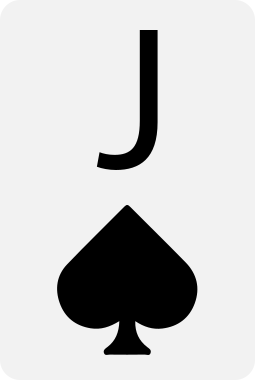
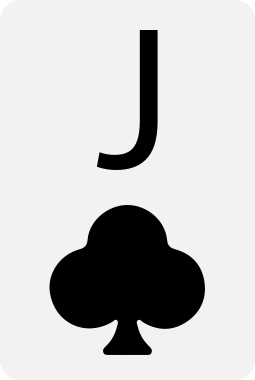
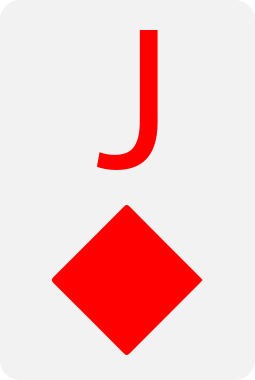
Jack Six Offsuit is one of the weaker hands in Texas Hold’em. It combines a decent high card in the jack with a low, disconnected six, and crucially carries no suited bonus to compensate for that gap. The result is a hand with limited ways to improve, poor connectivity, and a kicker that almost always plays dead if the jack pairs.
J6o is widely considered an unprofitable hand in most contexts. Understanding why – and recognising the rare spots where it has some marginal relevance – is the purpose of this breakdown.
What These Odds Show for J6o
The draw odds paint a clear picture of a hand that struggles to find the board. On the flop, J6o remains a high card hand 53.88% of the time, meaning it fails to improve at all in more than half of all dealt flops. By the river that figure falls to 19.30%, but only as a product of more cards being available, not because the hand has genuine draw potential.
The pair probability on the flop is 40.41%, but this number carries an important caveat. Pairing the jack gives you top pair in many situations, which has real value. Pairing the six gives you bottom or low pair with a jack kicker, which is frequently a losing hand against any meaningful opposition. Context matters enormously here.
The straight odds are where J6o shows a slight edge over even weaker hands. A straight by the river arrives 3.43% of the time – noticeably higher than a hand like Q2s (2.35%) – because the jack and six, while gapped, exist in a range of ranks that at least theoretically connect to surrounding cards. However, the five-card gap between jack and six means no single straight draw uses both hole cards simultaneously, so this number reflects the jack or the six contributing to board straights rather than the hand working together as a unit.
The overcard situation is the most telling statistic on this page. There is a 56.96% chance of an overcard appearing on the flop, climbing to 76.31% by the river. That means nearly three quarters of all runouts will feature a card higher than the jack on the board. With no ace and no king, the jack is vulnerable to being outranked on almost any flop, and when that happens, top pair potential disappears entirely.
Hand Strength Summary
- Hand type: Weak offsuit disconnected hand
- Relative strength: Bottom quarter of all starting hands
- Best feature: Jack provides top pair potential on lower boards
- Main vulnerability: No suit bonus, poor connectivity, severe overcard exposure
J6o has no inherent strength as a starting hand. Its value, where it exists at all, comes entirely from opportunistic spots and positional advantages rather than raw card strength.
How J6o Wins
When J6o wins at showdown, it typically does so through one of the following:
- Flopping top pair with the jack on a board where no overcard arrives
- Making two pair on a jack-low board
- Winning uncontested pots through positional aggression and timely bluffs
- Opponents missing the board entirely and folding to continuation bets
The hand very rarely wins through straight draws or any premium hand combination. Its path to winning is narrow and heavily dependent on how the board interacts with the jack specifically.
Main Weaknesses
J6o carries a significant number of structural weaknesses:
- No suited component, removing any flush draw equity
- The six has almost no straight draw value in combination with the jack given the four-card gap
- Overcard exposure is severe – at 76.31% by the river, the board will regularly outrank the jack entirely
- Pairing the jack creates a vulnerable top pair with a very weak kicker, easily dominated by J7 through JQ
- Pairing the six almost always results in a losing hand
- The hand is easily dominated when someone holds a jack with a better kicker, which covers the vast majority of jack-x combinations
Best and Worst Flop Textures
Strong flops for J6o:
- Jack-high boards with small disconnected side cards (J♠ 4♦ 2♣), giving top pair with little straight or flush draw danger
- Boards where the six also pairs, giving two pair on a low texture
- Dry, rainbow boards where aggressive betting can take down uncontested pots
Dangerous flops for J6o:
- Ace or king-high boards, which the overcard odds suggest will occur the majority of the time
- Coordinated boards where your pair of jacks or sixes is likely behind a draw or a better made hand
- Any board where an opponent continuation bets – J6o has little to call with against real pressure
How It Plays by Position
Early position:
Always a fold. J6o does not have the strength or the draw potential to warrant entering the pot against players yet to act who could hold genuinely strong hands.
Middle position:
Still a fold in virtually all standard games. Loose passive tables might create edge cases, but they are rare.
Late position / button:
The only position where J6o has any case to be played, and only in specific circumstances such as a steal against tight blinds or a very cheap multiway limp pot.
Blinds:
From the big blind it can be seen cheaply in limped pots, but should be played with extreme caution and abandoned quickly when the board does not connect.
J6o is a hand defined almost entirely by position. Without the button or a very favourable dynamic, it should not be in the hand.
Common Mistakes with J6o
- Calling raises with J6o from any position, giving away chips against hands that dominate it
- Continuing past the flop with a pair of sixes in any contested pot
- Overestimating top pair strength – jack with a six kicker loses to any jack with a better kicker, which is a very wide range
- Chasing on the turn with no realistic draw to justify the call
- Playing the hand too often simply because the jack looks like a reasonable high card in isolation
Comparison to Similar Hands
- Stronger than: J2o, J3o, J4o, J5o (marginally, due to slightly better rank combination)
- Weaker than: J7o and above, where connectivity and kicker value begin to improve meaningfully
- Similar to: Other weak offsuit jacks and weak offsuit tens such as T6o in terms of overall playability
The suited version of this hand, Jack Six Suited, is meaningfully stronger due to the addition of flush draw equity. J6o offers none of that compensation and sits firmly in the category of hands best avoided in standard play.
How J6o Performs in Multiway Pots
J6o is particularly poorly suited to multiway pots:
- More opponents increase the chance that the jack is dominated by a better kicker
- Any pair of sixes becomes increasingly worthless as more players see the board
- Without flush or strong straight draw potential, the hand cannot apply semi-bluff pressure on draw-heavy boards
- Fold equity decreases significantly in multiway pots, removing one of the hand’s few viable routes to winning
If J6o does end up in a multiway pot, the best outcomes come from flopping two pair or top pair on a very dry board – scenarios that are the exception rather than the rule.
FAQ: Jack Six Offsuit
Is J6o ever worth playing?
Rarely. It has a narrow range of playable spots limited to late position steals, very cheap multiway limps, or big blind defences against minimal raises. In most situations it should be folded.
How does J6o compare to Jack Six Suited?
Jack Six Suited is notably stronger. The flush draw equity adds a meaningful secondary path to winning and makes it a more viable speculative hand in position. J6o has no such fallback.
What is the biggest problem with J6o?
The overcard exposure. With a 76.31% chance of a card higher than the jack appearing on the board by the river, the hand’s top pair potential is realised far less often than the raw pair odds suggest.
Why is the six such a weak second card here?
The gap between jack and six is too large to generate useful straight draws using both hole cards, and the six on its own provides almost no independent value. It is neither a high card nor connected enough to contribute to combination draws.
Related Hands