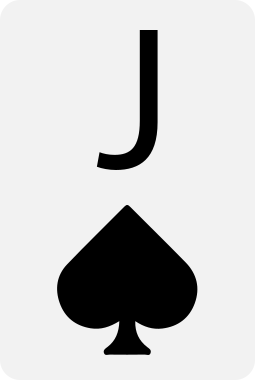
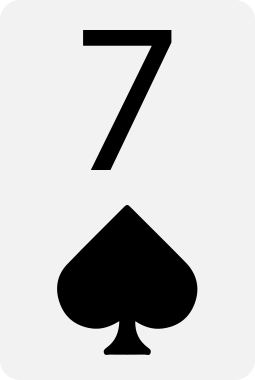
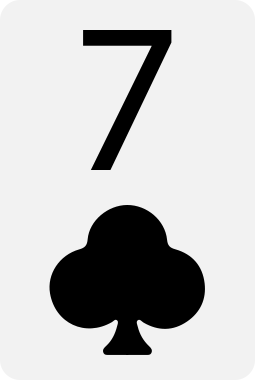
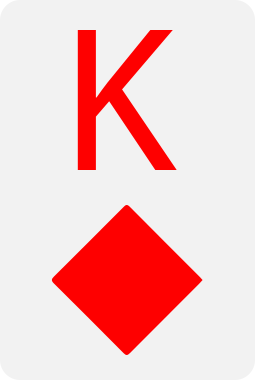
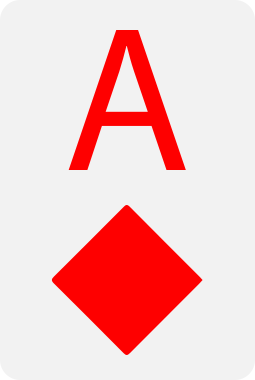
Jack-Seven offsuit occupies an awkward middle ground that defines an entire family of hands — high enough that the top card carries some board presence, low enough that the bottom card contributes almost nothing, and gapped enough that straight potential is limited but not entirely absent. J7o is not as hopelessly low as 54o, not as kicker-trapped as K5o, and not as straight-capable as 86o. It sits in the uncomfortable space between all of them, with a distinct set of problems that make it one of the more deceptive hands to play correctly.
What These Odds Show for J7o
The overcard table is the first place to look, and it immediately separates J7o from the weak kings covered previously. With a jack as the top card, three ranks sit above it — queen, king, and ace — which produces an overcard rate of 56.96% on the flop. That is meaningfully higher than the 22.55% seen with king-high hands, but considerably lower than the 86.73% of 86o or the near-certain overcard exposure of 54o. J7o sits in a middle band where overcards are more likely than not on the flop, but not so dominant that board texture planning becomes futile.
By the turn that figure rises to 67.95% and by the river to 76.31%. So roughly three in four runouts will contain at least one card that outranks the jack. That is significant, but it leaves a meaningful minority of boards where the jack is genuinely the top card — a luxury that low connectors and low offsuit hands simply do not have.
The draw odds show a familiar offsuit hand pattern in most categories. High card on the flop at 53.55%, pair by the river at 45.00%, two pair at 22.66%, three of a kind at 4.43%. These are consistent with the other offsuit hands in this range.
The straight rate is where J7o shows its structural limitations most clearly. At 0.33% on the flop, 1.72% by the turn, and 4.76% by the river, the straight completion rate is the lowest of any hand covered so far. The four-card gap between jack and seven means the number of straight configurations available is limited. Compare this to 54o’s 9.18% or even 86o’s 7.75%, and the cost of the gap becomes concrete. J7o can form straights, but it needs a very specific set of board cards to do so, and those combinations appear less than one in twenty times by the river.
Hand Strength Summary
- Hand type: Weak offsuit gapped hand
- Relative strength: Below average — weaker than its card values might suggest
- Best case: Jack-high board with no overcards, paired well, heads-up in position
- Main vulnerability: Overcard exposure from three ranks, minimal straight potential, poor kicker
J7o is caught between two worlds. It is not high enough to lean on card strength the way a weak king can, and not connected enough to draw to straights the way low connectors can. That dual weakness leaves it with fewer legitimate paths to winning a pot than either of those hand types.
How Jack-Seven Offsuit Wins
J7o wins through a narrow set of circumstances, none of which involve being the best hand before the flop or on most flop textures:
- Pairing the jack on a board with no queen, king, or ace, and holding up against an opponent who missed entirely
- Flopping two pair on a jack-seven board and getting action from overcards drawing to a higher pair
- Making a straight on the relatively rare occasions the board cooperates — specifically needing cards in a tight range to form the combination
- Stealing uncontested pots preflop from late position where no opponent has found a reason to continue
- Semi-bluffing on boards where a partial draw exists, taking the pot before showdown
Main Weaknesses
The gap is the defining structural problem. Unlike 86o, which has a one-card gap and can form draws with considerable frequency, J7o needs to hit a very specific window of cards to build towards a straight. The practical weaknesses this creates include:
- A 4.76% straight completion rate by the river — just over half the rate of 86o and less than a third of 54o’s rate
- The seven kicker produces the same pair-of-jacks kicker trap seen with weak kings — any opponent holding J8 through JA has top pair beaten
- A pair of sevens on most boards has no realistic showdown value
- Overcard exposure from three ranks rather than one means board texture planning is genuinely difficult
- No flush equity, with the 1.95% flush rate belonging entirely to the board
The combination of moderate overcard exposure and poor straight potential means J7o lacks the compensating factor that makes other weak hands occasionally viable. Weak kings have low overcard exposure. Low connectors have strong straight potential. J7o has neither to a sufficient degree.
Best and Worst Flop Textures
Strong flops:
- Low boards with no queen, king, or ace — giving the jack genuine top-card status and a chance to win without improvement
- Jack-seven boards giving immediate two pair, ideally on a dry, uncontested texture
- 8-9 or 8-10 boards that create a gutshot straight draw, the hand’s most realistic drawing scenario
- Boards where opponents have clearly missed and a continuation bet takes the pot immediately
Dangerous flops:
- Any board containing a queen, king, or ace — which occurs on 56.96% of flops and immediately puts a pair of jacks in a difficult position
- Jack-high boards where an opponent holds a better kicker — a scenario that is more common than it appears given how wide ranges tend to be in late-position confrontations
- Coordinated boards where draws are live but J7o has no meaningful draw of its own
- Multiway flops on almost any texture, where the hand’s marginal pair value and limited draw equity are not sufficient to compete
How It Plays by Position
Early position:
A fold in all standard circumstances. J7o cannot withstand the pressure of a full table acting behind it, and the hand has no fallback equity to justify the risk.
Middle position:
Still a fold at a full ring table. In a very loose, passive game with multiple limpers ahead, a limp might be considered, but the hand’s limited upside makes even this marginal.
Late position:
The hand’s only viable home, and even here it requires unopened pots and passive opponents. From the button or cutoff against players unlikely to continue, J7o can be raised as a steal. The jack provides modest blocker value against premium jack holdings, and the fold equity of a positional raise does most of the work.
Blinds:
In the big blind with favourable pot odds against a single raise, J7o can be defended once. The overcard exposure of 56.96% means you will face an overcard-heavy board more often than not, so the plan is largely to check-fold unless the flop cooperates well. From the small blind, a fold is almost always correct.
Common Mistakes with Jack-Seven Offsuit
J7o creates a specific set of traps because the jack feels like a playable card to many players, particularly those coming from games where any face card is treated as a licence to enter a pot:
- Treating the jack as equivalent to a king or ace in terms of board dominance — the 56.96% overcard rate on the flop demonstrates that a jack-high board is the minority outcome, not the majority
- Continuing on flops with a pair of sevens against any resistance, where the hand has almost no realistic path to being best at showdown
- Overvaluing a gutshot straight draw that only has four outs when the board produces a partial connection
- Calling raises from multiple positions because the jack looks like a real card, ignoring that the seven turns most boards into a kicker problem or a complete miss
- Playing the hand in multiway pots where its limited equity is spread across too many opponents to generate profit
Comparison to Similar Hands
- Stronger than: J2o through J6o, where the kicker is even weaker and straight potential is further reduced; 97o, which has better connectivity but a lower top card
- Weaker than: J7 suited, which adds the flush equity that transforms this hand’s playability; J8o and J9o, where the kicker becomes competitive and straight potential improves significantly; Q7o, which has higher card strength with a similar kicker problem
- Similar to: T6o — comparable gap, comparable overcard exposure from a mid-tier top card, similar absence of compensating draw equity
The jump from J7o to J8o is more significant than a single kicker rank suggests. J8o introduces a hand where both cards contribute meaningfully to straight draws, the kicker has genuine value against most jack-pair scenarios, and the structure of the hand shifts from primarily weak toward occasionally viable.
How Jack-Seven Offsuit Performs in Multiway Pots
J7o performs poorly in multiway pots for reasons that are by now familiar from the other hands on this page, but the specific combination of moderate overcard exposure and weak straight potential creates its own problems:
- In a three or four-way pot, at least one opponent is highly likely to have a card that outranks the jack, making top pair an underdog position rather than a strong one
- The 4.76% straight completion rate means drawing to a straight multiway requires both hitting the draw and having it hold against multiple opponents
- A pair of sevens multiway has no realistic showdown value under almost any board conditions
- The hand has no flush equity to create surprise value on wet boards
- Unlike low connectors, which can occasionally win large multiway pots by completing a hidden straight, J7o’s straight combinations are limited enough that opponents can often read the board more accurately
FAQ: Jack-Seven Offsuit
Why is J7o considered weaker than 86o despite having a higher top card?
Because 86o’s straight potential at 7.75% by the river is more than 60% higher than J7o’s 4.76%. The one-card gap in 86o produces significantly more drawing combinations than the four-card gap in J7o. Higher card rank matters less than structural connectivity when the hand has no other way to win.
Is there any scenario where J7o plays well?
In a heads-up, late-position, steal-and-take-the-pot scenario where the jack does just enough work to fold out opponents. On the rare flop that gives the hand two pair or a genuine straight draw, it can also play well. Both scenarios require the right conditions, and neither happens often enough to make J7o a hand worth seeking out.
How does the overcard situation compare to K5o?
Dramatically differently. K5o sees an overcard on just 22.55% of flops. J7o sees one on 56.96% of flops. That gap reflects the difference between holding the second-highest card in the deck versus a middle-rank card, and it significantly changes how the hand plays across all board textures.
Should you ever slow play a flopped two pair with J7o?
Rarely. Two pair with J7o is a strong holding relative to this hand’s usual outcomes, but it is vulnerable to overcards and higher two pair combinations. Getting value quickly is usually better than allowing free cards to overtake it.
Related Hands