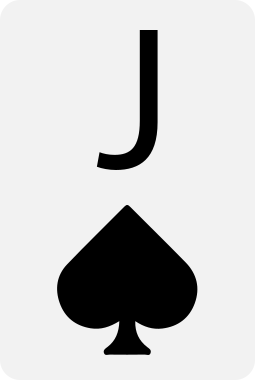
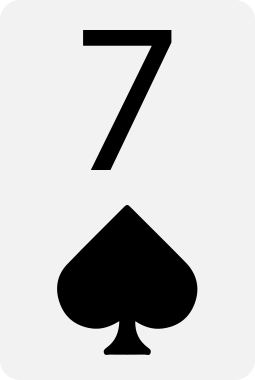
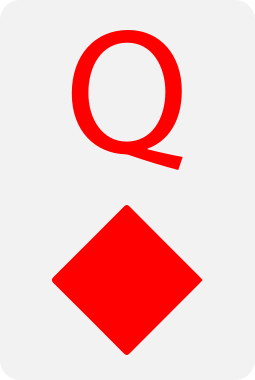
Jack-Seven Suited is an awkward hand that sits in an uncomfortable middle ground. It is not a premium hand, not a suited connector, and not quite speculative enough to play purely for drawing value in the way that 65s or 87s can. The four-card gap between the Jack and the Seven severely limits straight combinations, and while the Jack provides a meaningful high-card anchor that lower suited hands lack, it does not make up for the loss in connectivity.
Most experienced players treat J7s as a marginal hand – occasionally playable in the right conditions, but one that requires discipline to avoid overplaying.
What These Odds Show for J7s
The straight odds tell the clearest story about what the gap costs this hand. By the river, J7s reaches just 4.45% for a straight, compared to 7.27% for 86s and 8.57% for 65s. The four-card gap leaves very few board combinations that complete a straight using both hole cards, and those that do exist require a very specific runout. The straight flush odds of just 0.06% by the river reflect this further – nearly three times lower than 65s.
Flush equity is broadly in line with other suited hands at 6.52% by the river, as expected. The suit matters independent of the gap, so J7s is not penalised there.
The overcard table is where J7s genuinely separates itself from lower suited hands. At 56.96% on the flop, 67.95% by the turn, and 76.31% by the river, overcards are present in roughly three quarters of runouts but far from certain. This is a marked improvement over 65s at 99.60% or 86s at 96.90%. The Jack gives this hand a legitimate top-pair possibility on a meaningful portion of boards, which is something the lower suited connectors simply cannot claim.
Hand Strength Summary
- Hand type: Suited gapper (four-card gap)
- Relative strength: Marginal and situational; below average as a starting hand
- Main draws: Flush draws, occasional gutshot straights, Jack-high top pair on lower boards
- Main vulnerability: Very limited straight combinations; relies heavily on flush draw or pairing the Jack
How J7s Wins
- Pairing the Jack on a board where it holds as top pair
- Completing a flush draw
- Making two pair using both hole cards on the right board texture
- Gutshot straights on the rare boards that align
- Winning with Jack-high in three-bet pots where opponents fold to aggression
Unlike pure suited connectors, J7s has a meaningful backup plan in the Jack. Top pair with a Jack kicker is a real hand on many boards, giving this hand a dimension that 65s or 75s simply does not have.
Main Weaknesses
- The four-card gap makes straight draws rare and almost always gutshots rather than open-ended
- The Seven contributes very little independently – it rarely pairs into a strong kicker
- Vulnerable to domination when the Jack pairs – opponents with AJ, KJ, or QJ have a much better kicker
- Flush draws are the hand’s most reliable draw, but that equity is shared with any other suited hand
- Awkward to continue with on many board textures where neither card connects cleanly
Best and Worst Flop Textures
Strong flops
- Jack-high boards with low cards (J♣ 4♦ 2♣) – top pair with limited kicker danger
- Flush draw boards in your suit with a Jack on the board giving pair plus draw
- Boards like 9♥ 8♦ T♣ where a gutshot to a Queen or six is available alongside other equity
Dangerous flops
- Ace or King-high boards where the Jack is no longer top pair and the Seven is irrelevant
- Boards that give opponents straight and flush draws while you have only a weak pair
- Coordinated boards (T♣ 9♣ 8♦) where you have no draw and no pair
How It Plays by Position
- Early position: Not a hand worth opening in most circumstances; the gap and kicker vulnerability make it too speculative
- Middle position: Fold in most cases; an occasional steal attempt in very tight games is the exception
- Late position / button: Its best home – a reasonable steal candidate, and the position advantage helps navigate awkward post-flop spots
- Blinds: A borderline defend from the big blind in heads-up situations; fold to multi-street aggression quickly if neither card connects
Common Mistakes
- Playing it like a suited connector when the gap fundamentally changes its draw equity
- Continuing with Jack-top-pair into heavy action without considering kicker vulnerability
- Overvaluing the flush draw and calling raises from poor position
- Chasing gutshot straights without sufficient pot odds or implied odds
- Treating the Seven as a meaningful card when it almost never is independently
Comparison to Similar Hands
- Stronger than: J7o (the flush draw adds significant equity), lower gappers like J6s or J5s
- Weaker than: J8s (one fewer gap, meaningfully better straight potential), J9s (close to a connected hand), T9s or 98s (true suited connectors with far better straight odds)
- The gap is the defining feature. Moving from J9s down to J7s cuts the straight equity roughly in half, and that loss is not recovered elsewhere
How J7s Performs in Multiway Pots
J7s is not a hand that thrives in multiway pots the way low suited connectors do. Its implied odds on straights are low because straights are rare and often gutshots. Its flush draw equity is real but vulnerable to higher flushes when multiple players are in the pot. And its top-pair value with a Jack drops significantly when several opponents are contesting the pot, as kicker problems become more acute.
This hand is better suited to heads-up or short-handed situations where its pair potential and flush draw can be the best hand without being complicated by multiway dynamics.
FAQ: Jack-Seven Suited
Why is J7s considered a gapper rather than a suited connector?
Suited connectors are adjacent cards – the gap between them is zero. J7s has a four-card gap, meaning you need four specific intermediate cards on the board to complete a straight using both hole cards. That dramatically reduces straight combinations and changes the hand’s character entirely.
Is the Jack enough to make J7s worth playing?
Situationally, yes. The Jack provides top-pair potential on a wide range of boards and meaningfully reduces overcard exposure compared to low suited hands – the table shows just 56.96% overcard odds on the flop versus over 95% for hands like 65s. But the Jack alone does not make it a strong hand; it makes it a marginal one with a specific kind of value.
How often does J7s complete a flush by the river?
6.52% of the time from a starting hand perspective. This is consistent with other suited hands and is the most reliable draw this hand has.
When is J7s at its most dangerous?
When it flops a flush draw alongside top pair with the Jack. That combination gives you a made hand with backup equity, which plays well on most textures and is difficult for opponents to read accurately.
Related Hands