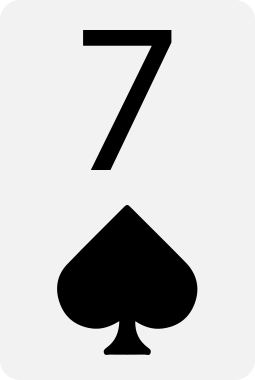
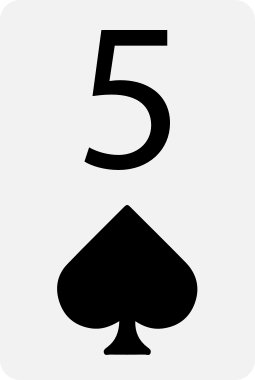
Seven-Five Suited is a one-gap suited connector that occupies a very similar space to 86s in terms of hand structure and strategic identity. Two mid-low cards separated by a single rank gap, suited, with genuine straight and flush potential and essentially no high-card fallback. It is a hand built entirely for post-flop play, requiring the right conditions to justify seeing a flop and the right board to justify continuing past it.
Where 75s differs from 86s is subtle but real. The rank sits one step lower, which pushes the overcard exposure higher and makes the straights it completes slightly weaker on average. Neither difference is dramatic, but together they place 75s a notch below 86s in the one-gap suited connector hierarchy.
What These Odds Show for 75s
The draw odds table for 75s is remarkably close to 86s across every category. Straight odds land at 7.32% by the river versus 7.27% for 86s – essentially identical, as both are one-gap suited connectors with the same number of straight combinations available. Flush odds match at 6.43%, full house at 2.22%, and straight flush at 0.15%. The hand construction produces nearly the same draw profile regardless of the one-rank difference.
The overcard table is where the rank difference registers. At 92.14% on the flop, 96.82% by the turn, and 98.76% by the river, overcards are present on almost every runout. This is higher than 86s at 86.73% on the flop and meaningfully higher by the river at 98.76% versus 96.90%. The Seven and Five simply cannot compete with most of the deck on high-card strength, and by the river it is approaching the near-certainty seen with hands like 65s and 54s.
The high card figure of 52.07% on the flop – the same as 86s – confirms that 75s misses the board entirely and is left with only high cards as its best hand on more than half of all flops.
Hand Strength Summary
- Hand type: Suited connector (one-gap)
- Relative strength: Speculative; similar to 86s but slightly weaker due to lower rank
- Main draws: Straights, flushes, two pair from connected boards, combination draws
- Main vulnerability: Near-certain overcards in most runouts; no high-card equity; straight draws occasionally vulnerable to the higher end
How 75s Wins
- Completing straight draws, which are well disguised at this rank
- Completing flush draws
- Flopping two pair when both the Seven and Five connect with the board
- Building combination draws – open-ended straight draw plus flush draw – that generate significant equity even before completion
- Taking pots through semi-bluffing when a draw is live and opponents cannot comfortably continue
The disguise factor with 75s is comparable to 65s and 54s. Opponents holding overpairs or top pair on a board like 4♣ 6♦ 8♥ rarely anticipate that 75s has flopped the nut straight. That concealment is a genuine source of value in deep-stacked play.
Main Weaknesses
- Overcards approaching certainty by the river at 98.76% – there is effectively no high-card fallback
- One-gap structure reduces straight combinations relative to zero-gap connectors like 65s or 76s
- Low straights are vulnerable to higher ends – opponents holding 86s, 97s, or similar can have the top of the straight when you hold the bottom
- Flush draws can be beaten by any opponent holding a higher card of the same suit
- Entirely board-dependent; a disconnected high board leaves the hand with no equity whatsoever
Best and Worst Flop Textures
Strong flops
- Connected low boards creating open-ended straight draws (4♣ 6♦ 9♣ or 6♥ 8♦ 3♣)
- Two-tone boards in your suit alongside straight draw potential
- Boards pairing one hole card while a draw exists simultaneously (7♦ 9♣ 8♣ gives a pair plus gutshot)
Dangerous flops
- High disconnected boards (A♣ K♦ J♣) – complete whiff with no draw and no pair
- Boards where the straight is available but opponents with higher connectors hold the better end
- Monotone flops in a suit you do not hold
How It Plays by Position
- Early position: Not a hand to open; the post-flop disadvantage of playing out of position combined with the near-certain overcards makes the risk-reward unattractive
- Middle position: Marginal; better suited to passive multiway games where cheap flop entry is realistic
- Late position / button: Its natural home – steal potential, cheap flop access, and the positional advantage needed to navigate post-flop decisions correctly
- Blinds: A reasonable big blind defend against a single late-position raiser when pot odds are favourable; requires disciplined folding when the flop misses entirely
Common Mistakes
- Calling raises from out of position, which undermines the implied odds model the hand depends on
- Drawing to the low end of a straight without recognising when an opponent holds 8-6 or 9-6 for the higher end
- Continuing past the flop with no pair, no draw, and no backdoor equity
- Overvaluing the flush draw in multiway pots where a higher flush is likely to be in play
- Playing the hand in shallow-stack situations where implied odds cannot justify the preflop investment
Comparison to Similar Hands
- Stronger than: 75o (the flush draw transforms the hand’s equity profile), 64s (weaker rank and straight range)
- Weaker than: 86s (one rank higher, overcard exposure drops from 98.76% to 96.90% by the river, and straights tend to be stronger), 76s (zero-gap, meaningfully better straight combinations)
- The most instructive comparison is with 76s. Moving from 76s to 75s introduces a one-card gap that cuts straight equity noticeably – 76s reaches around 8.5% straight odds by the river as a zero-gap connector, while 75s sits at 7.32%. That difference compounds with the slightly higher overcard exposure to make 75s the weaker hand in most situations despite looking superficially similar
How 75s Performs in Multiway Pots
Like other low suited connectors, 75s benefits from multiway pots in terms of implied odds. More players mean larger pots when straights and flushes complete, and the concealment of low connected hands increases in fields where nobody is looking for a 7-5 to have arrived at the nuts.
The risks scale accordingly. Higher flush draws become more likely with more players in the pot, and the danger of drawing to the losing end of a straight increases when several opponents may hold connected cards. As with 65s and 54s, the key discipline in multiway pots is identifying whether a draw is to the nuts or to a second-best hand before committing significant chips.
FAQ: Seven-Five Suited
How does 75s compare to 86s in practice?
Very closely. The draw odds tables are nearly identical – straight odds differ by just 0.05% by the river, and flush odds are the same. The practical difference is in overcard exposure and the rank of straights completed. 75s sees overcards on 98.76% of rivers compared to 96.90% for 86s, and its straights top out one rank lower, making them marginally more vulnerable to the higher end. In most situations they play similarly, but 86s has a slight edge.
Is the one-card gap a significant disadvantage compared to 76s?
Yes, meaningfully so for straight equity. Zero-gap connectors like 76s have one additional straight combination that one-gap hands lack. That translates to roughly a one percentage point improvement in river straight odds and slightly better flop straight odds. Over many hands, the difference in how often you connect with the board is real.
What stack depth does 75s need?
Like all low suited connectors, it needs deep stacks – typically 100 big blinds or more – to generate the implied odds that justify seeing flops. In shorter stack situations the pots you win when hitting are not large enough to offset the frequency of missing.
When does 75s have combination draw equity?
When the flop gives you both an open-ended straight draw and a flush draw simultaneously. On a board like 4♥ 6♥ K♣ with 7♥ 5♥ in hand, you have an open-ended straight draw to both ends and a flush draw, giving you potentially 15 outs – enough to be a favourite or near-favourite against a made hand. These situations are the hand’s highest-value spots.
Related Hands