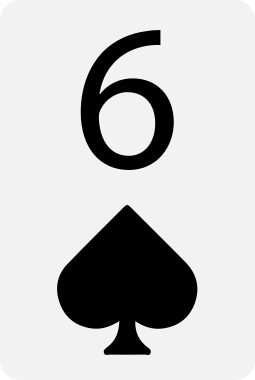
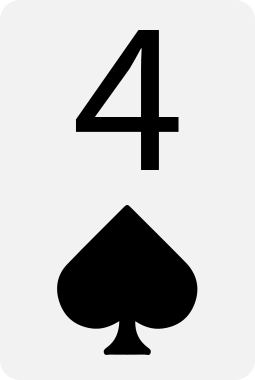
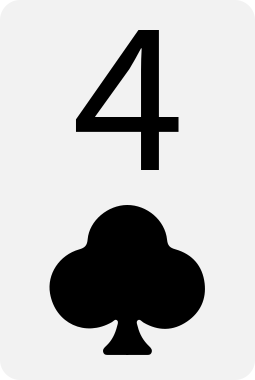
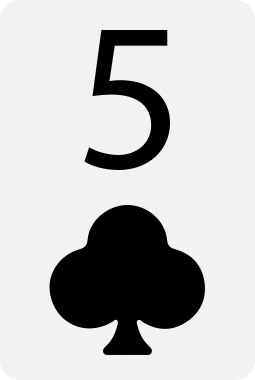
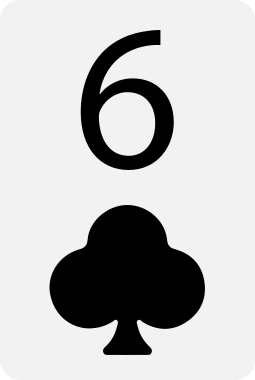
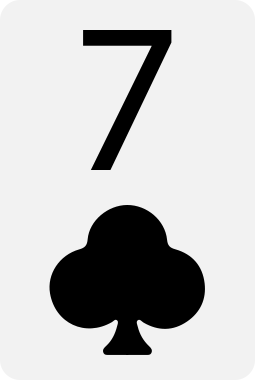
Six-Four Suited is a one-gap suited connector at the lower end of the rank spectrum, sitting one step below 75s in the same structural family. Two low cards separated by a single rank gap, suited, with genuine straight and flush drawing potential and essentially no high-card value to speak of. It shares the same strategic identity as 86s and 75s – a hand played entirely for post-flop drawing value in the right conditions – but the lower rank pushes overcard exposure closer to the near-certainty levels seen with zero-gap hands like 65s and 54s.
64s is a hand for players who understand implied odds, position, and post-flop discipline. In the wrong conditions it bleeds chips quietly. In the right conditions it makes disguised, powerful hands that win large pots.
What These Odds Show for 64s
The straight odds for 64s land at 6.97% by the river, sitting between 75s at 7.32% and 96s at 6.02%. This is consistent with a one-gap hand at this rank – better straight equity than two-gap hands, but slightly below the figures for one-gap hands one rank higher. The 0.96% flop straight odds match 75s and 86s exactly, confirming the shared one-gap structure. Straight flush potential at 0.15% is in line with the other one-gap low suited hands.
Flush equity is 6.43% by the river, identical to 75s and 86s as expected.
The overcard table is the most instructive figure for understanding where 64s sits in the hierarchy. At 95.84% on the flop, 98.67% by the turn, and 99.60% by the river, the numbers are identical to 65s. This makes sense – the overcard calculation is driven by the highest card in the hand, and both 64s and 65s have a Six as their top card. Whether the second card is a Four or a Five makes no difference to how often a higher card appears on the board. The Six is simply not a strong enough anchor to suppress overcard frequency, and by the river a board without an overcard is a near-impossibility.
The practical consequence of matching 65s on overcards while having lower straight equity than 65s is that 64s sits strictly below 65s in the one-gap versus zero-gap comparison – more overcard exposure for its rank level, and fewer straight combinations than the zero-gap equivalent.
Hand Strength Summary
- Hand type: Suited connector (one-gap)
- Relative strength: Speculative; low rank with near-certain overcards and limited high-card fallback
- Main draws: Straights, flushes, two pair from connected boards, combination draws
- Main vulnerability: Overcards essentially guaranteed by the river at 99.60%; one-gap structure reduces straight combinations versus zero-gap equivalents; low straights vulnerable to the higher end
How 64s Wins
- Completing straight draws, which are deeply disguised at this rank
- Completing flush draws
- Flopping two pair when both hole cards connect with the board
- Building combination draws – open-ended straight draw plus flush draw – that create substantial equity even before completion
- Taking pots through semi-bluffing on scare cards when a draw is live
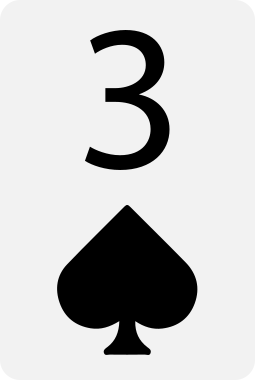
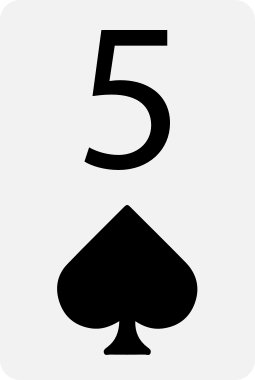
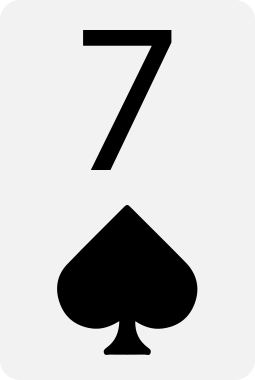
The disguise with 64s is considerable. On a board of 3♣ 5♦ 7♥, opponents holding overpairs or top pair have no reason to put 64s on the nut straight. That concealment, combined with the implied odds from opponents who will not fold strong hands, is the core source of value.
Main Weaknesses
- Overcards approaching certainty at 99.60% by the river – there is no high-card plan
- One-gap structure means one fewer straight combination than zero-gap connectors like 65s, reflected in the lower river straight odds of 6.97% versus 8.57%
- Low straights are vulnerable to the higher end – opponents holding 75s, 86s, or 97s can have the top of a straight when 64s holds the bottom
- Flush draws can be beaten by any opponent holding a higher card of the same suit
- The Four contributes very little independently beyond completing specific straight draws and the occasional two pair
Best and Worst Flop Textures
Strong flops
- Low connected boards creating open-ended straight draws (3♣ 5♦ 8♣ or 5♥ 7♦ 2♣)
- Two-tone flops in your suit with straight draw potential alongside
- Boards where both hole cards pair simultaneously (6♦ 4♣ A♥ gives two pair, though the Ace requires caution)
Dangerous flops
- High disconnected boards (A♣ K♦ T♣) – no pair, no draw, no reason to continue
- Boards completing straights for higher connectors where 64s is drawing to the losing end
- Monotone flops in a suit you do not hold
How It Plays by Position
- Early position: Not a hand to open; the near-certain overcards, limited high-card strength, and post-flop disadvantage of playing out of position make the implied odds model very hard to justify
- Middle position: Marginal at best; suitable only for passive multiway games where cheap flop entry is realistic and stack depth supports implied odds
- Late position / button: Where this hand belongs – steal potential, cheap flop access, and the positional advantage necessary to navigate frequent missed flops without haemorrhaging chips
- Blinds: A reasonable big blind defend against a single late-position raiser when pot odds are favourable; requires disciplined folding on flops with no pair, no draw, and no backdoor equity
Common Mistakes
- Calling raises from out of position, which destroys the implied odds model the hand depends on entirely
- Drawing to the low end of a straight without recognising when an opponent holds the higher end – with 64s on a board of 3-5-7, any opponent with 8-6 or 8-7 has a higher straight
- Continuing past the flop with no pair, no draw, and no backdoor equity, which happens frequently given the overcard certainty
- Overestimating flush draw value in multiway pots where higher flush draws are likely to be present
- Playing in shallow-stack situations where implied odds cannot justify seeing flops with a hand that misses this frequently
Comparison to Similar Hands
- Stronger than: 64o (the flush draw is a significant addition to a hand with no high-card strength), 53s (weaker rank and more constrained straight range)
- Weaker than: 75s (one rank higher, overcard exposure drops from 99.60% to 98.76% and straight equity improves to 7.32%), 65s (zero-gap, one additional straight combination, river straight odds of 8.57% versus 6.97%)
- The comparison to 65s is the sharpest. Both hands share the same overcard table – driven by the Six as the top card – but 65s has the zero-gap advantage that adds a full straight combination, producing 8.57% river straight equity versus 6.97% for 64s. That 1.6 percentage point difference in the hand’s primary draw is the clearest argument for preferring 65s when both are available in similar situations
How 64s Performs in Multiway Pots
64s shares the multiway pot profile of other low suited connectors. More players mean larger implied odds when straights and flushes complete, and the low-rank disguise factor is considerable – opponents rarely anticipate a Six-Four having arrived at the nuts. These are genuine advantages in multiway pots with cheap preflop entry.
The risks are familiar. More players increase the probability that someone holds a higher flush draw, and the danger of drawing to the low end of a straight – where an opponent holds the higher end – scales with the number of opponents holding connected cards. The discipline required is identical to 65s and 75s: identify whether the draw is to the nuts before committing significant chips on later streets.
FAQ: Six-Four Suited
How does 64s compare to 65s given they share the same overcard odds?
The overcard tables are identical because both hands have a Six as their highest card. The meaningful difference is in straight equity – 65s is a zero-gap connector with one additional straight combination, producing 8.57% river straight odds versus 6.97% for 64s. Since straights are the primary winning hand for both, 65s is the stronger hand in most situations despite the overcard tables being the same.
Why are 64s straight odds lower than 75s despite both being one-gap hands?
They are not dramatically different – 6.97% versus 7.32% – but the small gap reflects the specific straight combinations available at each rank. The number of board configurations that complete a straight using both cards differs slightly depending on how many valid straights exist in each direction. For 64s, the bottom end of the straight range is constrained by the bottom of the deck, reducing combinations slightly compared to 75s which has more room in both directions.
What is the wheel risk with 64s?
64s can be involved in straights at the very low end of the range – boards like A-2-3 give a wheel draw using the Four and Five of the board, or 2-3-5 gives a straight draw. These straights are the weakest possible and are vulnerable to any higher straight. Being aware of when you are drawing to or have made a wheel-adjacent straight is important with low connector hands.
Does 64s ever play like a zero-gap connector?
On specific boards, yes. A flop of 3-5-x or 5-7-x gives 64s an open-ended straight draw just as a zero-gap connector would. The difference is that these boards are less frequent for 64s than the equivalent for 65s, because 64s has one fewer combination in its straight structure. When those boards do appear, the hand plays very similarly to 65s or 75s in terms of draw strength and semi-bluff potential.
Related Hands