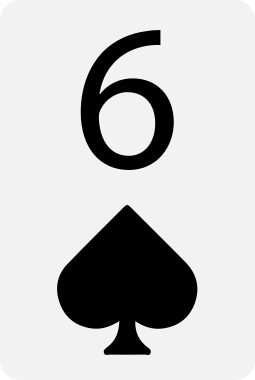
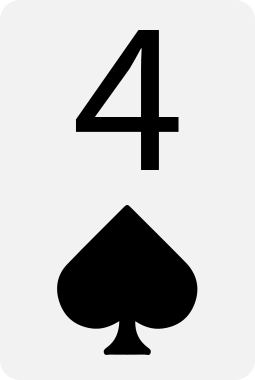
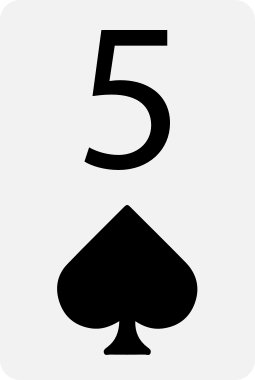
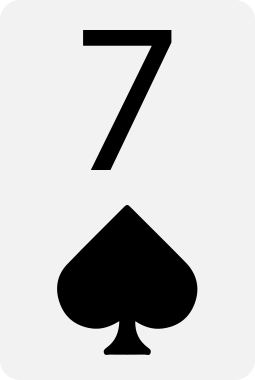
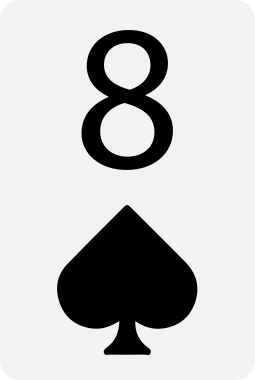
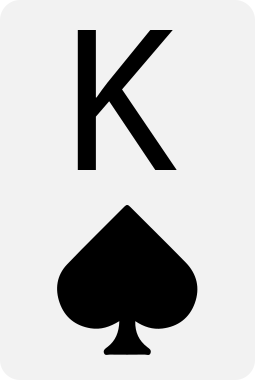
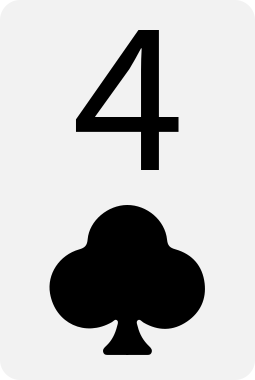
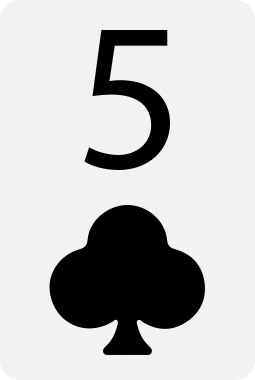
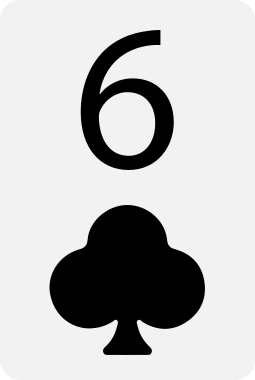
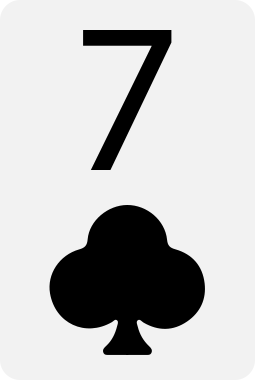
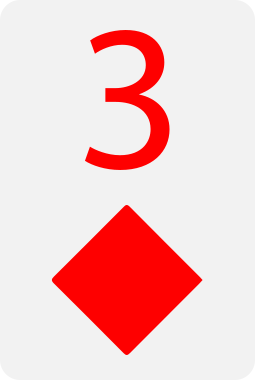
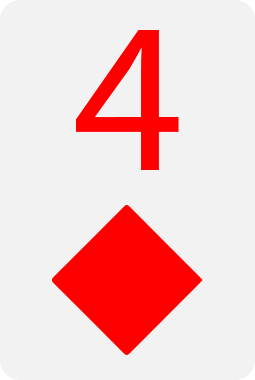
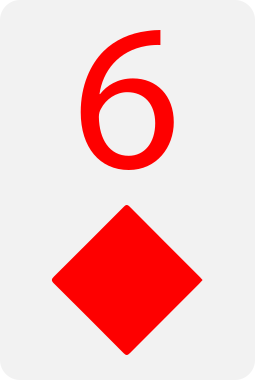
Six-Four offsuit is a low one-gap connector that sits in the same structural family as 86o and 75o, one rank below each of them respectively. The hand shares the defining characteristics of that family – moderate straight potential, no flush equity, and overcard exposure severe enough to make pair-based hands almost entirely unreliable – while operating at the bottom end of the range where both cards are low enough that board presence is nearly absent. It is a hand whose entire case for occasional playability rests on a single number in the draw odds table, and everything else argues against it.
What These Odds Show for 64o
The draw odds table for 64o follows the one-gap connector pattern with precision. High card on the flop at 52.90% – identical to 86o and 75o. Pair by the river at 43.58%, two pair at 22.40%, three of a kind at 4.37%, full house at 2.22% – consistent across the family. The straight rate is 0.98% on the flop, 3.41% by the turn, and 7.42% by the river.
That 7.42% straight rate deserves a moment of attention. It sits below 86o’s 7.75% and 75o’s 7.80%, continuing the gentle decline seen as the one-gap connector family moves down the rank ladder. The four straight combinations available to 64o run through ace-to-five, three-to-seven, four-to-eight, and five-to-nine. The presence of the wheel draw – A-2-3-4-5 – is worth noting, as it is the same low-end straight available to 54o and 75o but not to 86o, whose range begins at five-to-nine. However, as discussed with those hands, the wheel is the lowest possible straight and carries reduced implied value compared to higher straights.
The overcard table is where 64o separates most clearly from the higher one-gap connectors. At 95.84% on the flop, the six-high is staring up at overcards on essentially every board it sees – only slightly better than 54o’s 98.14% and measurably worse than 75o’s 92.14%. By the turn that figure reaches 98.67%, and by the river 99.60%. In practical terms, 64o will see at least one overcard on the board in every single session across any meaningful sample. There is no realistic low-board strategy to plan around – it is an occasional exception, not a baseline scenario.
Hand Strength Summary
- Hand type: Low offsuit one-gap connector
- Relative strength: Weak – among the least viable starting hands that retain any straight potential
- Best case: Open-ended straight draw on a low board, in position, with sufficient implied odds
- Main vulnerability: Near-certain overcard domination, no flush equity, no pair value under most conditions
64o has one legitimate use case and one realistic path to winning a meaningful pot. That path is the straight. Everything else the hand produces – pairs, high card, even two pair in most board contexts – is either dominated or irrelevant in a contested situation. The hand is as close to a pure draw hand as an offsuit holding can be while still retaining a straight rate worth discussing.
How Six-Four Offsuit Wins
64o wins through a narrower set of routes than even the low connectors higher in this series:
- Completing an open-ended straight draw, ideally on a board where opponents holding top pair or two pair do not recognise the straight possibility
- Flopping two pair specifically on a six-four board – a low-probability but decisive outcome when it arrives on a dry texture
- Semi-bluffing an open-ended draw with eight outs and taking the pot before completion through fold equity in position
- Winning uncontested pots preflop from late position where no opponent has found a reason to play back
A pair of sixes or fours in any contested pot with the overcard exposure this hand carries is not a realistic winner. The 99.60% overcard rate by the river is not a statistical curiosity – it is a near-guarantee that applies to every hand played.
Main Weaknesses
The weaknesses of 64o are the low connector problems taken to their logical extreme:
- The 95.84% overcard rate on the flop leaves pair equity with almost no value. A pair of sixes or fours on a board with a seven, eight, nine, ten, jack, queen, king, or ace – which describes virtually every board – is not a hand that wins contested pots
- The one-gap structure reduces straight combinations compared to true connectors, and at this rank the reduction is felt most acutely because the boards that 64o connects with are also the boards that carry the highest risk of opponents holding better draws
- No flush equity whatsoever. The 1.95% flush rate by the river is entirely the board
- A pair of fours is the second-lowest possible pair, trailing only a pair of threes and twos, and has essentially no independent showdown value
- Multiway pots dilute the already limited straight value when opponents in the same low-to-mid range share outs or hold blocking cards
- The wheel draw, while a genuine made straight when completed, is the lowest possible straight and can be beaten by any higher straight on boards that produce it
Best and Worst Flop Textures
Strong flops:
- 3-5 or 5-7 boards giving an open-ended straight draw – the primary and essentially only objective
- 2-5 boards creating a draw toward the wheel end of the straight range, though these boards attract other low-card holdings that may share outs
- 6-4-x boards for immediate two pair, best on a completely dry texture where no draw is available to opponents
- Low, uncontested boards in position where a semi-bluff can take the pot without requiring the draw to complete
Dangerous flops:
- Any board with two or more cards above a six – which describes 95.84% of flops and is the dominant experience with this hand
- Boards where the straight outs are partially blocked by opponents holding middle-range connectors or suited cards
- Monotone or two-tone high boards where the hand has no connection and no draw, and continuation is pure bluffing
- Any flop in a multiway pot where overcard exposure compounds across multiple opponents simultaneously
How It Plays by Position
Early position:
Never. 64o from early position in any standard game format is an automatic fold with no qualifying circumstances.
Middle position:
A fold at any full ring table. The hand requires too specific a board texture to justify entering a pot against multiple players yet to act.
Late position:
The hand’s only defensible home, and even here it requires an unopened pot and a clear read that opponents will not play back aggressively. From the button or cutoff, 64o can be raised speculatively or played for a cheap flop with the straight potential as the justification for a single investment.
Blinds:
In the big blind with pot odds against a single steal raise, 64o is a marginal defend at best. The connectivity means a straight draw will arrive on a subset of flops, and the pot odds may justify one street of investment to find out. The plan is entirely draw-dependent – check-fold any flop that does not produce an open-ended draw or two pair, and play aggressively when the draw arrives. From the small blind, a fold is correct against most opponents.
Common Mistakes with Six-Four Offsuit
The errors with 64o are familiar from 86o and 75o, concentrated by the hand’s position near the bottom of the playable range:
- Continuing on flops with only a pair of sixes or fours, where the overcard exposure of 95.84% means the hand is almost certainly behind any opponent who has connected
- Treating a gutshot draw as equivalent to an open-ended draw – four outs at the turn is not a reason to call significant bets, and 64o produces gutshots as often as open-ended draws on boards that partially connect
- Overestimating implied odds for the straight when playing at stack depths that do not justify the investment or against opponents who will not pay off a completed draw
- Confusing 64o with 64 suited, which is a notably more playable hand due to the flush equity added by the suited version
- Playing the hand in multiway pots beyond a single cheap call, where the compounding of overcard pressure and shared outs erodes the already limited equity
Comparison to Similar Hands
- Stronger than: 6-3o and 6-2o, where the kicker is weaker and straight combinations fewer; 5-3o, which sits at a similar level with slightly different straight combinations
- Weaker than: 64 suited, which adds flush draw equity that transforms the hand’s multiway and semi-bluff potential; 75o, where the higher top card reduces the overcard rate from 95.84% to 92.14% – a meaningful difference across a session; 86o, where both cards sit one rank higher and board presence improves further
- Similar to: 75o – the closest structural comparison, one rank higher with nearly identical straight rates and only the overcard table separating them meaningfully
The relationship between 64o and 75o mirrors the relationship between 75o and 86o established earlier in this series. Each step up the rank ladder in the one-gap connector family produces nearly identical straight rates while providing a consistent reduction in overcard exposure. The straight rate at 7.42% is marginally lower than 75o’s 7.80%, which is marginally lower than 86o’s 7.75%. The overcard rate at 95.84% is meaningfully higher than 75o’s 92.14%, which is higher than 86o’s 86.73%. The pattern is consistent: moving down the rank ladder costs overcard protection faster than it costs straight potential.
How Six-Four Offsuit Performs in Multiway Pots
The implied odds argument for low connectors in multiway pots reaches its weakest form with 64o. The theoretical case – more players, bigger pots when the straight arrives – applies in narrow circumstances:
Arguments in favour:
- A hidden straight on a low board in a multiway pot can win a large pot, and 64o’s straight combinations on boards like 3-5-7 or 5-7-8 can be genuinely disguised against opponents focused on their own top pair or two pair holdings
- The wheel draw creates occasional large-pot opportunities on A-2-3 and A-2-5 type boards where opponents with aces feel confident
Arguments against:
- The 99.60% overcard rate by the river means pair equity contributes nothing in multiway pots under virtually any conditions
- Opponents playing low cards in multiway pots are frequently holding the same low-range cards that block or share 64o’s straight outs
- Without flush equity, any board with a flush draw in play gives opponents a clean route to winning the pot that 64o cannot challenge
- At any point where the pot becomes significant multiway, 64o’s two pair is vulnerable to higher two pairs and sets, and its straight draws are only as clean as the opponents’ holdings allow
FAQ: Six-Four Offsuit
How does 64o compare to 54o despite having a gap?
54o is a true connector with five straight combinations and a 9.18% completion rate by the river. 64o has a one-card gap, four straight combinations, and a 7.42% completion rate. 54o is the better drawing hand despite having lower-ranked cards, because the absence of a gap produces more consistent straight connectivity. This illustrates that gap matters more than rank for drawing hands at this level of the range.
Is the wheel draw a meaningful advantage for 64o?
It is a genuine straight combination that 86o does not have, but the wheel is the lowest possible straight and carries the caveat that it can be beaten by any higher straight on the same board. On boards where the wheel is possible, experienced opponents often recognise the low-board texture and proceed with caution, which can reduce implied value.
At what stack depth does 64o become playable?
The hand requires deep stacks to justify speculative play – generally 100 big blinds or more – because the implied odds for completing a straight need to be substantial to offset the frequency of missing. At shorter stack depths, the investment required to see the draw through is too large relative to the pot available to win.
Does position matter more for 64o than for higher hands?
Yes, significantly. The hand’s reliance on a specific draw rather than pair value means it is almost exclusively dependent on position to generate any profit. Out of position, the hand cannot easily build pots when the draw arrives and cannot easily control the pot size when it misses. Position is not just important for 64o – it is the primary determining factor of whether the hand has any value at all.
Related Hands