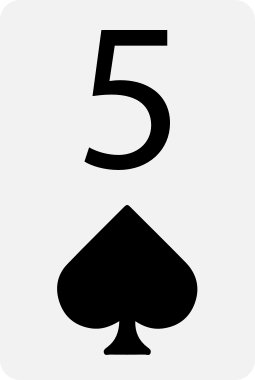
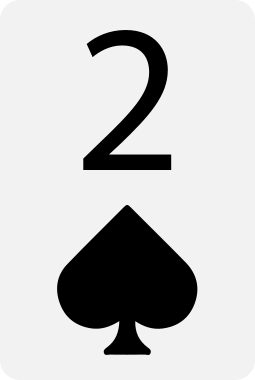
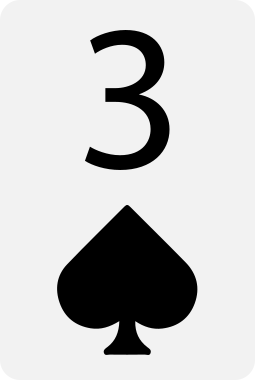
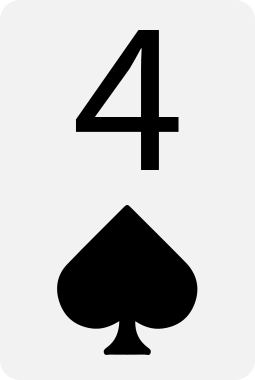
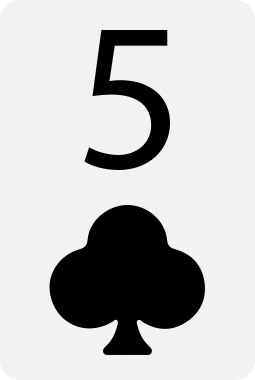
Five-Three offsuit is a low one-gap connector that occupies the same structural position relative to 54o as 64o occupies relative to 65o – one step down from the true connector at the same rank level, trading the maximum straight potential of a gapless hand for a slightly different set of straight combinations that arrive at nearly the same frequency. The hand shares its overcard table exactly with 54o, faces the same near-certain board domination on every street, and differs from it primarily in the specific draws it produces rather than how often those draws complete. It is a hand at the extreme low end of anything resembling playability, and its strategic discussion is brief not because it lacks structure but because that structure has already been established in full by the hands above it in this series.
What These Odds Show for 53o
The draw odds table for 53o is strikingly close to 64o across every category. High card on the flop at 52.90%, pair by the river at 43.58%, two pair at 22.40%, three of a kind at 4.37% – all identical to 64o. The straight rate is 0.98% on the flop, 3.41% by the turn, and 7.47% by the river, placing it marginally above 64o’s 7.42% and marginally below 75o’s 7.80%. These differences are within statistical noise for any practical purpose.
The four straight combinations available to 53o run through ace-to-five, two-to-six, three-to-seven, and four-to-eight. Compared to 64o, the range has shifted one step lower – 53o loses the five-to-nine combination available to 64o and gains the two-to-six combination instead. The net effect on the completion rate is essentially zero, confirming that adjacent one-gap connectors of similar rank have equivalent straight equity regardless of which specific four combinations are available.
The overcard table is 98.14% on the flop, 99.57% by the turn, and 99.91% by the river – identical to 54o’s figures to the decimal place. Both hands share the same top card, the five, and the only difference between them is whether the second card is a four or a three. Since the overcard table measures exposure to cards higher than the five, and both hands have a five as their highest card, the figures are necessarily the same. This is the same logic that produced identical overcard tables across the entire weak king series, now applied at the opposite end of the rank ladder.
Hand Strength Summary
- Hand type: Low offsuit one-gap connector
- Relative strength: Among the weakest starting hands in Texas Hold’em with any residual straight potential
- Best case: Open-ended straight draw on a very low board, in late position, with deep stacks and implied odds
- Main vulnerability: Near-certain overcard domination on every board, no flush equity, no pair value in contested situations
53o and 54o are functionally the same hand in strategic terms. Both have a five as the top card, both face overcards on virtually every board, and both rely entirely on completing a straight to win meaningful pots. The difference between a four and a three as the lower card shifts which specific straight combinations are available but does not change the frequency of completion, the overcard exposure, or the strategic approach in any meaningful way.
How Five-Three Offsuit Wins
53o wins through the same routes as 54o, 64o, and 75o, with no new mechanisms:
- Completing an open-ended straight draw, particularly on low boards where opponents holding top pair with high cards do not anticipate the straight
- Flopping two pair specifically on a five-three board, best on a completely dry, low texture
- Semi-bluffing an open-ended draw with eight outs from position, taking the pot before completion through fold equity
- Stealing uncontested pots preflop from late position – the hand’s weakest positional case of any one-gap connector in this series, given that a five is the lowest top card available to any hand with straight potential
The two-to-six straight deserves brief mention as a combination not available to 54o. On a board reading A-2-4 or 2-4-6, 53o picks up draws that the true connector cannot form. These are genuine combinations but narrow ones, and they do not materially change the hand’s overall profile.
Main Weaknesses
53o’s weaknesses are the low one-gap connector problems at their most pronounced:
- The 98.14% overcard rate on the flop is the same near-certainty seen with 54o – both hands share a five as their top card, and five is the second-lowest possible top card for any hand with straight potential
- A pair of fives or threes in any contested pot is behind virtually every opponent who has connected with the board
- The three as an independent card has less straight-forming value than a four – specifically, a three contributes to two-to-six and three-to-seven combinations, while a four contributes to three-to-seven and four-to-eight. Neither is superior, but the three pushes the hand’s straight range slightly further into low-board territory where the wheel and near-wheel combinations dominate
- No flush equity whatsoever
- Multiway pots dilute the already limited straight equity when opponents hold cards in the same low range
- The wheel draw produces the lowest possible straight, which can be beaten on boards that allow higher straights
Best and Worst Flop Textures
Strong flops:
- 2-4 or 4-6 boards giving an open-ended straight draw – the primary target
- A-2 boards creating a draw toward the wheel end of the straight range, though the wheel’s implied value is limited
- 5-3-x boards for immediate two pair on a completely dry, rainbow texture
- Low, uncontested boards in position where a semi-bluff can take the pot without requiring completion
Dangerous flops:
- Any board with two or more cards above a five – which describes 98.14% of flops without exception
- Boards where low connecting cards are present but opponents with 64, 75, or 86 type holdings have better straight draws
- Any multi-opponent pot on any board texture
- High or coordinated boards where the hand has no connection whatsoever and continuation is unsupported bluffing
How It Plays by Position
Early position:
Never. 53o from early position is not a consideration under any standard game conditions.
Middle position:
A fold at any full ring table. Even in short-handed games, the hand sits below the threshold where middle-position entry is justified.
Late position:
The hand’s only viable home, and even here the case is weaker than for the higher one-gap connectors. From the button or cutoff in an unopened pot, 53o can be raised speculatively, but the five as the top card provides less high-card credibility for a steal than an eight, nine, or ten would. The straight potential justifies a single investment in position when the pot is unopened and opponents are passive.
Blinds:
In the big blind with pot odds against a single steal raise, 53o is at the outer limit of a defensible call on connectivity grounds alone. The strategy is entirely draw-dependent – check-fold boards that miss, play aggressively when an open-ended draw arrives, and avoid investing further without clear justification. From the small blind, a fold is correct against most raises.
Common Mistakes with Five-Three Offsuit
The errors with 53o are the low connector mistakes applied at their most concentrated:
- Continuing past the flop with only a pair of fives or threes, where the 98.14% overcard rate means the hand is almost certainly behind any opponent who has connected
- Treating the hand as equivalent to 54o in all respects – while the strategic approach is the same, the specific draws differ, and players should recognise that 53o’s straight combinations are concentrated further into low-board territory than 54o’s
- Chasing a gutshot draw rather than an open-ended draw – 53o will produce gutshots as often as open-enders on partially connecting boards, and four outs does not justify continued investment at most stack depths
- Overvaluing the wheel draw by equating it with higher straights – a made hand is a made hand, but the lowest straight is the most vulnerable to being counterfeited or beaten by higher straights
- Playing the hand in multiway pots beyond the absolute minimum investment
Comparison to Similar Hands
- Stronger than: 5-2o, where the kicker has no straight combinations above the wheel, making this the lowest one-gap connector with any residual multi-straight potential; 4-2o and 3-2o, where the connectivity is further reduced
- Weaker than: 53 suited, which adds flush draw equity that doubles the hand’s path to a strong made hand; 54o, which is a true connector with one more straight combination and marginally higher completion rate; 64o, where the higher top card reduces overcard exposure from 98.14% to 95.84%
- Similar to: 54o – the closest structural comparison, one step up the rank ladder with identical overcard exposure and only the specific straight combinations differing between them
The comparison between 53o and 54o is the most instructive pairing for this hand. Both share the five as their top card, producing identical overcard tables. 54o has five straight combinations to 53o’s four, giving it a 9.18% completion rate by the river versus 53o’s 7.47%. That 1.71 percentage point difference in favour of the true connector is the clearest quantification of what the gap in 53o costs – not a dramatic reduction in drawing potential, but a consistent and real one that compounds across every session the hand is played.
How Five-Three Offsuit Performs in Multiway Pots
The multiway argument for 53o is the same as for 64o and 75o, now at its weakest iteration. The implied odds case – more players, bigger pots for a hidden straight – applies in the narrowest possible form:
Arguments in favour:
- A completed straight on a low board in a multiway pot is genuinely well-disguised, particularly the two-to-six or three-to-seven straight on boards opponents read as safe for their top pair
- The wheel on an A-2-4 or A-2-3 board can trap opponents with strong aces who feel confident in their holding
Arguments against:
- The 99.91% overcard rate by the river means pair equity contributes nothing in any realistic multiway scenario
- Low boards attract other low-card holdings, and straight outs are frequently shared or blocked
- Without flush equity, wet boards give opponents advantages that 53o cannot contest
- At the stack depths where implied odds justify speculative play with hands like this, multiway pots often do not generate the pot sizes needed to offset the frequency of missing
FAQ: Five-Three Offsuit
How does 53o differ from 54o strategically?
In practice, almost not at all. Both hands have a five as the top card, identical overcard exposure, and rely entirely on the straight as the path to winning meaningful pots. 54o has one additional straight combination and a 1.71% higher completion rate by the river. The strategic approach – fold early and middle, steal late, draw-dependent postflop – is the same for both.
Is 53o better or worse than 64o?
The hands are very similar. 64o has a higher top card, which reduces the overcard rate from 98.14% to 95.84% and provides marginally more pair equity. 53o has a 7.47% straight rate versus 64o’s 7.42% – essentially identical. 64o is the marginally stronger hand due to better board presence, but neither hand is meaningfully playable outside of late-position speculation.
Does the two-to-six straight provide any unique value?
It provides a genuine straight combination on low boards that 54o cannot form – specifically on boards running through 2-4-x or 2-3-4 type textures alongside A-2-x boards. Whether this creates unique implied value depends entirely on whether opponents are holding high cards with which they will pay off the completed straight. On very low boards, opponents holding premium hands with high cards may feel pot-committed when the straight arrives unannounced.
When does 53o have the highest expected value?
In late position, in an unopened pot, against passive opponents at deep stack depths who will pay off a completed straight. The hand’s value is almost entirely positional, situational, and dependent on implied odds rather than intrinsic hand strength. It has essentially no value in any other context.
Related Hands