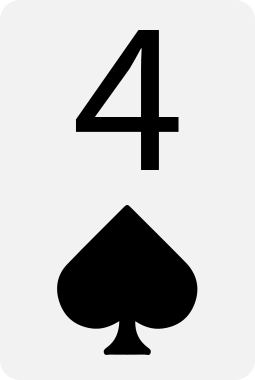
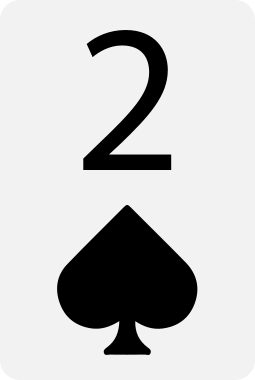
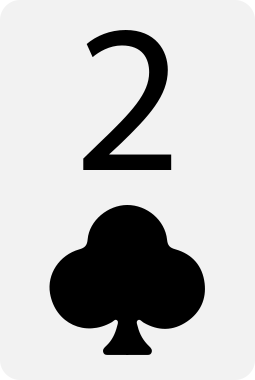
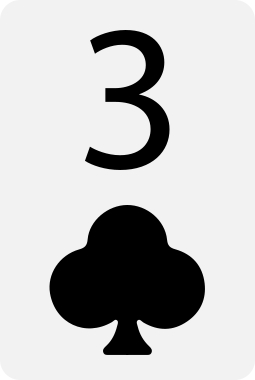
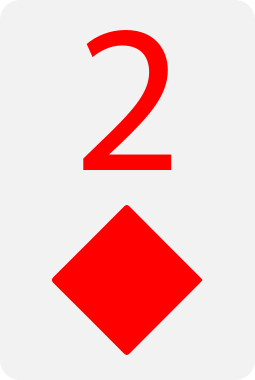
Four Two Offsuit is one of the weakest starting hands in Texas Hold’em. It holds no high card, no flush draw potential, and only modest connectivity between its two low components. The four and two sit close enough in rank to generate some straight draw equity, but neither card offers any meaningful showdown value through pair strength, and the overcard exposure figures for this hand are the most extreme in the entire starting hand matrix – effectively a statistical certainty on every street.
42o is not a hand that belongs in the pot in standard situations. Its profile is similar to 52o and 63o, sharing the same general characteristics of weak low connectors with limited but identifiable straight draw potential. What distinguishes 42o from those hands is that its overcard exposure is even more severe, its pair value even more negligible, and its straight potential, while real, is fractionally lower than its nearest comparisons.
What These Odds Show for 42o
The high card outcome on the flop is 53.22%, consistent with other hands of similar connectivity such as 52o and 63o. By the river that figure drops to 18.78%, sitting between 52o (18.55%) and 63o (18.60%) – a reflection of how tightly grouped the draw profiles of these low connector hands are, despite their differences in rank.
The pair probability on the flop is 40.41%, the standard figure for all non-paired starting hands. Pairing the four gives a very low pair in almost every conceivable board context. Pairing the two gives the weakest possible pair in Texas Hold’em. Neither outcome produces a hand with meaningful showdown confidence in any contested pot, and the combination of the two as kicker to each other offers no comfort when both players pair the same board card.
The straight odds by the river are 5.38%, slightly lower than 52o’s 5.76% and 63o’s 5.71%. On the flop there is already a 0.65% chance of having completed a straight, rising to 2.35% by the turn. The four and two can contribute to straights built around threes, fives, and sixes, with the wheel – ace through five – representing one of the most accessible combinations since the ace is the most common overcard to appear on low boards. The hand is slightly less straight-capable than 52o because the four-to-two gap, while only two ranks, sits so low in the deck that fewer board combinations can connect both cards simultaneously compared to the five-to-two combination.
The overcard odds are the defining feature of this page, and they are extraordinary. There is a 99.39% chance of an overcard appearing on the flop. By the turn that reaches 99.91%, and by the river 99.99%. This is as close to a statistical certainty as exists anywhere in Texas Hold’em starting hand analysis. In practical terms, 42o will almost never hold a top pair. Every pair either hole card makes is bottom or near-bottom pair on essentially every board ever dealt. Playing this hand for pair strength is not a strategy – it is an exercise in wishful thinking.
Hand Strength Summary
- Hand type: Weak offsuit low connector, among the worst starting hands in the game
- Relative strength: Bottom tier of all 169 starting hands
- Best feature: Modest straight draw potential including wheel combinations with board aces
- Main vulnerability: No high card, no flush draw, near-total overcard exposure approaching a statistical certainty, essentially no showdown value through pair strength
42o does not win through conventional hand strength. When it wins at showdown, it almost always does so by completing a straight, and even that requires very specific board conditions to develop.
How 42o Wins
42o has an extremely narrow set of winning paths:
- Completing a wheel straight when an ace and connecting low cards such as a three and five appear on the board
- Completing other low straights on boards containing threes, fives, and sixes in the right combinations
- Flopping two pair on extremely low boards where both the four and two connect simultaneously – a rare outcome that requires a board lower than almost anything opponents are likely to hold
- Winning uncontested pots through late position aggression before showdown against opponents who miss equally badly
- The board running out so low that a pair of fours represents any value at all – a near-impossibility given the overcard figures
Main Weaknesses
42o is structurally compromised in virtually every dimension:
- No card above a four means it is outranked at pair strength by essentially every other starting hand combination in existence
- No suited component removes any flush draw potential entirely
- Overcard exposure of 99.99% by the river makes top pair a statistical impossibility – the hand will always be making bottom or near-bottom pair
- Even its straight draw requires very specific board textures and does not justify any meaningful investment to pursue
- Pairing the two is the single weakest pair outcome available in Texas Hold’em
- The hand has no nut potential in any category outside of the occasional wheel straight, and even that straight is the lowest possible straight in the game
- Any two pair the hand makes will be an extremely low two pair, vulnerable to being outdrawn or already behind a higher two pair
Best and Worst Flop Textures
Strong flops for 42o:
- Boards containing an ace and two connecting low cards such as A♠ 3♦ 5♣, delivering a completed wheel straight
- Low connected boards with threes and fives that deliver open-ended straight draws toward the six or high end
- Boards containing a three and a five simultaneously, giving an open-ended straight draw that can be completed by any ace or six
Dangerous flops for 42o:
- Any board with cards above a four, which the overcard odds confirm will occur on essentially every single flop ever dealt – making dangerous flops virtually synonymous with all flops for this hand
- Flush draw boards where opponents can apply pressure and 42o has no equivalent semi-bluff mechanism to fight back with
- Any flop that generates meaningful action from opponents, since 42o almost never holds the hand strength to call bets without a strong straight draw already materialised
How It Plays by Position
- Early position: An unconditional fold in every standard game without exception. There is no rational argument for entering a pot with 42o from early position.
- Middle position: Still a fold. No amount of positional advantage at this stage compensates for the hand’s fundamental weaknesses.
- Late position / button: The one position with any theoretical basis for playing, limited to steal attempts against very passive or tight blinds in unraised pots, or extremely cheap multiway limps where straight draw implied odds – particularly toward the wheel – could theoretically justify the negligible cost of entry.
- Blinds: From the big blind it can see cheap flops in limped pots at no additional cost, which is the hand’s most natural and defensible home. Even here it should be abandoned rapidly unless the flop delivers meaningful straight draw texture.
42o requires the combination of maximum position and minimum cost to have any presence in a hand at all. Even then it remains among the least viable holdings available.
Common Mistakes with 42o
- Continuing past the flop with a pair of twos or fours in any contested pot without a straight draw to accompany it
- Calling raises with 42o under any circumstances – the hand is a significant underdog to every realistic raising range and has no compensating equity
- Overestimating the straight draw value – 5.38% by the river requires specific board conditions and does not justify investments beyond the minimum cost to see a flop
- Entering pots from early or middle position without a clear and rational justification for doing so
- Treating the wheel draw as a reason to apply aggression when only one connecting card has appeared on the board and the draw remains incomplete
Comparison to Similar Hands
- Stronger than: Hands with no connectivity at all such as 72o, where the gap between hole cards removes even the modest straight draw potential that 42o carries
- Weaker than: 52o, 53o, 43o, and their suited versions, where connectivity is marginally tighter, rank is slightly higher, or flush draw equity is added
- Similar to: 32o, which shares an almost identical draw profile, equally extreme overcard exposure, and the same fundamental reliance on straight completion as its primary winning path
The suited version, Four Two Suited, is a meaningfully better hand in practice. The flush draw adds a second genuine equity path, transforms many marginal flops into semi-bluffing opportunities, and justifies playing in a broader range of cheap positional spots. 42o has no such compensation and should be treated as one of the game’s most straightforwardly unplayable holdings in standard situations.
How 42o Performs in Multiway Pots
42o presents one narrow argument in favour of multiway pots and several against. The implied odds of completing a wheel straight or another low straight improve when more players are in the pot, since those opponents are more likely to pay off a well-disguised made hand they did not anticipate. The wheel in particular benefits from this dynamic – opponents holding aces often feel strong enough to commit chips, unaware that the low end of the straight is in play.
Against those implied odds must be weighed the following:
- More opponents increase the chance that someone holds a significantly stronger hand or a better draw
- Any pair made with 42o is essentially indefensible in multiway pots against players holding any meaningful board presence
- Without flush equity, the hand cannot apply semi-bluff pressure on draw-heavy boards at any point in the hand
- Fold equity disappears entirely in multiway situations, removing the option of winning without showdown
The most viable multiway scenario for 42o is a cheap limped pot from the big blind or button where the cost to see the flop is negligible and the board delivers an ace with connecting low cards for the wheel draw. Outside of that specific setup, multiway pots offer 42o very little.
FAQ: Four Two Offsuit
Is 42o one of the worst starting hands in Texas Hold’em?
Yes, by almost any measure. The overcard exposure of 99.99% by the river means it effectively never holds top pair. Its only genuine winning path is straight completion, and its pair strength is the weakest available outside of 32o. It competes with 72o and 32o for the title of least playable starting hand in the game.
How does 42o compare to 72o?
Both are among the worst starting hands in Texas Hold’em, but for slightly different reasons. 72o has a larger gap between its components and marginally worse straight potential, but the seven at least has some pair value on very low boards. 42o has tighter connectivity and therefore better straight draw potential, but its pair value is essentially nonexistent given the near-total overcard exposure. Which is worse depends on the specific scenario, but neither belongs in the pot in standard play.
Why does 42o have a slightly lower straight percentage than 52o?
The five-two combination can generate straights across a slightly wider range of board textures than the four-two combination, because the five sits one rank higher and therefore connects with more mid-range board cards. The difference is small – 5.76% versus 5.38% by the river – but it reflects the general principle that even within this tier of weak low connectors, rank matters at the margins.
What does a 99.99% overcard exposure figure actually mean in practice?
It means that across all possible board runouts for 42o, only a vanishingly small fraction result in a board where no card higher than a four appears. In practical terms, it means the hand will never hold top pair in any meaningful sense, and any pair it makes should be treated as a bluff-catcher at best and folded to significant pressure in almost all circumstances.
Related Hands