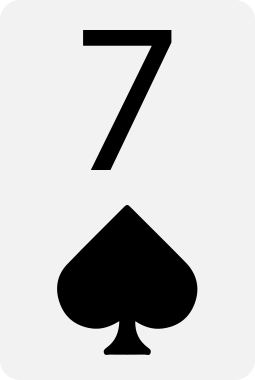
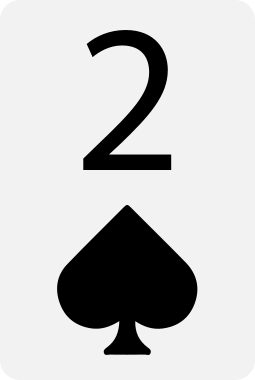
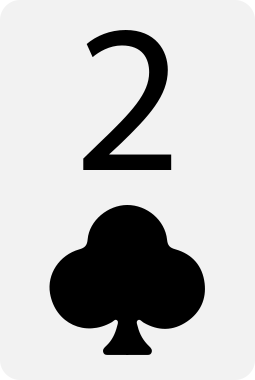
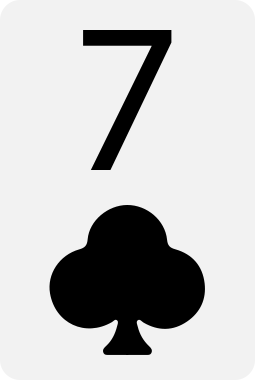
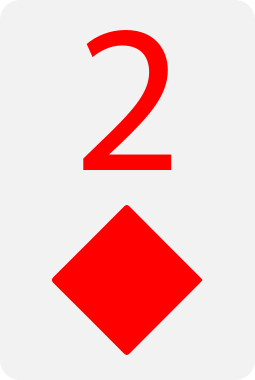
Seven Two Offsuit is the hand most synonymous with weakness in Texas Hold’em. Its reputation as the worst starting hand in the game is longstanding and widely recognised – referenced in poker culture, used as a prop bet in high-stakes games, and cited in virtually every introductory strategy discussion as the benchmark for an unplayable hand. Whether or not it is strictly the worst by every mathematical measure, it captures the concept of a fundamentally broken starting hand better than any other combination, and the draw odds table confirms why that reputation is deserved.
72o holds no high card, no flush draw potential, and no meaningful connectivity between its components. The seven offers minimal pair value in narrow board contexts, and the two contributes almost nothing. Together they form a hand with no coherent winning strategy in standard play.
What These Odds Show for 72o
The high card outcome on the flop is 53.88%, consistent with other large-gap offsuit hands. More than half of all flops leave 72o completely unimproved, and by the river that figure drops to 19.76% – the highest of all the seven-x offsuit hands in this series and higher than the equivalent figures for 82o (19.53%) and 92o (19.53%), reflecting the two’s absolute bottom-of-deck position limiting board connections across all streets. The seven is low enough in rank and the two disconnected enough from it that the hand fails to find the board more frequently than virtually any other starting hand with a similar gap structure.
The pair probability on the flop is 40.41%, the standard figure for all non-paired starting hands. Pairing the seven gives low pair on essentially every board ever dealt – the seven sits low enough in the deck that eights through aces, a vast overcard universe, will regularly appear above it on the board. Pairing the two gives the weakest possible pair in Texas Hold’em. Top pair with a two kicker is the most vulnerable form of top pair available in the seven-x family, dominated by every seven-x hand from 73o upward. The seven’s low rank means even its top pair outcome is less useful than the equivalent outcome for eight-x, nine-x, or ten-x hands, because a seven is more frequently middle or low pair than top pair on any given board.
The straight odds by the river are 2.67%, the lowest of any seven-x offsuit hand and notably lower than 73o’s 4.38%. The five-rank gap between seven and two is wide enough that joint straight contributions are essentially impossible, and the two’s position at the absolute bottom of the deck constrains its independent straight contributions more severely than any other second card. No straight is possible on the flop, the turn figure of 0.66% is the modest product of very specific board conditions beginning to develop, and the 3.05% figure seen in 82o and 83o drops further still here to 2.67% – matching the figures previously observed in J2o and representing the structural minimum for a seven-high hand. The seven connects to straights built around eights, nines, tens, and sixes, while the two connects to straights involving aces, threes, fours, and fives. Those two straight families have essentially no overlap, and the result is the lowest straight percentage among seven-x offsuit hands.
The overcard odds are identical to 73o: 92.14% on the flop, rising to 98.76% by the river. This consistency across 72o and 73o confirms the established pattern – overcard exposure within the seven-x family is determined entirely by the seven’s rank rather than the second card. With eights through aces all representing overcards to the seven, the hand faces a vast and consistent overcard universe on virtually every board, and by the river the probability of at least one overcard appearing approaches certainty. The seven is low enough in the deck that even on boards that miss most players, the seven will regularly be outranked.
Hand Strength Summary
- Hand type: Weakest unpaired seven-x offsuit hand, widely regarded as the worst starting hand in Texas Hold’em
- Relative strength: Bottom of all starting hand rankings by most measures
- Best feature: Seven provides low pair potential in very narrow board contexts
- Main vulnerability: No high card, no flush draw, essentially no joint straight draw, near-total overcard exposure, the weakest possible kicker
72o does not win through conventional hand strength in any realistic scenario. When it wins at showdown it does so almost exclusively through opponents missing the board more completely, or through very specific low board textures producing unlikely straight completions or two pair combinations.
How 72o Wins
72o has the most constrained winning profile of any starting hand alongside 32o:
- Flopping low pair with the seven on a board completely devoid of eights through aces – a scenario the overcard odds confirm approaches impossibility by the river
- Making two pair on a very low board where both the seven and two connect simultaneously
- Winning pots uncontested through late position aggression before showdown on boards that miss everyone, where the seven-high range can credibly represent at least some hand strength
- Opponents folding to pressure on completely dry low boards where any bet represents a believable made hand
- Completing a straight in the rare scenarios where the board delivers enough connecting cards around the seven to build one without the two’s contribution
Winning at showdown through pair strength in any contested pot is so infrequent as to be essentially irrelevant to any strategic discussion of the hand.
Main Weaknesses
72o is structurally compromised in ways that combine to produce the game’s most recognisable example of an unplayable starting hand:
- No high card above a seven means it is outranked at pair strength by the vast majority of starting hands
- No suited component removes any flush draw potential entirely
- Overcard exposure of 98.76% by the river makes top pair an effectively impossible outcome in practice
- The five-rank gap between seven and two produces the lowest straight percentage of any seven-x hand at 2.67% by the river
- Pairing the two produces the weakest possible pair in Texas Hold’em
- Even pairing the seven typically produces low pair rather than middle or top pair, since the seven’s rank places it near the bottom of the board hierarchy on most textures
- The two provides absolutely no blocking value, no connectivity, no kicker strength, and no draw contribution in any realistic game scenario
- The hand has no nut potential in any hand category whatsoever
Best and Worst Flop Textures
Strong flops for 72o:
- Completely low boards where the seven sits at or near the top rank (7♠ 2♦ 3♣), giving top pair with two pair potential – a scenario requiring a board that most opponents with any reasonable hand will have also missed
- Boards where both the seven and two connect simultaneously to give two pair on an extremely low texture, such as 7♥ 2♦ 4♣
- Dry rainbow boards where positional aggression can take down uncontested pots without reaching showdown
Dangerous flops for 72o:
- Any board featuring an eight or higher, which the overcard odds confirm will occur on 92.14% of all flops – making dangerous flops effectively synonymous with almost all flops for this hand
- Flush draw boards where opponents can apply pressure and 72o has no equivalent semi-bluff mechanism
- Any flop generating any action from any opponent, since 72o almost never holds enough hand strength to call any bet without a made two pair or better already in place
How It Plays by Position
- Early position: An unconditional fold in every standard game without any exception. There is no rational argument for entering a pot with 72o from early position under any circumstances in any game format.
- Middle position: Still a fold. No positional advantage from middle position makes 72o a viable starting hand.
- Late position / button: The one position with any theoretical basis for playing, limited exclusively to steal attempts against very tight or passive blinds in unraised pots, or extremely cheap multiway limps where the cost to see a flop is negligible. Even here it is the weakest possible hand to be playing.
- Blinds: From the big blind it can see cheap flops in limped pots at no additional cost. This is the hand’s only genuinely defensible home. Even here it should be abandoned immediately unless the flop delivers very specific low board texture.
72o requires the absolute combination of maximum position and minimum cost to have any presence in a hand at all. Even under those ideal conditions it remains the game’s most recognisable example of an unplayable starting hand.
Common Mistakes with 72o
- Continuing past the flop with a pair of twos or sevens in any contested pot under any circumstances
- Calling raises with 72o – the hand is a significant underdog to every starting hand in the game
- Overestimating the cultural cachet of 72o as a prop bet hand and allowing it to influence real game decisions
- Entering pots from any position other than the button or blinds with no justification for doing so
- Treating 72o as equivalent to 72s, which benefits from flush draw equity that meaningfully – though not dramatically – changes the hand’s overall playability profile
Comparison to Similar Hands
- Stronger than: 32o by some measures – the seven produces slightly more independent pair value than the three on low boards, and 72o’s overcard exposure at 98.76% is marginally lower than 32o’s effectively absolute 100.00%. The differences are minimal and neither hand belongs in the pot in standard situations
- Weaker than: 73o, which benefits from tighter connectivity between components at 4.38% straight potential by the river versus 72o’s 2.67%, and every other seven-x hand above it where kicker strength and connectivity both improve
- Similar to: 82o in terms of overall profile – a low card paired with the absolute minimum kicker and no suited component – with 72o differing in that the seven’s lower rank produces worse overcard exposure than the eight, even as both hands share the same fundamental unplayability in standard situations
The suited version, Seven Two Suited, is a more playable hand due to the addition of flush draw equity. However, even Seven Two Suited sits at the weaker end of the suited hand spectrum, and the improvement from offsuit to suited is less transformative here than in hands with a stronger high card, because the seven provides so little independent value that even the addition of flush equity cannot make 72o’s suited counterpart into a genuinely strong speculative hand.
How 72o Performs in Multiway Pots
72o presents the same narrow multiway argument available to all extreme low hands, paired with the same overwhelming list of disadvantages:
In its favour – the implied odds of a well-disguised low made hand increase with more players in the pot. Two pair with a seven and two on a very low board is a hand opponents will rarely put anyone on, and the pot odds in a cheap multiway limped situation can theoretically justify the investment to see a flop.
Against that – virtually everything else. Any pair made with 72o is low pair at best and bottom pair at worst, carrying almost no value against multiple opponents. More players increase the chance of someone holding a better hand or a stronger draw. Without flush equity the hand cannot apply pressure on draw-heavy boards. Fold equity disappears entirely in multiway situations. The hand has no nut potential in any category that multiway pots reward.
The only multiway scenario with any logic is a limped pot from the big blind where the cost to see a flop is zero, the board delivers a very low texture, and two pair or better arrives at no additional investment. Outside of that specific combination of circumstances, multiway pots offer 72o nothing.
FAQ: Seven Two Offsuit
Is 72o genuinely the worst starting hand in Texas Hold’em?
By cultural consensus and most practical measures, yes. It combines a low high card with the weakest possible kicker, no flush draw potential, near-total overcard exposure, and the lowest straight percentage among seven-x hands. Its nearest competitor for worst hand is 32o, which has lower overcard exposure from a pure pair value perspective but benefits from tighter connectivity and wheel draw potential. Most players and strategists place 72o at or very near the absolute bottom of the starting hand matrix, and its reputation in poker culture reflects that assessment accurately.
Why is 72o considered worse than 32o when 32o has higher overcard exposure?
The comparison is genuinely close and reasonable people disagree. The case for 72o being worse rests primarily on its lower straight potential – 2.67% by the river compared to 32o’s 5.01% – and the argument that the seven’s low pair value is less useful than the three’s wheel draw equity in the specific situations where each hand can win. The case for 32o being worse rests on its near-absolute overcard exposure and the fact that its pair value is even weaker than the seven’s. In practice both hands are unplayable in standard situations and the distinction is largely theoretical.
Does the prop bet culture around 72o affect how it should be played in real games?
Not in standard play. In games where a specific bonus is paid for winning a pot with 72o, the hand gains artificial value that changes the calculus around playing it in certain spots. In any standard game without such a rule, the prop bet history is irrelevant and 72o should be treated exactly as its draw odds suggest – as a hand with almost no viable home outside the big blind in a limped pot.
What is the single best realistic outcome for 72o in a standard game?
Stealing the blinds with a late position raise before seeing the flop. That outcome requires no board cooperation, no showdown, and no contribution from either hole card beyond the credibility of the raise itself. It is the hand’s most reliably achievable positive result, which says everything about its limitations as a starting hand.
Related Hands