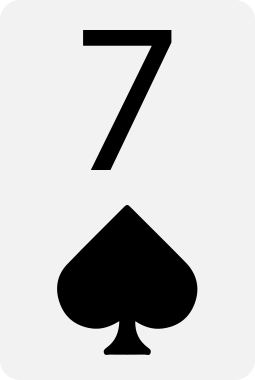
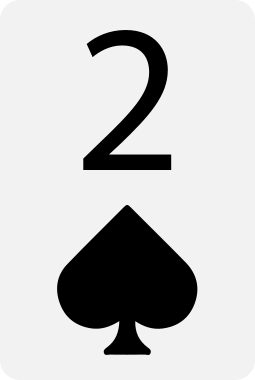
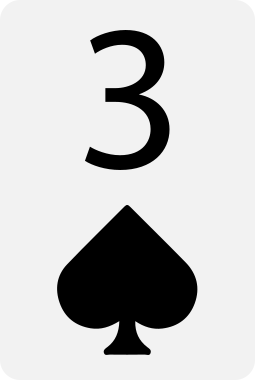
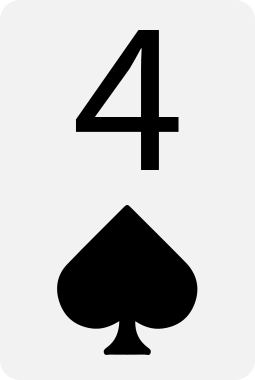
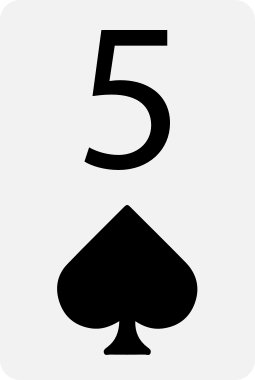
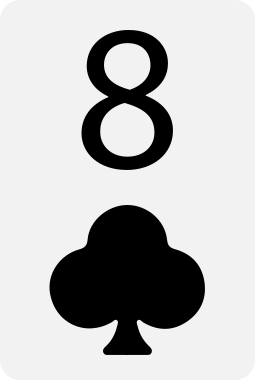
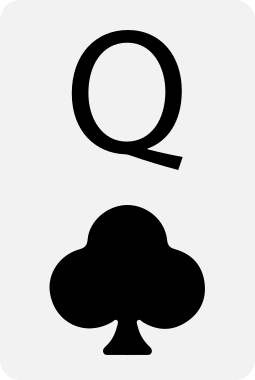
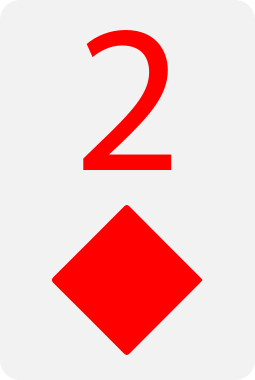
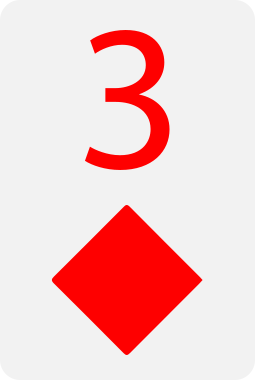
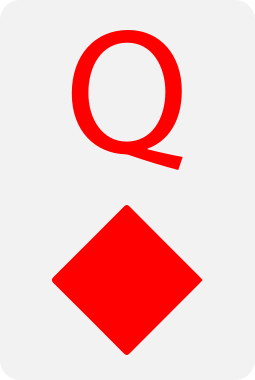
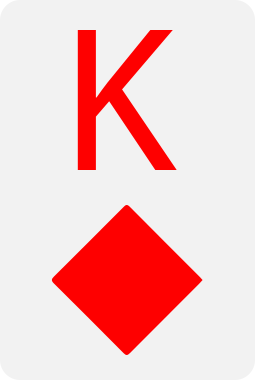
Seven-Five offsuit is the lower sibling of 86o, sharing the same one-gap structure but sitting one rank further down the deck. The two hands are closely related in design — both are offsuit one-gap connectors with moderate straight potential and no high-card value — but 75o operates in more severe overcard territory and with a slightly different set of straight combinations. Understanding how those differences play out in practice is what separates treating 75o as interchangeable with 86o from playing each hand correctly on its own terms.
What These Odds Show for 75o
The draw odds table for 75o is nearly identical to 86o across most categories. High card on the flop at 52.90%, pair by the river at 43.44%, two pair at 22.40%, three of a kind at 4.37% — these figures match 86o exactly or within rounding. The structural similarity between one-gap connectors one rank apart is reflected precisely in the numbers.
The straight rate follows the same pattern: 0.98% on the flop, 3.52% by the turn, and 7.80% by the river. That 7.80% is marginally higher than 86o’s 7.75%, a difference so small it is statistically negligible. Both hands have access to four distinct straight combinations — 75o can form straights running ace through five, three through seven, four through eight, and six through ten — and the near-identical completion rates confirm that one-gap connectors of adjacent ranks have equivalent straight equity.
Where 75o separates from 86o meaningfully is in the overcard table. At 92.14% on the flop, rising to 96.82% by the turn and 98.76% by the river, 75o faces overcard pressure on almost every board it sees. Compare this to 86o’s already severe 86.73% on the flop, and the additional six percentage points represent a real and consistent difference in how often the hand plays from behind. By the river, 75o is in overcard territory 98.76% of the time — only marginally better than 54o’s near-certain 99.91%, and dramatically worse than 86o’s 96.90%. The seven, rather than the eight, as the top card closes most of the gap between one-gap connectors and the lowest hands in the deck.
Hand Strength Summary
- Hand type: Low offsuit one-gap connector
- Relative strength: Weak — comparable to 86o but with more severe overcard exposure
- Best case: Open-ended straight draw on a low board with position and implied odds
- Main vulnerability: Overcard domination on nearly every board, no high-card fallback, no flush equity
75o is a one-job hand. That job is making a straight, and everything else the hand produces is difficult to defend in a serious pot. Where 86o can occasionally rely on a pair of eights having some residual value on a low board, 75o’s pair of sevens operates in territory where virtually every board is covered by higher cards.
How Seven-Five Offsuit Wins
The winning routes for 75o are narrow and closely mirror those of 86o, with the important difference that the pair-based routes are even less reliable here:
- Completing a straight, ideally in a disguised way on a board that does not announce the draw obviously
- Flopping two pair on a low seven-five board and getting paid by opponents holding single overcards
- Semi-bluffing an open-ended straight draw with eight outs and taking the pot before the draw completes
- Winning preflop or on the flop in unopened pots from late position through fold equity alone
A pair of sevens or fives rarely wins a contested pot. The 98.76% overcard rate by the river means that in almost every hand, at least one opponent will hold a card that makes a higher pair on the same board. The straight is not just the best route — it is essentially the only route in most serious pots.
Main Weaknesses
75o’s weaknesses are structural and largely unavoidable. The hand enters almost every pot as an underdog on the board, and its one compensating feature — straight potential — only materialises about one time in thirteen by the river:
- The overcard rate of 92.14% on the flop means planning around low boards is a minority strategy, not a default approach
- Both cards are low enough that pairing either creates a holding with minimal independent value
- The offsuit nature removes flush equity entirely — the 1.95% flush rate by the river is the board’s contribution, not the hand’s
- A one-gap structure means some draw configurations produce gutshots rather than open-ended draws, reducing the out count in those scenarios
- Multiway pots heavily dilute the value of the straight when opponents are holding cards in the same low-to-middle range and sharing outs
Best and Worst Flop Textures
Strong flops:
- 4-6 or 6-8 boards giving an open-ended straight draw — the primary target for this hand
- 3-4 boards creating a draw toward the wheel end of the straight range, though low boards attract attention
- 7-5-x boards for immediate two pair, best on a dry, rainbow texture with no obvious draws for opponents
- Low, uncontested boards where the hand can pick up a draw and apply pressure with a semi-bluff
Dangerous flops:
- Any board with two or more cards above a seven — which, given the 92.14% overcard rate, is most of them
- Boards containing an eight and a nine or higher, where opponents with 86, T8, or T9 type hands have better straight draws than 75o
- Flush-draw-heavy boards where opponents carry equity that 75o completely lacks
- High coordinated boards where the hand has no connection whatsoever and continuation becomes pure bluffing
How It Plays by Position
Early position:
Never a consideration. 75o from early position in a standard game is a leak regardless of table dynamics.
Middle position:
A fold at any full ring table. The hand needs too much help from the board and too much positional advantage to justify entering the pot with players left to act.
Late position:
The hand’s only legitimate home. From the cutoff or button in an unopened pot, 75o can be raised as a steal or played speculatively to see a cheap flop. The straight potential justifies a single investment in position, provided the pot stays small and the flop cooperates.
Blinds:
In the big blind with pot odds against a single late-position raise, 75o is a reasonable defend given its connectivity. The plan is to check-fold most flops unless a draw or two pair arrives, and to play the draw aggressively when it does. From the small blind, the out-of-position disadvantage makes a call marginal at best.
Common Mistakes with Seven-Five Offsuit
The errors with 75o are familiar from the other low connectors on this page, but the specific overcard situation creates one trap that is particular to hands in this range:
- Assuming that low boards are common enough to plan around — at 92.14% overcard exposure on the flop, the majority experience with this hand is playing from behind, not from ahead
- Confusing a gutshot draw with an open-ended draw when the board produces a partial connection — four outs is not a reason to continue for significant money
- Continuing with a pair of sevens against any meaningful resistance on a board with two or more overcards, which is almost every board
- Overestimating implied odds when the straight completes on a board obvious enough that opponents will not pay off
- Treating 75o as equivalent to 75 suited, which has an entirely different strategic profile due to flush equity
Comparison to Similar Hands
- Stronger than: 7-4o and 7-3o, which have fewer straight combinations and worse connectivity; 6-4o, which sits even lower with similar structural issues
- Weaker than: 7-5 suited, which transforms the hand with flush draw equity; 8-6o, where the higher top card reduces overcard exposure from 92.14% to 86.73% — a meaningful difference over a session; 8-7o, which has no gap and significantly better straight connectivity
- Similar to: 86o — the closest comparison, one rank higher, with nearly identical draw odds and only the overcard table separating them meaningfully in practice
The relationship between 75o and 86o is the most instructive comparison here. With near-identical straight rates, the primary difference between the two hands is the overcard table — 86o faces an overcard on the flop 86.73% of the time, while 75o faces one 92.14% of the time. That 5.4 percentage point difference might appear small, but across a large number of hands it represents a consistent structural disadvantage that compounds with every street.
How Seven-Five Offsuit Performs in Multiway Pots
The implied odds argument for playing low connectors is most often made in the context of multiway pots — more players means bigger pots when the straight arrives. That argument applies to 75o in limited form:
- A hidden straight on a low board in a multiway pot can win a large pot, and 75o’s straight is less likely to be telegraphed on boards with low cards than a higher hand’s straight might be on a coordinated mid-range board
- The disguise value of hitting 3-4-6 or 4-6-8 with 75o is real — opponents with top pair on those boards will often not credit a straight
The counterarguments are equally real:
- The near-certain overcard exposure means pair hands have almost no multiway value
- Opponents playing low cards in multiway pots are often holding the same straight outs, reducing the number of clean draws available
- Without flush equity, any board with a flush draw gives opponents a route to winning the pot that 75o cannot contest
- Two pair with 75o in a multiway pot is vulnerable to overcards, higher two pairs, and sets, and does not generate the same pot-building potential as a strong draw
FAQ: Seven-Five Offsuit
How does 75o differ from 86o in practice?
The draw odds are nearly identical, making them structurally similar hands. The main practical difference is the overcard table — 75o faces overcards on 92.14% of flops versus 86o’s 86.73%. Over a large sample, that difference represents a consistently higher frequency of boards where the hand is playing from behind with no pair equity, which slightly reduces the hand’s overall viability even in position.
Is the wheel draw (A-2-3-4-5) a strong outcome for 75o?
It is a made straight, and on the right board it can win a large pot. However, the wheel is the lowest possible straight, is vulnerable to any higher straight on the same board, and is often recognisable to experienced opponents on low boards. Its implied value is somewhat lower than completing a higher straight combination.
Does 75o play differently from 75 suited in terms of strategy?
Significantly. The suited version adds flush draw equity that gives the hand a second path to a strong made hand, transforms its playability on wet boards, and adds genuine value in multiway pots. 75o is dependent almost entirely on the straight; 75s can combine a straight draw with a flush draw on certain boards, creating a semi-bluff with substantial equity.
When is 75o most profitable?
In late position, in an unopened pot, against opponents likely to fold to a continuation bet on low boards. The hand’s value is almost entirely positional and situational rather than intrinsic.
Related Hands