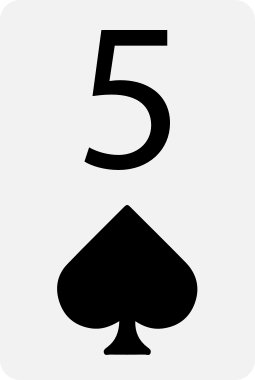
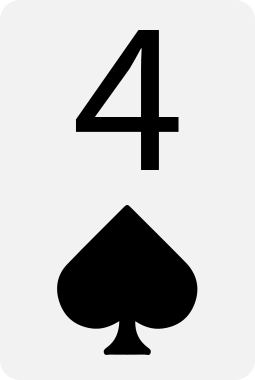
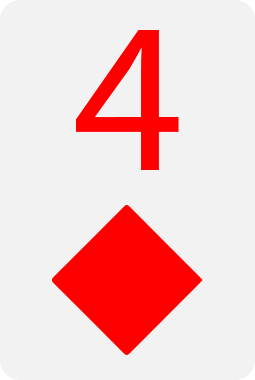
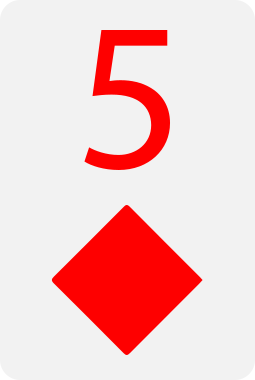
Five-Four Suited is the lowest zero-gap suited connector that most players consider worth putting in the playable category. It shares the same structural DNA as 65s and 76s – adjacent ranks, suited, with maximum straight combinations for its level – but it sits at the very bottom of the rank ladder, and that has consequences that go beyond just the overcard table.
What 54s offers is pure drawing value, deep disguise, and strong implied odds in the right environment. What it demands in return is discipline, position, and opponents with enough chips to pay you off when you get there.
What These Odds Show for 54s
The draw odds for 54s are strikingly similar to 65s across almost every category. Straight odds land at 8.62% by the river versus 8.57% for 65s – virtually identical, as expected from two zero-gap suited connectors separated by just one rank. Flush odds match at 6.38%, and straight flush potential is the same at 0.20%. The hand construction is essentially parallel; the rank is just lower.
The meaningful difference is in the overcard table, and it is stark. At 98.14% on the flop, 99.57% by the turn, and 99.91% by the river, overcards are not a possibility with 54s – they are a near-certainty on every street of every hand. The fraction of a percent where no overcard appears represents boards so low that they are genuinely rare. In practical terms, you will almost never have the best high card on the board with this hand, and you should plan accordingly on every single street.
Hand Strength Summary
- Hand type: Suited connector (zero-gap, lowest practical rank)
- Relative strength: Highly speculative; entirely dependent on completing a draw
- Main draws: Straights, flushes, straight flushes, two pair from connected boards
- Main vulnerability: The weakest high-card ceiling of any suited connector; overcards essentially guaranteed at 99.91% by the river
How 54s Wins
- Completing straights, which are heavily disguised at this rank
- Completing flush draws
- Making two pair when the board pairs both hole cards
- Combination draws (open-ended straight draw plus flush draw) that create enormous equity even before completion
- Taking pots on scare cards through well-timed semi-bluffs
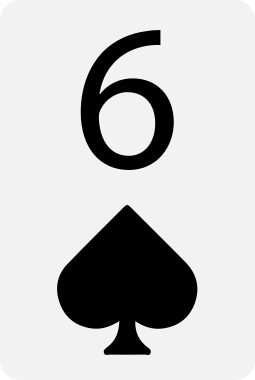
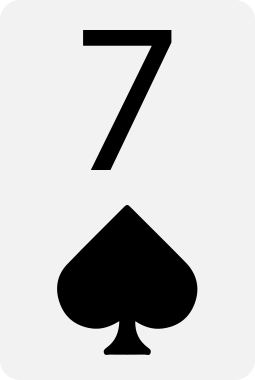
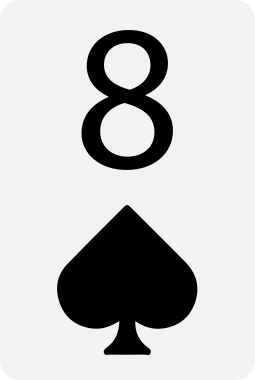
When 54s makes a straight, opponents holding top pair or overpairs almost never see it coming. A board of 6♣ 7♦ 8♥ looks like a draw-heavy board to most players, but if you flopped the nut straight from the start, you are already there. That concealment is a core part of this hand’s value.
Main Weaknesses
- The weakest high-card strength of any hand in the suited connector family
- Overcards are essentially guaranteed, as 99.91% by the river confirms – there is no fallback plan involving high cards
- Low straights are vulnerable to being beaten by the higher end – any opponent holding 6-8, 7-9, or similar has you drawing dead or dominated
- Flush draws can be beaten by any higher card of the same suit in an opponent’s hand
- Requires specific board textures to have any equity; a disconnected high board leaves this hand with nothing
Best and Worst Flop Textures
Strong flops
- Low connected boards that hit both cards or create open-ended draws (3♣ 6♦ 7♣ or 2♥ 3♦ 8♣)
- Two-tone flops in your suit with straight draw potential alongside
- Boards where both hole cards pair (5♦ 4♣ A♥ gives immediate two pair, though the Ace is a concern)
Dangerous flops
- Any high board – and given the overcard odds, this is the overwhelming majority of flops
- Boards completing straights for higher connectors where you are drawing to the losing end
- High monotone flops in a suit you do not hold
How It Plays by Position
- Early position: Should not be opened in most games; the combination of weak high cards, out-of-position post-flop play, and near-certain overcards makes the implied odds model very hard to justify
- Middle position: Marginal at best; fold to standard raising ranges, consider limping only in very passive multiway games
- Late position / button: Where this hand lives. The button is the ideal seat for 54s – cheap pot entry, position post-flop, and the ability to fold cheaply when the flop misses entirely
- Blinds: A reasonable big blind defend when the price is right against a single late-position raiser, but requires careful post-flop management given the overcard certainty
Common Mistakes
- Calling preflop raises from out of position, which destroys the implied odds that justify playing the hand at all
- Drawing to the low end of a straight without recognising when an opponent holds the higher end
- Continuing past the flop with no pair, no draw, and no backdoor equity – which given the overcard odds happens more often than players expect
- Overestimating flush draw value against multiple opponents who may hold higher flush draws
- Playing the hand in low-stack-depth situations where implied odds are insufficient to recover the preflop investment
Comparison to Similar Hands
- Stronger than: 54o (the flush draw adds substantial equity in a hand that otherwise has no high-card strength to fall back on), 43s (weaker straight range and more constrained by the bottom of the deck)
- Weaker than: 65s (one rank higher, meaningfully reduces overcard exposure from 99.91% to 99.60% – a small but real difference – and produces slightly stronger straights on average), 76s and above
- The comparison to 65s is the most instructive. The draw odds tables are nearly identical, but the overcard exposure climbing to 99.91% by the river with 54s versus 99.60% with 65s illustrates how even a single rank lower compounds the high-card disadvantage
How 54s Performs in Multiway Pots
54s benefits from multiway pots more than almost any other hand in this range. Larger fields mean larger pots when straights and flushes complete, and the implied odds – already the primary justification for playing this hand – improve further with more players putting money in. The disguise factor also increases: nobody expects the low end of the deck to have made the nuts.
The risks are proportional. More opponents means higher probability that someone holds a higher flush draw, or holds the 6-8 that has your straight drawing to a chop or a loss. Reading the board for whether you are drawing to the nuts or second-best becomes even more important in multiway pots with 54s than with any other hand in this family.
FAQ: Five-Four Suited
Is 54s worth playing at all given the near-certain overcards?
Yes, but only with the right conditions. The overcard table at 99.91% by the river is not the reason to fold – it is simply the reality to accept. The hand’s value comes entirely from its drawing potential, and that drawing potential is genuine. Position, stack depth, and pot odds determine whether it is worth seeing a flop.
How does 54s compare to 65s in practice?
Almost identically in draw odds – the tables are nearly indistinguishable. The real difference is the overcard exposure and the rank of the straights you make. A 54s straight tops out at 8-high on the board (A-2-3-4-5 being the wheel, or 4-5-6-7-8), meaning opponents with higher connectors can have the higher end. 65s makes slightly stronger straights on average.
What stack depth does 54s need to be profitable?
Generally, deep stack situations – typically 100 big blinds or more – are where implied odds are sufficient to justify the preflop investment. In short-stack situations, the hand loses most of its value because the pots it wins when it hits are not large enough to offset the frequency of missing.
What is the wheel and why does it matter for 54s?
The wheel is A-2-3-4-5, the lowest possible straight in Hold’em. 54s can make the wheel using a board of A-2-3, which is one of its unique straight combinations. However, the wheel is the weakest straight and loses to any higher straight, so while it is a made hand, it requires caution on boards that allow opponents to have a higher straight.
Related Hands