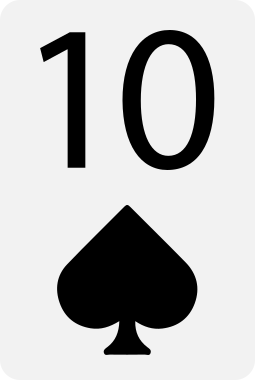
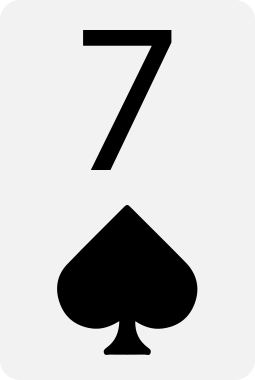
Ten Seven Suited is a one-gap suited hand sitting in an awkward position in the hand rankings. It has the high card appeal of a Ten, the flush draw equity that comes with being suited, and some straight potential — but the gap between Ten and Seven costs it meaningful connectivity compared to the suited connectors on either side. It is a playable hand in the right conditions, but it requires honest assessment of where its value actually comes from.
T7s is not a bad hand. It is a hand that is easy to misidentify as better than it is.
What These Odds Show for T7s
The straight odds tell the most important story for this hand. At 0.64% on the flop rising to 6.06% by the river, the straight potential is noticeably lower than 76s at 8.53% or 97s at 7.27%. The one-gap between Ten and Seven reduces the number of board textures that create an open-ended straight draw — the hand needs an Eight and Nine, or a Six and Eight, or a Nine and Jack together to form a clean draw, and a gap in the sequence means fewer flops deliver that combination naturally. Some boards produce gutshot draws rather than open-ended ones, which halves the outs available.
The flush odds are consistent with other suited hands at this rank — 6.47% by the river, with a flopped flush draw arriving in roughly 10% of cases. This is where the hand retains its most reliable equity, and a Ten-high flush is a strong holding in most situations.
The straight flush figure of 0.11% is lower than 76s at 0.20% and 97s at 0.15%, which directly reflects the reduced natural connectivity of the one-gap structure. The hand is less likely to simultaneously hold straight and flush draw equity on the same board texture.
The overcard table shows 69.47% on the flop, rising to 86.87% by the river. This is meaningfully lower than 76s at 92.14% — the Ten provides genuine top pair value on a wider range of boards, and any flop below a Jack gives T7s a Ten as an overcard to the board. That said, 86.87% by the river still confirms that pair-based holdings with this hand are frequently under pressure from higher cards opponents may have connected with.
Hand Strength Summary
- Hand type: One-gap suited hand — mid range
- Relative strength: Playable in position; weaker than true suited connectors of equivalent rank due to the connectivity gap
- Strengths: Ten provides top pair value on a wide range of boards, flush draw equity, some straight potential
- Main vulnerability: Reduced straight draw frequency compared to connected hands, Seven kicker is weak when pairing the Ten, gap limits combination draw opportunities
How Ten Seven Suited Wins
T7s has a few reliable winning paths:
- Completing a flush with a Ten-high draw, which is a strong holding on most boards
- Flopping top pair with the Ten on a mid-range board and winning in an uncontested or heads-up pot before the kicker becomes relevant
- Making a straight on the specific board textures that complete the gap — 8-9 boards in particular
- Semi-bluffing with flush draws on the flop, applying fold equity with a hand that has genuine outs if called
- Taking down small uncontested pots in position using the Ten’s high card strength and the suited nature as a credible bluffing range
Main Weaknesses
- The gap between Ten and Seven reduces straight draw frequency significantly — 6.06% by the river compared to 8.53% for 76s and 7.27% for 97s
- When straight draws do form, they are more often gutshots than open-ended draws, cutting available outs from eight to four
- The Seven kicker creates the same domination problem seen with weak suited kings — pairing the Ten with a Seven kicker loses to any T8 through TA that also pairs
- The combination draw frequency is lower than true suited connectors, reducing the hand’s semi-bluffing ceiling on the best board textures
Best and Worst Flop Textures
Strong flops
- 8♠ 9♠ x — open-ended straight draw in a suited hand with potential flush draw equity, the ideal board for T7s
- J♦ x x — Ten is an overcard with top pair potential and straight draw equity toward the lower end
- Low boards (e.g. 2♣ 7♦ 4♥) where the Seven becomes a mid pair and the board is unlikely to have connected with most opponent hands
- Two cards in your suit with any connected middle card
Dangerous flops
- Jack or Queen high boards where the Ten loses its top pair status and the hand is left with limited equity
- Boards where opponents are likely to hold strong made hands and the gutshot draw does not provide sufficient pot odds to continue
- Monotone boards in a different suit where flush equity is eliminated and only the weaker straight draw remains
How It Plays by Position
- Early position: A fold in most situations — the reduced connectivity and kicker weakness make this too speculative to open profitably against unknown ranges
- Middle position: Marginal; the Ten gives it slightly more playability than lower one-gap hands but still requires careful range construction
- Late position / Button: Where T7s has its clearest value — blind stealing with Ten-high, seeing cheap flops with flush draw potential, and applying semi-bluff pressure with position
- Blinds: Defensible from the big blind at the right price given the flush equity and top pair potential, but requires more discipline post-flop than true suited connectors
Common Mistakes with Ten Seven Suited
- Treating it like a true suited connector — the gap costs meaningful straight draw frequency and should temper how aggressively the hand is played
- Overvaluing top pair with a Seven kicker, particularly in multiway pots where domination by T8 through TA is a real concern
- Continuing with gutshot draws when the pot odds do not justify four outs — the reduced straight draw quality makes this a more common mistake with T7s than with connected hands
- Playing the hand out of position against aggressive opponents where the flush draw equity cannot be realised at the right price
Comparison to Similar Hands
- Stronger than: T6s, T5s — lower one-gap and two-gap hands with the Ten lose further straight connectivity without gaining anything in return
- Weaker than: T8s — closing the gap to one rank restores open-ended straight draw frequency on a much wider range of board textures and is a significant upgrade
- Compared to 76s, T7s gains a better top pair card and lower overcard rate but loses meaningful straight and combination draw potential — the two hands are roughly comparable in overall speculative value but play quite differently
- Against 97s, T7s has slightly higher top pair value but lower straight potential and fewer combination draw opportunities, making 97s the stronger drawing hand of the two
How Ten Seven Suited Performs in Multiway Pots
T7s is a more cautious multiway hand than true suited connectors. The flush draw retains its implied odds value in large pots, but the reduced straight draw quality means the hand has fewer routes to a disguised premium holding that can extract maximum value. Top pair with a Seven kicker becomes increasingly dangerous in multiway situations where at least one opponent is likely to hold a better Ten. The hand performs best in heads-up pots where the flush draw and top pair potential can be applied cleanly without the additional complexity of multiple opponents holding pieces of the board.
FAQ: Ten Seven Suited
How does the one-gap affect T7s compared to T8s or 76s?
Significantly. The gap between Ten and Seven means fewer flops create an open-ended straight draw, and when draws do form they are more commonly gutshots with four outs rather than open-ended draws with eight. T8s and 76s both produce open-ended draws on a wider variety of board textures, making them meaningfully stronger drawing hands.
Is the Ten a meaningful card in T7s?
Yes — it is the hand’s most valuable feature alongside the suited nature. The Ten provides top pair on any board below a Jack, which represents a large proportion of all flops, and it gives the hand some steal and blocker equity that lower suited one-gap hands lack.
When does T7s play like a suited connector?
On 8-9 boards where the hand forms an open-ended straight draw alongside its flush draw potential. These are the textures where T7s approaches the value of a true suited connector, and they are also where the hand’s semi-bluffing potential is at its peak.
Should you continuation bet T7s when you miss the flop?
In heads-up pots in position on boards below a Jack, a continuation bet is often justified — the Ten provides credibility on lower boards and the hand retains backdoor equity in many cases. In multiway pots or out of position, a missed flop with no draw equity is generally a reason to give up.
Related Hands