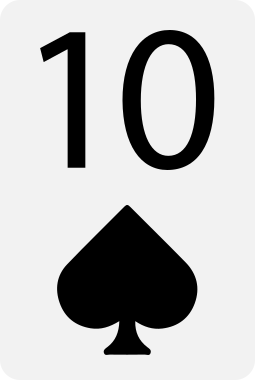
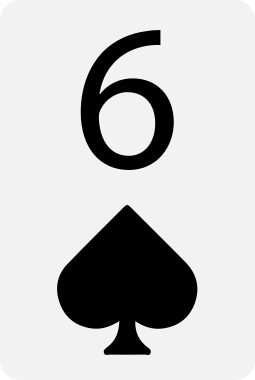
Ten-Six Suited is a four-gap suited hand that shares its overcard profile with T9o but plays an entirely different post-flop game. The Ten provides a strong high-card anchor – the same one that gives T9o its pair potential – while the Six sits far enough away to make straight draws rare and almost exclusively gutshots. It is a hand where the suit does significant work in compensating for the gap, but where that compensation only goes so far. T6s is not a suited connector, and treating it like one is the primary way players get into trouble with it.
The closest structural relative covered so far is J7s – another four-gap suited hand – but T6s operates with a lower high card, which means higher overcard exposure and a weaker top-pair outcome when the Ten does connect.
What These Odds Show for T6s
The straight odds reflect the four-gap penalty directly. At 0.32% on the flop, 1.76% by the turn, and 4.80% by the river, T6s has meaningfully less straight equity than one-gap or zero-gap hands at similar ranks. The 0.32% flop figure matches J7s exactly – both are four-gap hands with the same structural constraint on straight combinations. By the river, T6s reaches 4.80% versus J7s at 4.45%, a marginal difference driven by the specific straight combinations available around the Six versus the Seven. Straight flush odds of 0.07% by the river are similarly low, confirming that straight-related draws play a minor role in this hand’s equity profile.
Flush equity lands at 6.52% by the river, consistent with other suited hands as expected and the hand’s most reliable draw.
The overcard table sits at 69.47% on the flop, 79.86% by the turn, and 86.87% by the river – identical to T9o. This is the Ten doing the same work it does across every T-x hand: suppressing overcard frequency relative to lower-ranked hands. At 69.47% on the flop, overcards are present on roughly seven in ten boards, which is meaningfully better than the 79-92% range seen with Seven, Eight, and Nine-high hands. The Ten provides genuine top-pair potential across a broader range of boards than any lower card in the suited hand family covered so far.
Hand Strength Summary
- Hand type: Suited hand (four-gap)
- Relative strength: Marginal; flush draw backed by Ten top-pair potential, limited straight equity
- Main draws: Flush draws, Ten top pair on boards without an Ace, King, or Queen, gutshot straights on specific textures
- Main vulnerability: Four-gap structure limits straights to gutshots in most cases; the Six contributes minimally to the hand’s equity; kicker vulnerability when the Ten pairs
How T6s Wins
T6s wins through several distinct paths, each with its own frequency and strength:
- Pairing the Ten on boards without an Ace, King, or Queen
- Completing a flush draw
- Making two pair when both the Ten and Six connect with the board
- Gutshot straights on boards around the 7-8-9 or 7-8-J range that align with both hole cards
- Winning through positional aggression on boards that favour a Ten-high range
- Picking up combination equity on the rare boards where a flush draw and pair exist simultaneously
The Ten is the engine of this hand in the same way the Jack drives J7s. On boards like T♠ 4♦ 2♣ or T♥ 7♦ 3♠, T6s has top pair and a reasonable claim to being ahead, providing a winning route that purely low suited hands cannot access.
Main Weaknesses
- The four-gap structure means straight draws are almost exclusively gutshots – four outs rather than eight
- The Six contributes almost nothing to straight draws, pair potential as a kicker, or hand strength in most situations
- Kicker vulnerability when the Ten pairs is significant – AT, KT, QT, JT, T9, T8, and T7 all hold better kickers
- Flush draws are the most reliable draw but provide no combination draw pressure alongside straight draws on most boards
- On roughly 87% of rivers an overcard to the Ten will have appeared, stepping it down from top pair in the majority of runouts
Best and Worst Flop Textures
Strong flops
- Ten-high boards with low disconnected cards (T♠ 4♦ 2♣) – top pair with manageable kicker concerns against most ranges
- Flush draw boards in your suit where the Ten also pairs, giving a made hand plus draw
- Boards around 7♠ 8♦ 9♣ or 7♥ 8♦ J♠ where a gutshot straight draw becomes available using the Six or the Ten
Dangerous flops
- Ace, King, or Queen-high boards – the Ten loses top-pair status and the Six offers nothing
- Coordinated boards where opponents have multiple draws and T6s has neither pair nor flush draw
- High monotone flops in a suit you do not hold
How It Plays by Position
- Early position: Not a hand to open in standard games; the four-gap weakness and kicker vulnerability make it too speculative to build pots from out of position
- Middle position: Fold against standard raising ranges; occasionally playable in very passive or short-handed games where cheap flop entry is realistic
- Late position / button: Its best and most natural position – steal equity from the Ten, flush draw potential post-flop, and the positional advantage to navigate missed flops cheaply
- Blinds: A marginal big blind defend against a single late-position raiser; the Ten provides more post-flop playability than lower suited hands, but the four-gap weakness and kicker vulnerability mean it needs clean board textures to continue comfortably
Common Mistakes
- Treating T6s like a suited connector and overestimating straight draw frequency – gutshots are the realistic draw, not open-ended straight draws
- Continuing with Ten top pair into heavy action without accounting for kicker vulnerability against the broad range of Ten-x hands that dominate
- Calling raises from out of position based on the flush draw alone without a clear plan for the frequent boards where neither card connects
- Overvaluing gutshot straight draws as primary equity when four outs do not justify significant pot investment without additional equity alongside
- Comparing T6s to T9s or T8s and assuming similar playability – the gap makes a substantial difference to how often the hand connects
Comparison to Similar Hands
- Stronger than: T6 offsuit (the flush draw materially improves a hand with limited straight potential and no high-card dominance), T5s and below (weaker rank gap combinations with even less straight potential)
- Weaker than: T7s (one fewer gap, meaningfully better straight combinations), T8s (two-gap, approaching connected territory), T9s (one gap short of a true connector, dramatically stronger straight and combination draw equity)
The comparison to J7s is the most structurally relevant. Both are four-gap suited hands. J7s has a stronger high card in the Jack, giving lower overcard exposure – 56.96% on the flop versus 69.47% for T6s. T6s has marginally better river straight odds at 4.80% versus 4.45%, driven by the Six’s specific straight geometry. In most situations J7s has the edge due to the stronger anchor card, but the two hands are closely matched in overall character.
How T6s Performs in Multiway Pots
T6s occupies a similar multiway pot position to J7s and Q6s – it is not a hand that thrives in large fields. Straight equity is too low to generate meaningful implied odds on straight draws, flush draw equity becomes more dangerous as more opponents may hold higher flush draws, and Ten top-pair value decreases as more players contest the pot and the probability of being outkicked or outdrawn increases.
The hand is best suited to heads-up situations where the Ten can hold as the best pair, or to late-position steal spots where the pot is won preflop or on a single continuation bet. Multiway pots require the hand to connect well – and the frequency with which T6s connects well is not high enough to make multiway pot play a reliable strategy.
FAQ: Ten-Six Suited
How does T6s differ from T9o despite sharing the same overcard table?
The overcard tables are identical because both hands have a Ten as their highest card. But the hands play very differently post-flop. T9o has zero-gap connectivity with 9.13% river straight equity and no flush draw. T6s has four-gap connectivity with 4.80% river straight equity and a 6.52% flush draw. T9o relies primarily on straights and pair value; T6s relies primarily on flush draws and pair value. Neither is clearly superior – they have different strengths and different weaknesses.
Is the Ten a strong enough anchor to make T6s worth playing?
In position with cheap entry, yes – the Ten genuinely suppresses overcard exposure relative to lower-ranked hands and provides top-pair potential on a meaningful range of boards. The 69.47% flop overcard rate, while still high, is considerably better than the 86-99% rates seen with Seven, Eight, and Nine-high hands. The Ten does real work. Whether that work justifies playing T6s depends on position, stack depth, and pot odds.
What gutshot straight draws does T6s pick up?
The most common gutshot combinations for T6s involve boards that bridge part of the gap between Ten and Six. A board of 7-8-9 gives a gutshot to the Jack using the Ten. A board of 7-8-J gives a gutshot to the Nine using neither hole card directly but giving the Ten connectivity. Boards around 5-7-8 can give a gutshot using the Six. These are specific and relatively infrequent, which is why the flop straight odds sit at just 0.32%.
When is T6s at its strongest?
When it flops a flush draw alongside Ten top pair. That combination gives a made hand with backup equity on a board that favours the Ten’s range, creating a semi-bluffing situation that is difficult for opponents to navigate. It is the closest T6s gets to the combination draw power of genuine suited connectors, and it is the scenario where the hand generates the most value.
Related Hands