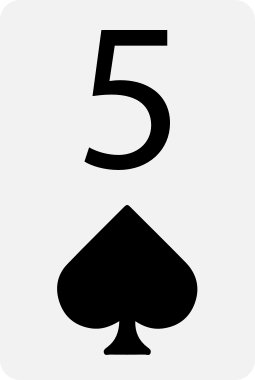
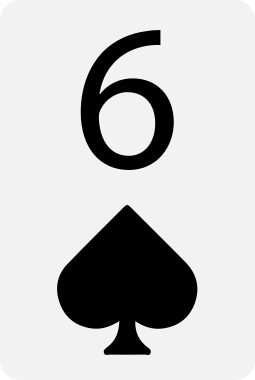
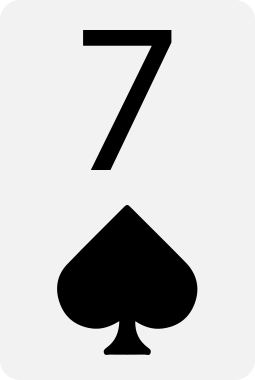
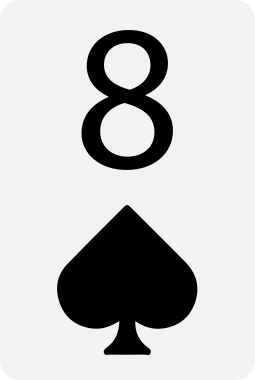
Ten-Six offsuit is a three-gap hand, and the draw odds table makes the consequences of that gap immediately visible. Where T7o – the one-gap version of a ten-low offsuit hand – produces a 6.46% straight rate by the river, T6o arrives at just 5.13%. The additional two-card gap between the ten and six compared to the ten and seven costs more than a percentage point of straight completion, and that reduction is the central fact of the hand. Everything else about T6o is either identical to T7o or changes only in ways directly traceable to that gap.
What These Odds Show for T6o
The draw odds table for T6o shows a familiar offsuit hand pattern in most categories, with the straight column as the key differentiator. High card on the flop at 53.55% – identical to T7o and J7o, reflecting the consistent behaviour of offsuit hands in this range. Pair by the river at 44.86%, two pair at 22.66%, three of a kind at 4.43% – all within the expected range for an unpaired offsuit hand.
The straight rate tells the gap story clearly. At 0.33% on the flop – matching J7o exactly – 1.83% by the turn, and 5.13% by the river, T6o’s straight potential sits below T7o’s 6.46%, below 85o’s 6.46%, and notably below the one-gap connectors in the eight-to-ten range. The three-gap structure between ten and six means the number of straight combinations is reduced to three: six-to-ten, seven-to-jack, and eight-to-queen. Three combinations versus T7o’s four, and those combinations require a more specific set of board cards to form, producing the lower completion rate.
The overcard table is identical to T7o: 69.47% on the flop, 79.86% by the turn, 86.87% by the river. This is exactly as expected – both hands have a ten as their top card, and the probability of a jack, queen, king, or ace appearing on the board is independent of whether the second hole card is a six or a seven. The overcard protection the ten provides is constant across all ten-low offsuit hands, and T6o benefits from it in the same way T7o does.
Hand Strength Summary
- Hand type: Low offsuit three-gap hand
- Relative strength: Weak – below T7o in drawing potential, equivalent in board presence
- Best case: Open-ended straight draw on a mid-to-low board, in position, heads-up
- Main vulnerability: Reduced straight potential from the three-gap structure, overcard pressure on the majority of boards, no flush equity
T6o is T7o with 1.33 percentage points less straight equity by the river and the same overcard exposure. The gap has cost the hand a meaningful portion of its primary drawing route without compensating through improved board presence, since the ten’s rank is unchanged. It is a hand that falls just below T7o in the hierarchy of speculative offsuit holdings, and T7o itself is already a marginal hand in most situations.
How Ten-Six Offsuit Wins
T6o wins through the same routes as T7o and 85o, adjusted for its slightly narrower straight range:
- Completing an open-ended straight draw on a board that suits the hand’s three combinations – specifically needing board cards in the seven-to-nine range to produce the most accessible draws
- Flopping two pair on a ten-six board on a dry, uncontested texture
- Semi-bluffing a straight draw with eight outs from position when the draw arrives, taking the pot before completion through fold equity
- Stealing uncontested pots preflop from late position where the ten’s high-card credibility carries the raise
The pair of tens route has the same residual value here as in T7o – on the minority of boards without overcards, a pair of tens can occasionally hold up. The same caveats apply: it requires a board with no jack or higher, which occurs on only 30.53% of flops, and heads-up rather than multiway.
Main Weaknesses
T6o’s weaknesses are T7o’s weaknesses with the straight penalty applied:
- The three-gap structure reduces straight combinations from four to three and straight completion from 6.46% to 5.13% by the river – a reduction of more than a fifth of T7o’s straight equity
- The 69.47% overcard rate on the flop means pair equity is unreliable in the majority of situations
- No flush equity whatsoever
- A pair of sixes has almost no showdown value on any board with overcard presence, which describes the vast majority of boards this hand sees
- Three-gap hands produce gutshot draws on a higher proportion of partially connecting boards than one-gap or two-gap hands, reducing the quality of the drawing equity available
- The six as an independent card has no board presence and contributes to straights only within a narrow window of board textures
Best and Worst Flop Textures
Strong flops:
- 7-8 or 8-9 boards giving an open-ended straight draw – the most accessible combination given T6o’s straight range runs six-to-ten through eight-to-queen
- 9-J boards creating a draw toward the higher end of the hand’s straight range, though this requires both a nine and a jack appearing alongside specific turn cards
- 10-6-x boards for immediate two pair on a dry, rainbow texture
- Low, disconnected boards in position where a continuation bet takes the pot regardless of connection
Dangerous flops:
- Any board with a jack, queen, king, or ace – covering 69.47% of flops and reducing pair-of-tens value to a secondary holding
- Boards that produce only a gutshot draw rather than an open-ended draw from partial connection – four outs rather than eight, a significant reduction in semi-bluff equity
- Flush-draw boards where opponents carry clean equity that T6o cannot match
- Any multiway pot on any texture, where the reduced straight potential and overcard exposure compound across multiple opponents
How It Plays by Position
Early position:
Never. T6o from early position is a straightforward fold under all standard conditions regardless of table dynamics.
Middle position:
A fold at any full ring table. The three-gap structure and limited straight potential make middle-position entry indefensible in normal play.
Late position:
T6o’s only legitimate context, and one step below T7o even here. From the button or cutoff in an unopened pot, a steal raise uses the ten’s credibility, and the straight potential – while reduced – still justifies a single speculative investment. The hand requires a more cooperative flop than T7o to continue past one street.
Blinds:
In the big blind with pot odds against a single late-position raise, T6o is a marginal defend – weaker than T7o in this spot due to the lower straight potential, but the ten’s pair value and the pot odds make a passive call defensible against a single opponent. Check-fold most flops. From the small blind, folding is correct in most situations.
Common Mistakes with Ten-Six Offsuit
The errors with T6o reflect the T7o pattern with one additional trap specific to the gap:
- Treating T6o as equivalent to T7o because both feature a ten as the top card, ignoring the straight rate reduction from 6.46% to 5.13% that reflects a genuine structural difference
- Continuing when the flop produces only a gutshot draw, which happens more frequently with three-gap hands than with one-gap or two-gap hands on partially connecting boards
- Overestimating the hand’s steal credibility – the ten works for a positional raise, but if called, the postflop playability is genuinely limited without a strong board connection
- Playing the hand in multiway pots where the reduced straight potential and overcard exposure leave the hand with minimal equity across the field
- Conflating the identical overcard table with T7o as a sign that the hands are equivalent overall, when the straight column tells a different story
Comparison to Similar Hands
- Stronger than: T5o and T4o, where the gap widens further and straight combinations decrease to two or fewer; T6 suited, which is the clearly superior version adding flush equity
- Weaker than: T7o, where the one-gap structure produces a straight rate of 6.46% versus T6o’s 5.13%; 96o, which has a lower top card but comparable gap structure and a different set of straight combinations; J6o, which has a higher top card and lower overcard exposure
- Similar to: J7o – the most structurally comparable hand in the series, sharing the same 0.33% flop straight rate and a similar gap penalty, with the top card as the primary differentiator between them
The J7o comparison is particularly useful here. Both T6o and J7o have a three-card gap between their hole cards, producing a 0.33% flop straight rate in both cases. J7o completes a straight 4.76% of the time by the river versus T6o’s 5.13% – a reversal of what might be expected, reflecting the different specific straight combinations available to each hand and how frequently their respective board requirements are met. The difference between the two hands in practice comes down to the overcard table: T6o faces overcards on 69.47% of flops while J7o faces them on 56.96%. T6o has worse pair equity but marginally better straight equity – a trade that, across most standard situations, does not favour either hand strongly.
How Ten-Six Offsuit Performs in Multiway Pots
T6o in multiway pots faces the same structural problems as T7o and 85o, with the reduced straight rate making the implied odds argument slightly weaker:
Arguments in favour:
- A completed straight in a multiway pot can win a large pot, and T6o’s straights on boards like 7-8-9 or 8-9-J are not always immediately obvious to opponents who have focused on their own top pair or two pair holdings
- The ten’s pair value has more residual worth multiway than the lower one-gap connectors, on the specific minority of low boards where no overcard appears
Arguments against:
- The 86.87% overcard rate by the river means that across most multiway pots, the ten will face pressure from multiple opponents who have connected better
- Three straight combinations rather than four means fewer boards produce draws, reducing the frequency of the semi-bluff opportunities that give speculative hands their multiway value
- Without flush equity, flush-draw boards give opponents advantages T6o cannot contest
- At 5.13% by the river, the straight completes in roughly one in twenty hands, requiring substantial implied odds to justify investment
FAQ: Ten-Six Offsuit
How does the gap between T6o and T7o translate in practice?
T7o completes a straight 6.46% of the time by the river. T6o completes one 5.13% of the time. The difference of 1.33 percentage points reflects one fewer straight combination available to T6o. Across a large sample, T6o will make fewer straights per hundred hands, which translates directly into fewer large pots won through its primary winning mechanism. Both hands are marginal, but T7o is the marginally better speculative hand when all else is equal.
Why does T6o have the same overcard rate as T7o despite the different kicker?
Because the overcard table measures the probability of a card higher than the ten appearing on the board, and that probability depends only on the ten – not on what the second hole card is. Any ten-high offsuit hand, regardless of kicker, will show 69.47% on the flop in the overcard column. This is the same principle that produced identical overcard tables across the entire weak king series.
Is T6o ever preferable to T7o?
In no standard strategic context. T7o has better straight potential and identical overcard protection. The only scenario where T6o might be played in a spot where T7o would not is if the specific hand combination is required as part of a range construction exercise, which is a consideration well beyond the scope of speculative hand selection for most players.
Does the three-gap structure affect bluffing frequency with T6o?
Modestly yes. Three-gap hands produce gutshots more frequently than one-gap hands on partially connecting boards, which means the semi-bluff opportunities with eight clean outs are less common. Pure bluffs without equity are generally unprofitable at any frequency, so the reduction in open-ended draws slightly narrows the range of boards where aggressive play is justified.
Related Hands