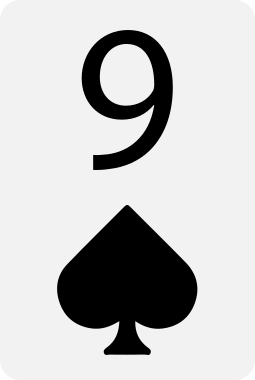
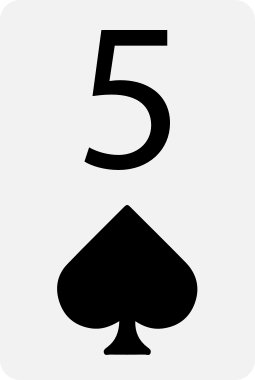
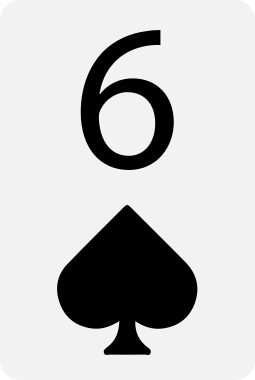
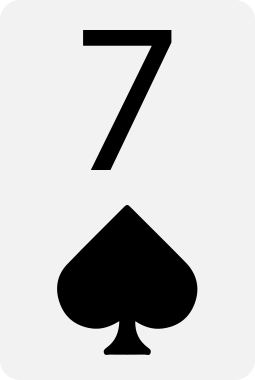
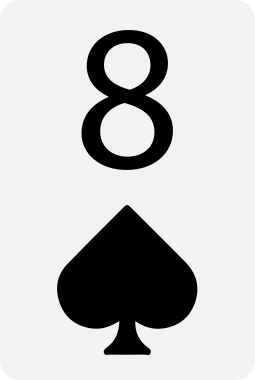
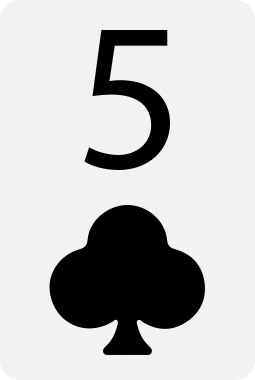
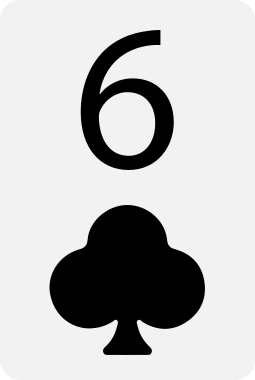
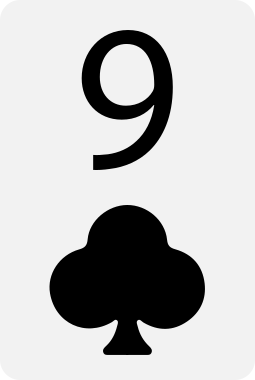
Nine-Six offsuit is a one-gap connector sitting one rank above 86o and one rank below T7o, and its draw odds reflect that position almost exactly. The hand shares the structural profile of the offsuit one-gap connector family – moderate straight potential, no flush equity, and overcard exposure severe enough to make pair-based hands unreliable – while occupying a specific point in the range where the nine as a top card provides marginally more board presence than an eight or seven, but substantially less than a ten or face card. It is a hand that poker players encounter frequently, misplay regularly, and whose value is almost entirely conditional on position and board texture.
What These Odds Show for 96o
The draw odds table for 96o sits predictably between its neighbours in the one-gap connector family. High card on the flop at 53.22% – identical to T7o, which shares the same gap structure one rank higher. Pair by the river at 44.15%, two pair at 22.53%, three of a kind at 4.40% – all consistent with other offsuit hands in this range.
The straight rate is 0.65% on the flop, 2.68% by the turn, and 6.42% by the river. This places 96o between T7o at 6.46% and 86o at 7.75%, which is exactly where a one-gap connector at this rank should sit. The four straight combinations available to 96o run through five-to-nine, six-to-ten, seven-to-jack, and eight-to-queen – a set of draws that covers a useful range of board textures without reaching the premium straight potential of true connectors like 87o or 98o.
The overcard table is where 96o’s position in the rank ladder becomes most visible. At 79.29% on the flop, the nine faces overcard pressure on nearly four in five boards – worse than T7o’s 69.47% but better than 86o’s 86.73%. By the turn that figure reaches 88.10%, and by the river 93.27%. The nine is high enough to sit above the low cards that dominate boards for 54o and 75o, but low enough that queens, kings, aces, tens, and jacks all appear as overcards, and collectively those five ranks cover a large portion of the cards remaining in any deck after two nines and two sixes are removed.
Hand Strength Summary
- Hand type: Low offsuit one-gap connector
- Relative strength: Below average – drawing hand with limited pair equity
- Best case: Open-ended straight draw on a mid-to-low board, in position, with implied odds
- Main vulnerability: Overcard pressure on the majority of boards, no flush equity, pair value unreliable
96o is a drawing hand that occasionally earns the right to be more. When it connects with a straight draw on a board that suits it, the hand can compete for meaningful pots. When it does not – which is most of the time – it is a pair of nines or sixes playing against a board where most opponents have it covered.
How Nine-Six Offsuit Wins
96o wins through the same routes as 86o and T7o, adjusted for its specific rank and straight combinations:
- Completing an open-ended straight draw, particularly one that arrives in a non-obvious way on a board opponents do not immediately read as dangerous for this hand
- Flopping two pair on a nine-six board and getting action from opponents holding single overcards
- Semi-bluffing a straight draw with eight outs and taking the pot before showdown through fold equity
- Stealing unopened pots from late position where the nine carries enough high-card weight to make a raise credible
- Occasionally holding a pair of nines as the best hand on a low, dry board where no opponent has connected
The pair of nines route is marginally more viable than a pair of eights or sevens in the equivalent position, because the nine sits above more of the low-card boards that appear in practice. It is still a vulnerable holding on any board with ten or higher, but it has more realistic moments of genuine top-pair value than the lower one-gap connectors.
Main Weaknesses
The structural weaknesses of 96o are familiar from the rest of the one-gap connector family, with the overcard table providing the clearest quantification:
- The 79.29% overcard rate on the flop means that on the majority of boards, at least one card outranks the nine. Pair equity is unreliable as a result
- The one-gap structure limits straight combinations compared to true connectors – 96o has four straight draws available, where 98o or 87o would have more consistent connectivity across board textures
- No flush equity. The 1.95% flush rate by the river belongs to the board
- A pair of sixes has essentially no showdown value on any board with multiple overcards, which is nearly every board given the 93.27% overcard rate by the river
- In multiway pots, straight outs are frequently shared or partially blocked by opponents holding middle-range cards
- The nine as a kicker, when pairing the six side of the hand, produces a holding that still loses to most reasonable opponent hands
Best and Worst Flop Textures
Strong flops:
- 7-8 or 5-7 boards giving an open-ended straight draw – the primary objective
- 8-10 boards creating a draw to the higher end of the hand’s straight range
- 9-6-x boards for immediate two pair, ideally rainbow with no obvious draws in play
- Low, dry boards where a pair of nines has a genuine chance of being the best holding
Dangerous flops:
- Any board with a ten or higher – which, given the 79.29% overcard rate, describes the majority of flops
- Queen or king-high boards where the hand has no pair equity and no straight draw of note
- Boards with active flush draws where opponents carry equity that 96o completely lacks
- High, coordinated boards where continuation requires either a bluff or a draw, and 96o has neither in most cases
How It Plays by Position
Early position:
A fold in all standard situations. 96o from early position cannot withstand the pressure of multiple players yet to act and offers no compensating equity to justify the risk.
Middle position:
A fold at a full ring table. In a very short-handed or passive game, a limp becomes marginally more defensible, but the hand remains below the threshold for a standard middle-position open.
Late position:
The hand’s only legitimate home. From the button or cutoff in an unopened pot, 96o can be raised as a steal or played speculatively for a cheap flop. The straight potential across four combinations justifies a single investment in position, provided the pot stays manageable and the flop provides a reason to continue.
Blinds:
In the big blind with pot odds against a single late-position raise, 96o is a reasonable defend given its connectivity. The strategy is to check-fold boards that miss entirely and play aggressively when a draw arrives. From the small blind, the out-of-position disadvantage makes a call marginal and a fold often correct against an aggressive raiser.
Common Mistakes with Nine-Six Offsuit
The errors with 96o closely mirror those of 86o and T7o, with one addition specific to the nine’s position in the rank ladder:
- Treating a pair of nines as a strong hand simply because the nine looks like a respectable card. On 79.29% of flops at least one overcard has appeared, and a pair of nines in that context is a marginal holding requiring careful navigation rather than confident betting
- Continuing with only a gutshot draw when the board produces a partial connection – four outs does not justify multiple streets of investment
- Confusing the hand’s straight potential with reliable drawing equity. A 6.42% completion rate by the river means the straight arrives in roughly one in sixteen hands – meaningful implied odds require significant stack depth and opponent tendencies to justify regular speculative play
- Overplaying the hand in multiway pots where pair equity is weak and straight outs are shared
- Playing 96o as if it were 96 suited – the flush equity added by the suited version is a categorical improvement, not an incremental one
Comparison to Similar Hands
- Stronger than: 85o and 74o, which have fewer straight combinations and lower top cards; 96o’s neighbours one step down in the one-gap connector family
- Weaker than: 96 suited, which adds flush equity and makes this a notably more playable hand; 97o, where the reduced gap provides better straight connectivity; T6o, which has a higher top card reducing overcard exposure from 79.29% to 69.47%
- Similar to: T7o and 86o – the three hands form a natural family of offsuit one-gap connectors with near-identical straight rates and a graduated overcard table that reflects each hand’s position in the rank ladder
The comparison between 96o and T7o is instructive. Both hands have a three-card gap, similar straight rates – 6.42% versus 6.46% by the river – and the same structural profile as offsuit one-gap connectors. The primary difference is the overcard table: T7o faces overcards on 69.47% of flops versus 96o’s 79.29%. That ten-point gap represents a real and recurring advantage for T7o, translating directly into more boards where a pair of tens has genuine value compared to a pair of nines. The hands are similar enough to be discussed together, but different enough that T7o consistently operates with more pair equity across a session.
How Nine-Six Offsuit Performs in Multiway Pots
96o’s performance in multiway pots follows the same pattern as the other one-gap connectors in this series. The implied odds argument for low connectors in multiway pots applies here in limited form:
Arguments in favour:
- A completed straight in a multiway pot can win a large pot, and 96o’s straight is not always obvious on boards with mid-range cards where opponents may have made top pair or two pair
- The disguise value of completing a straight through 7-8-10 or 5-7-8 board textures can be genuine against opponents who are not tracking possible straight combinations
Arguments against:
- At 93.27% overcard rate by the river, pair equity is almost never reliable in a multiway pot
- Opponents in multiway pots with mid-range holdings are frequently holding cards that block or share the straight outs
- Without flush equity, any board with a flush draw in progress gives opponents clean outs that 96o cannot contest
- Two pair with 96o in a multiway pot is vulnerable to higher two pairs and sets and does not generate the same pot-building confidence as a premium holding
FAQ: Nine-Six Offsuit
How does 96o relate to the broader one-gap connector family?
It sits precisely in the middle of the offsuit one-gap connector range – above 86o and 75o, below T7o and J8o. The draw odds confirm this structural position, with a straight rate that tracks the gradual increase seen as the top card rises through the connector range and an overcard table that reflects the nine’s position among the mid-range ranks.
Is 96o better or worse than T7o?
Both hands have nearly identical straight rates, but T7o faces fewer overcards on the flop – 69.47% versus 79.29%. T7o is the marginally stronger hand because its pair of tens holds up more often on low-to-mid boards. The difference is real but not dramatic enough to change the strategic framework for either hand.
Does 96o play differently at different stack depths?
Yes. At shallow stack depths, the implied odds for the straight draw shrink and the hand loses its primary source of value. At deep stack depths, the implied odds for a hidden straight in a large pot increase, making speculative investment more justifiable. 96o is better suited to deep-stack play than short-stack play.
Should 96o ever be 3-bet?
Only as a pure bluff in very specific late-position spots as part of a balanced 3-betting range. It has no value as a 3-bet for made-hand purposes, and any scenario requiring multiple streets of large investment is outside the hand’s realistic scope.
Related Hands