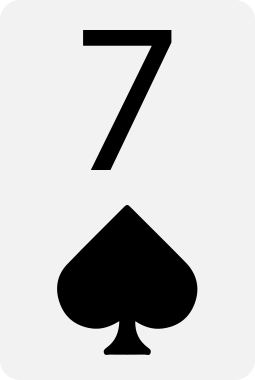
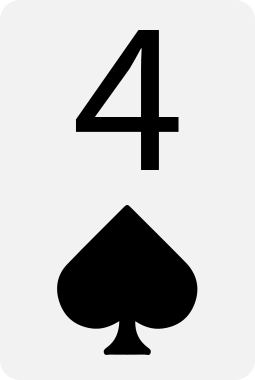
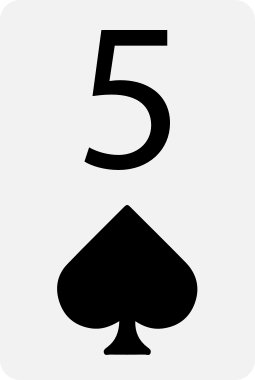
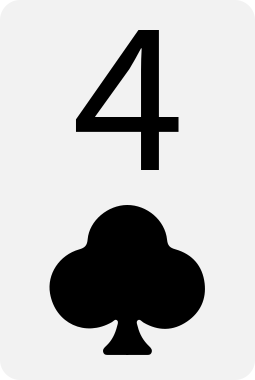
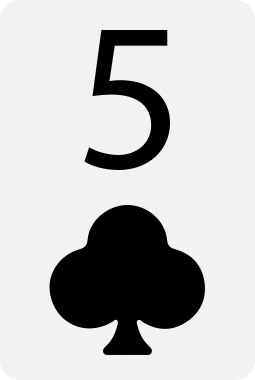
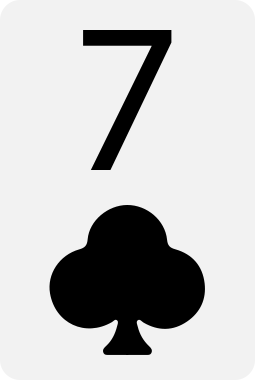
Seven-Four offsuit is a two-gap hand sitting in the lower-middle tier of the offsuit connector family, one rank below 85o and sharing its gap structure while operating with a lower top card and correspondingly worse overcard exposure. The hand belongs to the same strategic category as T6o and 85o – hands where the gap between the two cards reduces straight potential below the one-gap connectors without the compensating rank advantage that higher two-gap hands carry. 74o sits at the intersection of low rank and moderate gap, producing a hand with limited straight potential, near-certain overcard exposure, and no secondary drawing route to compensate.
What These Odds Show for 74o
The draw odds table for 74o shows the familiar offsuit hand pattern in most categories. High card on the flop at 53.22%, pair by the river at 44.29%, two pair at 22.53%, three of a kind at 4.40% – all consistent with other offsuit hands in this range and matching the figures seen with 96o and T7o, which share the same gap structure at higher rank levels.
The straight rate is 0.65% on the flop, 2.57% by the turn, and 6.09% by the river. This is the key number for understanding 74o’s position in the offsuit hand hierarchy. At 6.09%, it sits below 85o’s 6.46% and T7o’s 6.46% – both two-gap hands one and two ranks higher respectively – and well below the one-gap connectors in this range. The four straight combinations available to 74o run through three-to-seven, four-to-eight, five-to-nine, and six-to-ten. These combinations cover a useful range of mid-to-low board textures, but the two-gap structure means a more specific set of board cards is required to produce open-ended draws compared to hands like 75o or 86o.
The overcard table is 92.14% on the flop, 96.82% by the turn, and 98.76% by the river – identical to 75o. Both hands share a seven as their top card, and the probability of an overcard appearing on the board is determined entirely by that seven, not by whether the lower card is a five or a four. This identity in the overcard table is the clearest confirmation that the gap between the two hole cards changes straight potential but leaves board presence entirely unchanged.
Hand Strength Summary
- Hand type: Low offsuit two-gap hand
- Relative strength: Weak – below the one-gap connectors at this rank level, equivalent to 85o in gap structure with worse rank
- Best case: Open-ended straight draw on a low-to-mid board, in position, with implied odds
- Main vulnerability: Near-certain overcard domination, weaker straight potential than one-gap connectors, no flush equity, pair value negligible in contested situations
74o is 75o with lower straight potential. Both hands share identical overcard exposure – both have a seven as the top card – but 75o’s one-gap structure produces a 7.80% straight rate by the river versus 74o’s 6.09%. That 1.71 percentage point gap is the entire difference between the two hands, and it is real and consistent across every session the hand is played.
How Seven-Four Offsuit Wins
74o wins through the same routes as the two-gap hands covered earlier – 85o and T6o – adjusted for its specific straight combinations:
- Completing an open-ended straight draw, particularly on boards in the five-to-eight range where 74o’s combinations are most accessible
- Flopping two pair on a seven-four board on a dry, low-pressure texture where opponents with overcards are drawing thin
- Semi-bluffing an open-ended straight draw with eight outs from position, taking the pot before completion through fold equity
- Stealing uncontested pots preflop from late position where no opponent has found a reason to contest the pot
A pair of sevens has the same residual value here as in 75o – genuine top-pair status on the narrow minority of boards where no overcard appears. That minority is 7.86% of flops, the complement of the 92.14% overcard rate, and it is not a board texture to plan around as a default.
Main Weaknesses
The structural weaknesses of 74o combine the two-gap penalty with the low-rank overcard problem in their specific form for a seven-top-card hand:
- The two-gap structure reduces straight completion from 75o’s 7.80% to 6.09% – a reduction of more than one and a half percentage points, representing a consistent loss of the hand’s primary winning mechanism across a session
- The 92.14% overcard rate on the flop is the same as 75o – both have a seven as their top card – meaning the two-gap penalty costs straight potential without any compensating improvement in board presence
- No flush equity. The 1.95% flush rate by the river belongs entirely to the board
- A pair of fours has essentially no showdown value in any contested pot
- Two-gap hands produce gutshot draws more frequently than one-gap hands on partially connecting boards, reducing semi-bluff equity in those situations
- Multiway pots dilute the limited straight equity when opponents hold mid-range cards that share or block outs
Best and Worst Flop Textures
Strong flops:
- 5-6 or 5-8 boards giving an open-ended straight draw – the most accessible combination for 74o given its straight range of three-to-seven through six-to-ten
- 3-5 boards creating a draw toward the lower end of the straight range, though these boards attract other low-card holdings that may share outs
- 7-4-x boards for immediate two pair on a completely dry, rainbow texture with no draws active
- Low, uncontested boards in position where a continuation bet takes the pot regardless of connection
Dangerous flops:
- Any board with an eight or higher – covering 92.14% of flops, the same overwhelming majority that 75o faces
- Boards where partial connection produces only a gutshot rather than an open-ended draw, which occurs more frequently with two-gap hands
- Flush-draw boards where opponents carry equity that 74o cannot challenge
- High, coordinated boards where the hand has no connection and continuation is unsupported bluffing
How It Plays by Position
Early position:
Never. 74o from early position is a clear fold without exception.
Middle position:
A fold at any full ring table. The two-gap structure and low rank make middle-position entry indefensible in standard play.
Late position:
74o’s only legitimate context. From the button or cutoff in an unopened pot, a steal raise or speculative limp uses the hand’s straight potential as the justification for a single investment. The seven provides slightly less steal credibility than an eight, nine, or ten as a top card, which is a modest disadvantage in the fold-equity calculation.
Blinds:
In the big blind with pot odds against a single steal raise, 74o is a marginal defend – comparable to T6o and 85o in this spot. The connectivity means a draw or two pair will arrive on a subset of flops, and the pot odds may justify one street of investment. Check-fold without a draw or two pair. From the small blind, folding is correct against most raises.
Common Mistakes with Seven-Four Offsuit
The errors with 74o reflect the two-gap connector pattern established with T6o and 85o, with the low-rank overcard situation adding specific weight:
- Treating 74o as equivalent to 75o because both have a seven as the top card, ignoring the straight rate reduction from 7.80% to 6.09% – a difference that represents roughly 1.7 fewer straights completed per hundred river cards seen
- Continuing on flops that produce only a gutshot draw, where the two-gap structure makes four-out draws more common than in one-gap hands at this rank level
- Playing the hand in multiway pots beyond a single minimum investment, where the overcard exposure and reduced straight potential leave the hand with minimal equity across multiple opponents
- Overestimating pair-of-sevens value on boards where the 92.14% overcard rate applies – a pair of sevens on a board with one or more higher cards is a vulnerable holding in most contested situations
- Conflating the identical overcard table with 75o as a sign that the hands are equivalent overall, when the straight column reveals a genuine and consistent difference
Comparison to Similar Hands
- Stronger than: 7-3o and 7-2o, where the gap widens to three and four respectively, further reducing straight combinations to three or fewer; 6-3o, which has a similar two-gap structure one rank lower with worse overcard exposure
- Weaker than: 74 suited, which adds flush draw equity that significantly improves the hand across all dimensions; 75o, where the one-gap structure improves the straight rate from 6.09% to 7.80%; 85o, which is the two-gap hand one rank higher with the same straight rate of 6.46% but better board presence
- Similar to: 85o and T6o – both are two-gap offsuit hands with similar straight rates and the same structural limitation. 85o shares 74o’s straight completion range almost exactly at 6.46% versus 6.09%, while T6o sits at 5.13% reflecting the three-gap structure of that hand
The 74o versus 75o comparison is the most important for contextualising this hand’s limitations. Both hands have a seven as the top card, producing identical overcard tables. The sole difference between them is the gap – one card versus two cards – and that difference produces a straight rate of 7.80% for 75o versus 6.09% for 74o. The 1.71 percentage point difference represents the precise cost of the additional gap, quantified cleanly in the one column that defines both hands’ primary value. A player choosing between 74o and 75o in a speculative spot has a clear preference for 75o when all else is equal, and the draw odds table confirms why.
How Seven-Four Offsuit Performs in Multiway Pots
74o in multiway pots faces the compounding of its two primary limitations – low rank and moderate gap – across multiple opponents simultaneously. The theoretical case for implied odds applies in narrow circumstances:
- A completed straight on a low board in a multiway pot can win a large pot, and 74o’s straight combinations on boards like 5-6-8 or 3-5-6 are not always recognised by opponents focused on their own top pair holdings
- The low rank of both cards means that when the straight arrives, it can be well-disguised on boards that experienced players might read as safe
The practical counterarguments are consistent with every two-gap hand in this series:
- The 98.76% overcard rate by the river means pair equity is essentially non-existent in multiway pots under virtually any conditions
- The two-gap structure produces more gutshot draws than open-ended draws on partially connecting boards, reducing the semi-bluff opportunities available in multiway pots
- Without flush equity, opponents with flush draws carry clean equity that 74o cannot contest
- Straight outs in low-range multiway pots are frequently shared with opponents holding other low connectors or suited cards
FAQ: Seven-Four Offsuit
How does 74o differ from 75o in practice?
The overcard table is identical – both have a seven as the top card, producing 92.14% on the flop. The straight rate is the only meaningful difference: 75o completes a straight 7.80% of the time by the river, 74o completes one 6.09% of the time. That 1.71 percentage point gap reflects one fewer straight combination available to 74o and a slightly more specific set of board requirements. Over a large sample, 74o makes fewer straights per hundred river cards, which translates directly into fewer large pots won through the hand’s primary mechanism.
Is 74o better or worse than 85o?
Both are two-gap hands with similar straight rates – 85o at 6.46%, 74o at 6.09% – but 85o has a higher top card, which reduces its overcard rate from 92.14% to 86.73%. 85o is the stronger hand because its pair of eights has more residual value on low-to-mid boards. The straight rates are close enough that drawing potential is roughly equivalent, making board presence the primary differentiator.
Does the specific range of 74o’s straight combinations – three-to-seven through six-to-ten – create any unique strategic scenarios?
The three-to-seven and four-to-eight combinations cover very low board textures where 74o can occasionally pick up draws on boards that other hands in a similar range would miss. This creates modest disguise value – opponents holding high cards may not recognise the straight draw on a 3-5-6 or 4-5-8 board. The practical frequency of these specific boards is not high enough to materially change the hand’s overall profile.
Should 74o ever be played for more than one street without a strong draw?
Almost never in a contested pot. Without an open-ended straight draw or two pair, continuing for multiple streets with 74o requires either a clear read that the opponent is bluffing or a board texture where pair of sevens has genuine top-pair value – which requires no overcard on the board, an occurrence on only 7.86% of flops.
Related Hands