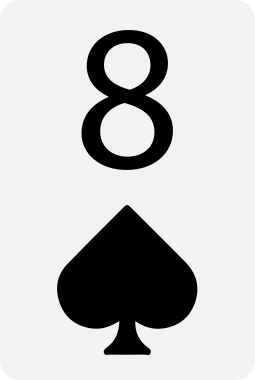
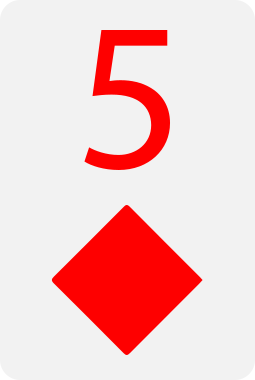
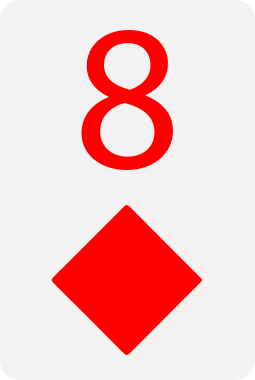
Eight-Five offsuit is a two-gap hand sitting between the one-gap connectors and the fully disconnected offsuit holdings that dominate the lower end of the starting hand rankings. The eight and five are familiar cards from the hands already covered in this series – the eight appeared as the top card in 86o and 87o, the five as the lower card in 54o and 53o – but their combination produces a hand with a specific and notably weaker drawing profile than either of those neighbours. The two-card gap is the defining structural feature, and its consequences show up clearly in the straight column of the draw odds table.
What These Odds Show for 85o
The first thing the draw odds table reveals about 85o is how closely it resembles T7o. High card on the flop at 53.22%, pair by the river at 44.15%, two pair at 22.53%, three of a kind at 4.40%, straight by the river at 6.46% – these figures are identical to T7o to the decimal place across every category. The overcard table is also identical: 86.73% on the flop, 93.51% by the turn, 96.90% by the river. Two hands separated by two full rank steps, one sitting at the top of the middle range and one at the lower end, sharing the same draw odds profile because they share the same gap structure and the same distance between their two cards.
This convergence is not a coincidence – it is the draw odds table confirming that for offsuit hands, the gap between the two cards is the primary determinant of straight potential, and rank determines overcard exposure. T7o and 85o both have a two-card gap and produce identical straight rates. T7o has a ten as its top card, producing a 69.47% overcard rate. 85o has an eight as its top card, producing an 86.73% overcard rate. Same gap, different rank, different overcard exposure – and every other column in the table is the same.
The straight combinations available to 85o run through four-to-eight, five-to-nine, six-to-ten, and seven-to-jack. Four combinations, the same count as T7o, confirming the structural equivalence. The 6.46% completion rate by the river sits below the one-gap connectors in this range – 86o at 7.75%, 75o at 7.80% – and reflects the cost of the additional gap.
Hand Strength Summary
- Hand type: Low offsuit two-gap hand
- Relative strength: Weak – comparable to T7o in drawing profile, worse in board presence due to lower rank
- Best case: Open-ended straight draw on a mid-to-low board, in position, with implied odds
- Main vulnerability: Severe overcard exposure on nearly every board, weaker straight potential than one-gap connectors, no flush equity
85o is T7o with worse overcard protection. Both hands draw to straights at the same rate and have the same structural limitations from the gap. The eight’s lower rank compared to the ten means the pair of eights has less inherent board presence and the overcard problem is significantly more acute. In all other respects, the two hands are interchangeable.
How Eight-Five Offsuit Wins
85o wins through routes identical in structure to T7o and 86o:
- Completing an open-ended straight draw, ideally in a disguised way on a board where opponents holding top pair do not recognise the straight possibility
- Flopping two pair on an eight-five board and getting action from opponents drawing with overcards
- Semi-bluffing a straight draw with eight outs from position, taking the pot before the draw completes through fold equity
- Stealing uncontested pots preflop from late position where no opponent has found a reason to continue
A pair of eights has marginally more value than a pair of sevens, sixes, or fives on low boards, but the 86.73% overcard rate on the flop means that board is available less than one time in seven. A pair of fives in any contested pot with significant overcards on the board has no realistic path to the best hand.
Main Weaknesses
The structural weaknesses of 85o combine the two-gap penalty from T7o with the low-rank overcard problem from 86o:
- The two-gap structure produces a 6.46% straight completion rate by the river – lower than the one-gap connectors at this rank level, which sit between 7.42% and 7.80%
- The 86.73% overcard rate on the flop means pair equity is unreliable as a primary plan on the vast majority of boards
- No flush equity – the 1.95% flush rate by the river is the board’s contribution
- A pair of fives as the lower card pair has almost no showdown value against any meaningful resistance
- Two-gap hands produce gutshot draws more frequently than open-ended draws on partially connecting boards, which reduces the out count and therefore the equity available for semi-bluffing
- In multiway pots, the combination of weaker straight potential and severe overcard exposure leaves the hand with minimal equity in most directions
Best and Worst Flop Textures
Strong flops:
- 6-7 boards giving an open-ended straight draw to both the four-to-eight and seven-to-jack ends of the range
- 4-6 or 6-9 boards creating open-ended draws depending on which end of the hand connects
- 8-5-x boards for immediate two pair on a dry, rainbow texture with no obvious draws in play
- Low, uncontested boards where the eight can occasionally represent the best holding with a single continuation bet
Dangerous flops:
- Any board with a nine or higher – covering 86.73% of flops and immediately reducing the pair value of either card
- Boards where only a gutshot draw is available from the partial connection, producing four outs rather than eight
- Flush-draw-heavy boards where opponents carry equity that 85o completely lacks
- High, coordinated boards where the hand has no connection and continuation requires unsupported bluffing
How It Plays by Position
Early position:
Never. 85o from early position is a clear fold under all standard conditions.
Middle position:
A fold at any full ring table. The two-gap structure and low rank combine to make middle-position entry indefensible in normal circumstances.
Late position:
The hand’s only legitimate home. From the button or cutoff in an unopened pot, 85o earns the same late-position consideration as T7o – a single speculative raise or steal attempt where the straight potential justifies a cheap look at the flop. The eight provides a modest amount of high-card credibility compared to the lower one-gap connectors, but less than a ten would.
Blinds:
In the big blind with pot odds against a single late-position raise, 85o is a marginal defend at best, comparable to T7o in this spot. The plan is entirely draw-dependent – check-fold boards with no connection, play aggressively when an open-ended draw arrives, and avoid building large pots with only a pair. From the small blind, folding is correct against most raises.
Common Mistakes with Eight-Five Offsuit
The errors with 85o reflect both the T7o pattern and the 86o pattern, since the hand sits structurally between them:
- Treating the hand as equivalent to 86o because both feature an eight as the top card – 86o’s one-gap structure gives it meaningfully higher straight potential at 7.75% by the river versus 85o’s 6.46%, a difference that adds up across a session
- Continuing with only a gutshot draw on boards that partially connect but do not produce an open-ended draw
- Playing the hand in position and then abandoning the plan when the flop misses, rather than making a disciplined single continuation bet and folding to resistance
- Comparing 85o to T7o in terms of playability and concluding they are equivalent, while ignoring that T7o’s ten as the top card produces an overcard rate of 69.47% on the flop versus 85o’s 86.73% – a significant difference in how often pair equity has any value
- Overestimating implied odds without the stack depth and opponent tendencies to support them
Comparison to Similar Hands
- Stronger than: 8-4o and 8-3o, where the two-gap widens to three and four respectively, further reducing straight combinations; 7-4o, which has a similar gap structure one rank lower with worse overcard exposure
- Weaker than: 85 suited, which adds flush equity that significantly improves the hand’s multiway and semi-bluff potential; 86o, where the one-gap structure improves the straight rate from 6.46% to 7.75%; 96o, which has a higher top card and lower overcard exposure while sharing a similar gap structure
- Similar to: T7o – the most structurally equivalent hand in this series, sharing identical draw odds across every category with the overcard table as the primary differentiator between them
The T7o comparison deserves particular emphasis. The fact that two hands separated by two full rank steps share identical draw odds tables is a useful illustration of how gap structure drives straight potential independently of rank. Any player who understands T7o understands 85o’s drawing profile. The only adjustment required moving from T7o to 85o is accounting for the substantially worse overcard situation – 86.73% versus 69.47% on the flop – which changes how often pair equity has any realistic value.
How Eight-Five Offsuit Performs in Multiway Pots
85o’s performance in multiway pots sits between T7o and 86o in the same way it sits between them in most other dimensions. The implied odds argument for the straight applies in limited form, and the counterarguments are familiar:
Arguments in favour:
- A completed straight on a board where opponents have made top pair or two pair can win a large multiway pot, and 85o’s straight combinations on boards like 6-7-9 or 4-6-7 are not always telegraphed to opponents
- The hand produces less obvious straight boards than some higher-ranked hands, which has modest implied value
Arguments against:
- The 96.90% overcard rate by the river means pair equity is essentially absent in multiway situations
- The two-gap structure means gutshots appear more frequently than open-ended draws on partially connecting boards, reducing the quality of the drawing hands available
- Without flush equity, opponents drawing to flushes have clean outs that 85o cannot challenge
- At 6.46% by the river, the straight completes in roughly one in fifteen hands – requiring substantial implied odds to justify regular speculative investment
FAQ: Eight-Five Offsuit
Why does 85o have the same draw odds as T7o?
Because both hands have a two-card gap between their hole cards, and gap structure is the primary determinant of straight potential for offsuit hands. The identical straight rates confirm that adjacent rank differences matter less than the gap between the two cards when calculating drawing equity. The difference between the hands lies entirely in the overcard table, where the ten’s higher rank provides significantly better board protection than the eight.
Is 85o better or worse than 86o?
Worse, specifically because of the straight rate. 86o’s one-gap structure produces a 7.75% straight completion rate by the river versus 85o’s 6.46%. Both hands share the same top card, so their overcard tables are identical. The only meaningful difference is the straight potential, and 86o wins that comparison comfortably. Whenever there is a choice between a one-gap and two-gap hand at the same rank, the one-gap version is strictly better for drawing purposes.
Does the two-gap matter as much at lower card ranks?
Yes, and arguably more so. At lower rank levels, pair equity is weaker due to higher overcard exposure, which means drawing potential carries more of the hand’s weight. A hand that reduces its straight rate from 7.75% to 6.46% through a wider gap is giving up a meaningful portion of its primary value source. The gap penalty is a consistent cost regardless of rank.
Should 85o be played differently from T7o at the table?
The strategic framework is identical – fold early and middle, steal late, draw-dependent postflop. The practical adjustment is that 85o should be played with even less confidence in pair equity than T7o, given the overcard rate difference. A pair of eights on a board with a nine or ten has some residual value. A pair of eights on a board covered by overcards, which 85o faces on 86.73% of flops, has almost none.
Related Hands