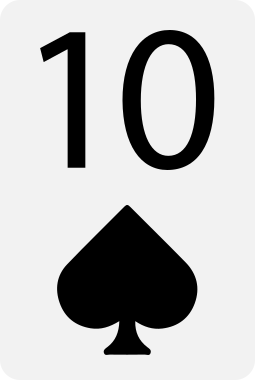
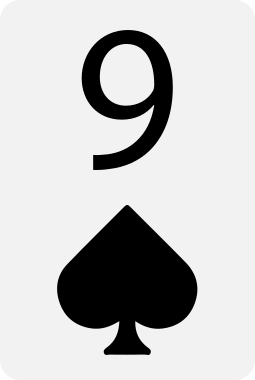
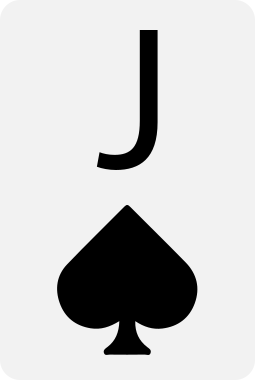
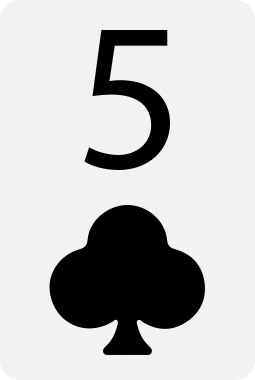
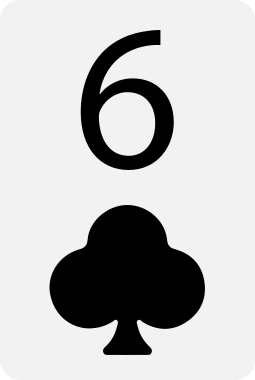
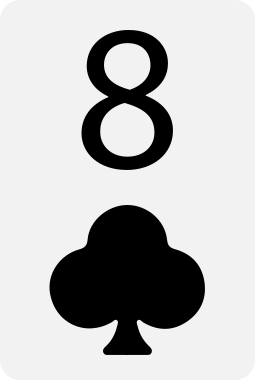
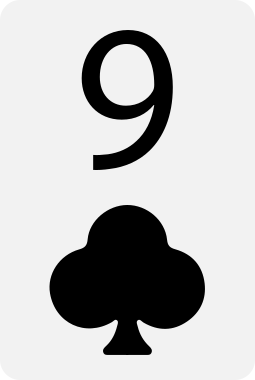
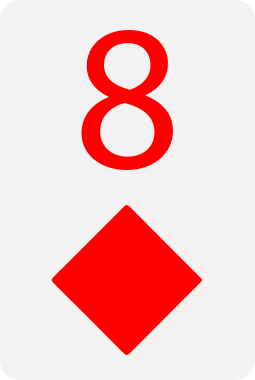
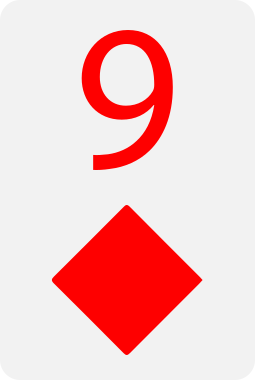
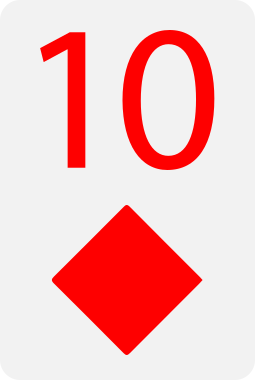
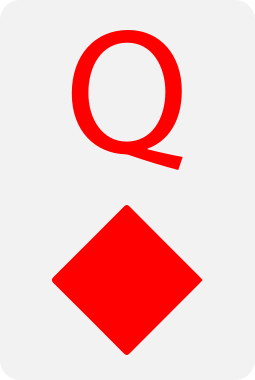
Ten-Nine Offsuit is one of the strongest non-suited connectors in Texas Hold’em. Two adjacent high-mid cards with the maximum number of straight combinations available for their rank, connected enough to make straights frequently, and high enough to have genuine top-pair value on a wide range of boards. What it lacks relative to its suited equivalent is the flush draw – and that absence is more significant than it might initially appear, both in raw equity terms and in the combination draw potential that makes T9s one of the most dangerous drawing hands in the game.
T9o is a legitimately strong speculative hand, but it requires an honest accounting of what the offsuit penalty costs it before deciding how aggressively to play it.
What These Odds Show for T9o
The straight odds are the headline figure and they are genuinely impressive. At 1.31% on the flop, 4.36% by the turn, and 9.13% by the river, T9o has the highest straight equity of any hand covered in this series so far. The zero-gap structure between Ten and Nine gives maximum straight combinations, and the higher rank means those straights tend to be stronger – a completed straight with T9o on a board of 6-7-8 or J-Q-K is a powerful hand that opponents with overpairs and top pair will not easily fold against.
The flush odds tell the other half of the story. At 0.00% on the flop, 0.43% by the turn, and 1.95% by the river, flush equity is negligible – what little exists comes from backdoor possibilities rather than any genuine flush draw. This is the defining cost of playing T9o over T9s. The suited version adds roughly 6.4 percentage points of river flush equity on top of comparable straight odds, which translates directly into combination draw situations where T9s can have 15 or more outs simultaneously. T9o cannot access those spots.
The overcard table sits at 69.47% on the flop, 79.86% by the turn, and 86.87% by the river. This is meaningfully better than lower-ranked hands – compare it to 75s at 92.14% or 86s at 86.73% – reflecting the Ten’s strength as a high-card anchor. A Ten is top pair on a large proportion of boards, and the Nine provides additional pair potential on boards where the Ten is not available.
Hand Strength Summary
- Hand type: Offsuit connector (zero-gap)
- Relative strength: Strong speculative hand; one of the better offsuit non-premium holdings
- Main draws: Straights (maximum combinations for this rank range), Ten or Nine top pair on appropriate boards
- Main vulnerability: No flush equity beyond negligible backdoor odds; relies entirely on straights and pair value for post-flop equity
How T9o Wins
T9o wins through a diverse set of scenarios, each leveraging different aspects of its hand strength:
- Completing straights, which are frequent relative to other hands in this range and often disguised on mid-range boards
- Pairing the Ten for top pair on boards without an Ace, King, or Queen
- Making two pair using both hole cards on connected boards
- Pairing the Nine for a strong middle pair in the right spots
- Winning through positional aggression on boards that favour a Ten-high or Nine-high range
- Dominating lower connectors and weaker Ten-x or Nine-x holdings
The Ten gives T9o a fallback plan that lower connectors lack. On many boards without an overcard, Ten top pair is a strong holding – and the Nine as a second card is close enough in rank to create two-pair possibilities on connected boards where both cards are live.
Main Weaknesses
- No flush draw equity in any meaningful sense – the 1.95% river flush figure is backdoor luck rather than a planned draw
- Without flush draws, combination draw situations are impossible – the hand cannot simultaneously threaten a straight and a flush the way T9s can
- Kicker vulnerability when pairing the Ten – AT, KT, QT, JT all have a better kicker and will be played strongly on Ten-high boards
- Overcard exposure of 86.87% by the river means Aces, Kings, and Queens appear on most runouts, stepping the Ten down from top pair
- Straight draws are open-ended and strong but cannot be combined with flush draw pressure to extract maximum equity
Best and Worst Flop Textures
Strong flops
- Mid connected boards giving open-ended straight draws (6♠ 7♦ Q♣ or 8♥ J♦ 2♠ giving open-ended draws in both directions)
- Ten-high boards with low-to-mid cards where top pair holds with reasonable kicker security
- Boards pairing the Nine where middle pair is strong given the action and field
Dangerous flops
- Ace, King, or Queen-high boards – the Ten steps down from top pair and the hand is reduced to straight draw potential only
- Monotone flops where opponents pick up flush draws that T9o cannot match or beat
- Boards where the straight draw is to the low end – particularly when the board allows higher connectors to have the top of the straight
How It Plays by Position
- Early position: Playable as an open in loose games but generally too speculative for tight early-position ranges; better as a limp or fold in standard conditions
- Middle position: A reasonable open in most games, particularly at looser tables; strong enough to play for value in multiway pots
- Late position / button: An excellent hand from late position – strong steal candidate, open-ended straight draw potential, and pair value on a wide range of boards
- Blinds: A clear defend from the big blind against most raises; the straight potential and pair equity make it one of the stronger offsuit non-premium hands to call with
Common Mistakes
- Treating T9o like T9s and overestimating its post-flop equity – the absence of flush draw potential is a genuine and significant difference
- Continuing on boards with no pair, no straight draw, and no backdoor equity when the hand has completely missed
- Overcommitting with Ten top pair without accounting for kicker vulnerability against the substantial range of Ten-x hands that beat it
- Drawing to the low end of a straight without recognising when a higher connector has the better end
- Playing too passively and allowing opponents to see cheap cards when an open-ended straight draw is live and semi-bluff equity is available
Comparison to Similar Hands
- Stronger than: T8o (one gap, meaningfully lower straight equity), 98o (one rank lower, lower overcard threshold and weaker straights), 87o and below
- Weaker than: T9s (the suited version adds approximately 6.4 percentage points of flush equity and combination draw access – a significant difference in post-flop potential), JTo (stronger high cards, lower overcard exposure)
The gap between T9o and T9s is larger than the suited versus offsuit distinction might suggest. It is not just the flush draw that T9s gains – it is the ability to combine a straight draw with a flush draw simultaneously, creating 15-out situations that make the suited version genuinely difficult to play against. T9o can never access those spots, which caps its ceiling in a meaningful way.
How T9o Performs in Multiway Pots
T9o is a hand that plays reasonably well in multiway pots, primarily because its straight potential scales well with pot size. When T9o completes a straight in a multiway pot, the implied odds are excellent – opponents with sets, two pair, and overpairs will often pay off generously. The straight is also reasonably disguised on mid-range boards where multiple players are involved.
The downside in multiway pots is the absence of flush draw equity. Where T9s can apply pressure through combination draws in multiway situations, T9o is limited to straight draws and pair value. Opponents with flush draws have an equity source T9o cannot match, and in multiway pots the probability of someone holding a flush draw on most board textures is significant.
FAQ: Ten-Nine Offsuit
How much does the offsuit penalty actually cost T9o compared to T9s?
In raw equity terms, roughly 6.4 percentage points of flush equity by the river. But the true cost is larger than that figure suggests, because the flush draw in T9s is often combined with the straight draw to create combination draw situations with 15 or more outs. T9o cannot generate those spots at all, which means its ceiling in post-flop play is materially lower even when the straight draw is equally strong.
Is T9o strong enough to open from early position?
In most standard games, it sits on the borderline. It is stronger than typical early-position speculative hands due to its straight potential and pair value, but it lacks the high-card strength and flush draw equity to play comfortably from out of position against the tight ranges that 3-bet early-position opens. In looser games it is more defensible; in tighter games it is generally better folded from early position.
How does T9o handle Ace-high flops?
Poorly, in most cases. The overcard table confirms that an Ace, King, or Queen appears on the board 86.87% of the time by the river, and on Ace-high flops specifically the Ten loses its top-pair potential entirely. What remains is straight draw potential if the board is connected, or a straightforward fold if it is not. Unlike hands with flush draws, T9o cannot pick up additional equity on an Ace-high board through a backdoor flush draw of significance.
What is the best straight T9o can make?
The strongest straight available to T9o is the King-high straight: 9-T-J-Q-K. This requires a J-Q-K board, which gives T9o the nut straight – an extremely strong holding on a high board. At the lower end, T9o can make a Six-high straight using a board of 6-7-8, which is the lowest straight it can make using both hole cards. The range of straights available spans from Six-high to King-high, which is a wide and powerful set of combinations.
Related Hands