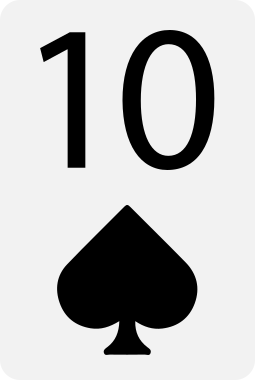
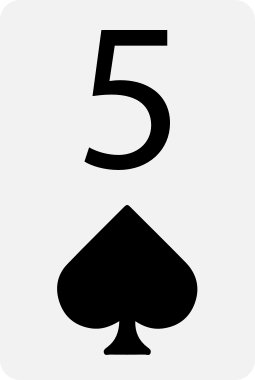
Ten Five Suited is a weak starting hand defined primarily by a large internal gap. With four ranks separating the ten and the five, the hand has almost no straight-drawing potential and relies almost entirely on its suited component and the occasional top-pair value of the ten to find any edge at all. It is categorised as a suited gapper, but at this distance the gap is so wide that the connectivity advantage enjoyed by suited connectors and even moderate gappers is largely absent.
This is a hand that occupies an awkward position in the hand rankings. It is too weak to play for high-card value in most situations, and too disconnected to play as a drawing hand in the way that suited connectors can be. When it does get played, it is usually for the flush draw and the rare instances where a ten on the board gives it a deceptive made hand.
What These Odds Show for T5s
The draw odds paint a familiar picture for a weak suited hand. On the flop, Ten Five Suited is a high card hand 53.04% of the time, meaning it arrives at the flop with nothing made in just over half of all runouts. By the river that figure falls to 17.58%, but by then the hand has had every available opportunity to improve.
Pairing one of the two hole cards on the flop happens 40.41% of the time, a figure shared by most unsuited non-pair hands. The important distinction here versus a hand like Five Two Suited is what that pair means. Pairing the ten gives a reasonable made hand with genuine showdown potential in many spots, while pairing the five produces little more than a low pair with almost no protection. By the river the pair rate climbs to 43.27%, which remains the most likely final hand category by a significant margin.
The straight odds are where Ten Five Suited really separates itself from more playable suited hands. There is a 0.00% chance of making a straight on the flop, rising to just 0.95% by the turn and only 3.59% by the river. For context, Five Two Suited – itself a hand with narrow straight potential – reaches 5.40% by the river. Ten Five Suited falls well short of that. The gap between these two ranks simply does not allow for the kind of connected draws that give speculative suited hands their appeal. The straight flush odds reflect this completely, showing 0.00% through to the turn and just 0.02% by the river. This is essentially a rounding artefact rather than a meaningful probability.
The flush remains the hand's most reliable premium draw. At 6.56% by the river it is slightly ahead of Five Two Suited's 6.48%, and this is the main structural advantage of playing the suited version. A ten-high flush is also a stronger made hand than a five-high flush, carrying more showdown value against most opponent ranges.
The overcard table is notably different from lower-ranked suited hands. Only 69.47% of flops will produce an overcard, compared to over 98% for hands where the top card is a five or lower. This means that roughly three times in ten, a flop will come with no card higher than a ten, giving this hand a genuine chance to hold the top pair. By the river the overcard rate rises to 86.87%, which is still significant, but the ten-high ceiling creates more workable flop situations than the hand's overall ranking might suggest.
Hand Strength Summary
- Hand type: Weak suited gapper
- Relative strength: Bottom tier of playable suited hands
- Best case: Flush in a multiway pot, or top pair on a low board
- Main vulnerability: Minimal straight equity, low pair value when the five is the made hand, dominated by most hands that call or raise
Ten Five Suited is not a hand built for consistency. Its positive outcomes are concentrated in a small number of situations, and it needs the right conditions to find any profit at all.
How Ten Five Suited Wins
The most reliable winning pathway for this hand is the flush draw. Flopping a flush draw and seeing it complete by the river gives a made hand that is often strong enough to win without further complication. The ten-high element helps here, since a ten-high flush will beat any opponent holding a flush with a nine as their highest flush card.
The second way it wins is through top pair on a low board. When the flop comes with a ten and two lower cards, Ten Five Suited has made top pair in a completely disguised way. Opponents holding jacks or better may read the board as safe and bet into a hand they cannot put you on.
More rarely, it wins by making two pair using both hole cards on a board that connects with both ranks, or by making three of a kind.
Main Weaknesses
The gap is the defining weakness of this hand. Four ranks between the ten and the five means the hand cannot realistically chase straights as part of its strategy. Even in the rare cases where a straight becomes possible by the turn, it typically requires a very specific board structure that also benefits many opponent holdings.
The five itself contributes very little. As a kicker it is poor, and as a made pair it is vulnerable to overcalls from a wide range of hands. Bottom pair with a ten kicker is not a strong place to be in most pots.
The hand also lacks the equity combinatorics of more connected suited hands. Where something like Eight Six Suited can flop a variety of draws and two-way straight-flush combinations, Ten Five Suited rarely has more than one dimension working for it at a time.
Best and Worst Flop Textures
Strong flops
- Ten-high boards with low cards alongside, giving top pair in an unlikely spot
- Boards with three cards of your suit, providing a flush draw
- Boards with a ten and two small cards below five, giving top pair with no obvious draws for opponents
Dangerous flops
- Any board with a jack or higher pairing an opponent and leaving you behind with no draw
- Boards that give you a pair of fives but are full of overcards
- Boards heavy in mid-range cards where opponents are hitting their straights and top pairs while you have missed entirely
How It Plays by Position
- Early position: Ten Five Suited should not be opened from early position in most games. The hand is too weak to build a pot and too disconnected to justify a call if raised. Folding is standard.
- Middle position: Still a fold in most circumstances. Against weak tables with loose passive tendencies there is a marginal case for a speculative play, but these spots are uncommon.
- Late position: The only position where Ten Five Suited has any real potential. On the button against folded action it can occasionally be used as a steal or a speculative flat to see a cheap flop. The flush equity and top-pair possibility are most valuable here.
- Blinds: In the big blind with a walk or a very small open to call, seeing the flop can be reasonable. Defending actively against raises is not recommended given the hand's limited upside.
Common Mistakes
The most common error with Ten Five Suited is treating it as a suited connector when it is not. Players familiar with the value of suited hands sometimes extend that logic too far and give this hand credit it does not deserve. The suited bonus applies across all hand types, but it does not rescue a hand that lacks all other redeeming qualities.
Another mistake is continuing when only the five pairs. A pair of fives on a board full of overcards against any sign of opponent interest is usually not a situation worth continuing in. The instinct to hold on because the hand is suited or because the ten is still in play is a trap.
Playing Ten Five Suited out of position for any significant money is also an error. The hand needs a cheap, multiway pot with implied odds and position to have any realistic path to profit.
Comparison to Similar Hands
How Ten Five Suited Performs in Multiway Pots
Like most speculative suited hands, Ten Five Suited improves in multiway situations where implied odds are higher and the pot size justifies chasing draws. A flush completed in a four-way pot pays significantly more than the same flush in a heads-up situation, which is the core reason to see cheap multiway flops with hands like this one.
The low straight equity does limit multiway value somewhat. Many speculative hands benefit from multiway pots because they can pick up straight draws alongside flush draws, creating two-way equity. Ten Five Suited rarely has that luxury and is more one-dimensional in how it can develop post-flop.
FAQ: Ten Five Suited
Is Ten Five Suited ever a reasonable open?
Only from late position in the right game conditions. As a steal on the button against weak blinds it has marginal playability. In most other circumstances it should be folded preflop.
How does Ten Five Suited compare to Ten Five Offsuit?
The suited version is meaningfully better due to flush equity, but both hands are weak overall. The flush draw and the small straight flush possibility are the entire difference between the two versions.
Is pairing the ten with this hand actually useful?
Yes, more than pairing the five. Top pair with a ten on a low board is a deceptive and reasonably strong made hand. The problem is that the five kicker is very poor, meaning the hand is vulnerable to dominated-pair situations when an opponent holds a better ten.
Why is the straight odds so much lower than other suited hands?
The four-rank gap between the ten and five means there are very few board combinations that complete a straight using both cards. The hands best suited for straight draws have ranks that are close together, allowing a variety of flops and run-outs to connect. Ten Five simply cannot manufacture those combinations.
Related Hands