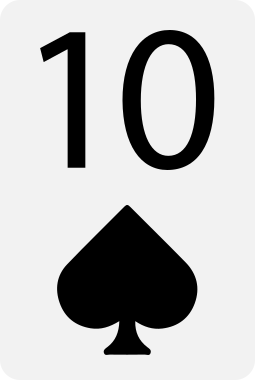
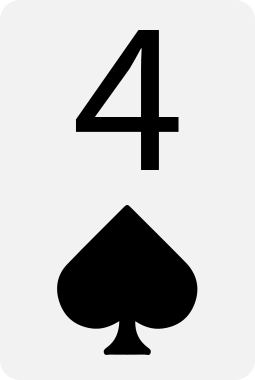
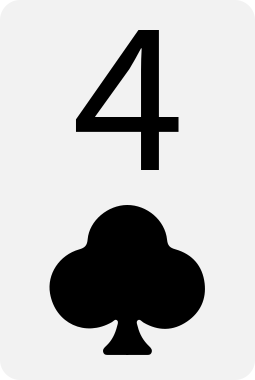
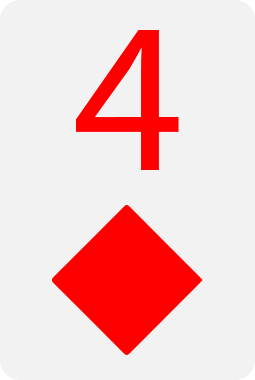
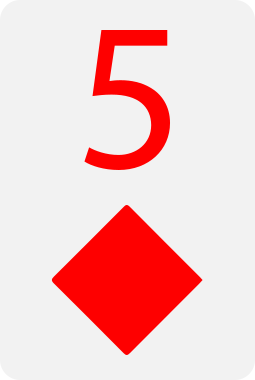
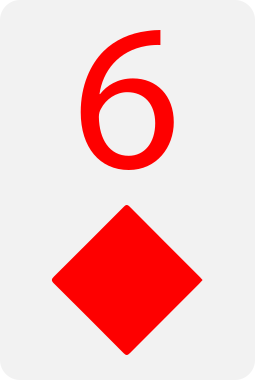
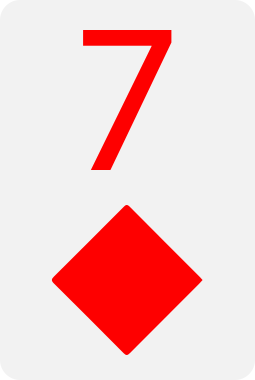
Ten Four Suited is a weak suited hand defined almost entirely by the gap between its two cards. With five ranks separating the ten from the four, this is as wide a gap as a ten-high suited hand can carry while still holding two distinct cards. There is no straight that can be made using both the ten and the four simultaneously – the distance between them exceeds the five-card span of any possible straight – which means the hand's drawing ability is reduced to a single dimension: the flush.
In that sense, Ten Four Suited is an instructive hand to study. It strips away almost everything that gives speculative suited hands their appeal and leaves only the flush draw standing. Understanding what a hand looks like when the suited component has to do all of the work makes it easier to appreciate why gap size matters so much when evaluating hands in this category.
What These Odds Show for T4s
The draw odds for Ten Four Suited are identical to those of Ten Five Suited across every category. On the flop, the hand is a high card 53.04% of the time. The pair rate on the flop is 40.41%, rising to 43.27% by the river. Two pair by the river comes in at 22.26%, three of a kind at 4.37%, and the full house probability by the river is 2.22%.
The straight odds confirm the gap problem directly. There is a 0.00% chance of making a straight on the flop, and while the turn and river figures show 0.95% and 3.59% respectively, these represent straights made primarily through the board connecting with just one of the hole cards – not through both working together. There is no board combination that can produce a straight using both a ten and a four, because the minimum cards needed to bridge that gap would require a six-card sequence. The 3.59% river straight figure is therefore a shared-board effect, not a reflection of genuine two-card drawing potential.
The flush odds are 6.56% by the river, consistent with other suited hands at this rank. This is the number that justifies any consideration of the hand at all, and it is worth noting that a ten-high flush carries real showdown value – if you make it, it beats any opponent holding a nine-high flush or lower.
The straight flush probability sits at 0.00% through the turn and just 0.02% by the river. Given that no board can use both the ten and four to complete a straight flush, this figure reflects the vanishingly rare scenario where the board itself provides four consecutive cards of your suit with either a ten or a four at one end.
The overcard table shows 69.47% on the flop, 79.86% by the turn, and 86.87% by the river – identical to Ten Five Suited. This is expected: the higher card in the hand determines overcard exposure, and since both hands share the ten as their top card, the overcard odds are the same regardless of whether the second card is a four or a five. Roughly three in ten flops will contain no card higher than a ten, giving the hand its best opportunity to pair the top card and hold something meaningful.
Hand Strength Summary
- Hand type: Weak suited large gapper
- Relative strength: Bottom tier of all starting hands
- Best case: Flush in a multiway pot; top pair on a low board
- Main vulnerability: No two-card straight equity whatsoever, weak kicker, low made-hand ceiling in most runouts
Ten Four Suited is a hand where the gap is large enough to eliminate one of the two main drawing advantages of suited hands entirely. The flush is all it has beyond the sporadic top-pair opportunity.
How Ten Four Suited Wins
The primary winning scenario is a completed flush. When the board delivers three or more cards of the hand's suit, Ten Four Suited has a clear, defined draw and a made hand on completion that is often strong enough to win at showdown. The ten as the highest flush card provides meaningful protection – there are fewer combinations of opponent hands that hold a higher flush than there would be with a four-high or six-high flush.
The second route to winning is pairing the ten on a board low enough to make it top pair. This requires a flop of all cards below ten, which – per the overcard table – happens roughly 30% of the time. On those boards, Ten Four Suited has made top pair in a way that is nearly impossible for opponents to read, since the four in the hand is entirely invisible to their range-reading process.
Beyond these two scenarios, the hand has very little to offer. It cannot draw to a straight using both cards, it cannot make a meaningful straight flush draw, and pairing the four produces almost no value.
Main Weaknesses
The defining weakness is the complete absence of two-card straight equity. This is not a hand that has poor straight potential – it has none at all when both cards are required to contribute. Every other suited hand in the deck with cards close enough together can at least theoretically draw to a straight by using both hole cards. Ten Four Suited cannot. That missing dimension reduces the hand's overall equity in a way that is significant across a large sample of hands.
The four is also a consistently weak component. As a kicker it is poor, and when paired it generates almost no value. The combination of a ten and a four means the hand is either relying entirely on the ten to be relevant, or it has missed altogether. There is very little middle ground.
Playing the hand out of position compounds both problems. Without the informational advantage of acting last, even the flush draw is harder to manage – knowing whether a bet represents strength or a bluff, and whether to call or fold on a draw, becomes more expensive without position.
Best and Worst Flop Textures
Strong flops
- Three cards of your suit, giving an immediate flush draw with a ten-high ceiling
- Boards of three low cards below ten, pairing the ten and leaving you with top pair against a field unlikely to have connected
- Boards that combine a ten with two low cards of your suit, giving both top pair and a backdoor flush draw simultaneously
Dangerous flops
- High boards with jacks, queens, or aces where neither card has connected and no draw is present
- Boards pairing the four against any interest from opponents
- Flush-completing boards in your suit where an opponent holds a jack, queen, king, or ace of that suit and has already made a higher flush
How It Plays by Position
- Early position: Should not be played. Ten Four Suited lacks the raw strength to justify an open and the drawing potential to justify a call facing a raise.
- Middle position: A fold in almost all games. The hand's value is position-dependent to a degree that makes middle-position play consistently unprofitable in most environments.
- Late position: The only realistic home for this hand. In an unopened pot from the button or cutoff it can function as a steal with the backup of occasionally seeing a playable flop. In multiway limped pots it can see a cheap flop with implied odds.
- Blinds: Taking a free look from the big blind is reasonable. Defending a raise from either blind requires significantly better hands than this.
Common Mistakes
The most frequent mistake is treating Ten Four Suited as comparable to hands like Ten Eight Suited or Ten Seven Suited simply because all three share a ten. The gap makes an enormous difference, and Ten Four Suited has almost none of the straight equity that makes the more connected ten-high suited hands playable.
Another error is chasing the flush in single-opponent pots without a backup draw. A flush draw alone without pair outs or straight draw equity has roughly a one-in-three chance of completing by the river, and in a heads-up pot with no other equity, that is often not enough to justify continuing against a player who is already betting into you.
Overvaluing top pair when the kicker is a four is also common. Ten-four top pair is a vulnerable holding – it loses to any opponent holding a ten with a better kicker, which is a large portion of the hands that will play back against a bet.
Comparison to Similar Hands
Ten Four Suited and Ten Five Suited share identical draw odds because neither hand can construct a straight using both hole cards. The difference between them is largely academic from an odds perspective, though the five provides a fractionally better kicker in edge cases.
How Ten Four Suited Performs in Multiway Pots
Multiway pots are where Ten Four Suited finds its best return, for the same reasons that apply to all flush-draw hands. Larger pots increase the implied odds of completing the flush, and in a multiway scenario the deceptive nature of making a ten-high flush with a four hidden in the hand is more likely to extract maximum value.
The absence of straight equity does limit the hand's multiway ceiling. Hands that can flop both a flush draw and a straight draw have much better multiway equity because they are drawing to more outs across more possible runouts. Ten Four Suited is always drawing to just nine flush outs when the draw is live, which is real equity but a narrower base than more connected suited hands.
FAQ: Ten Four Suited
Can Ten Four Suited ever make a straight using both hole cards?
No. A straight spans exactly five consecutive ranks, and a ten and a four are six ranks apart. No straight exists that includes both a ten and a four as part of the same five-card sequence.
Is Ten Four Suited noticeably worse than Ten Five Suited?
The draw odds are identical across every category, so from a probability standpoint they are the same hand. The four kicker is marginally weaker than the five in spots where kicker value matters, but in practice the difference between these two hands is minimal.
When is the flush draw from Ten Four Suited worth pursuing?
When the pot is multiway, the price to continue is reasonable relative to the pot size, and there are no signs that an opponent holds a higher flush draw. A ten-high flush is strong enough to win most flushes – the danger is mainly from opponents holding a jack or higher of the same suit.
Is there any argument for playing this hand regularly?
Not in most game environments. It is a situational hand at best, suitable for specific late-position or multiway spots where the conditions are right. Playing it consistently in a wide range of situations is a losing approach over time.
Related Hands