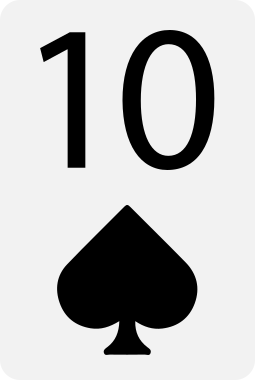
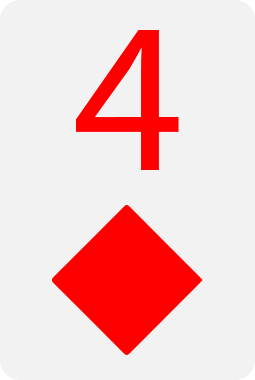
Ten Four Offsuit is a weak starting hand that combines a mid-range high card with a low, disconnected second card and no suited component to generate any secondary equity. The ten provides top pair potential on lower boards, but the four contributes almost nothing – the six-rank gap between them makes joint straight draws essentially impossible, pairing the four produces one of the weakest made hands available, and without flush draw potential the hand has no fallback when neither hole card connects usefully with the board.
T4o sits just below T5o in the ten-x offsuit family, and the draw odds table reflects this with near-identical figures across almost every category. The practical difference between the two hands is marginal, but the direction of travel is consistent – as the second card weakens, the hand loses incremental kicker value and marginally lower straight potential, reinforcing the same fundamental conclusion: fold in most situations and play only when position and cost align in the most favourable possible way.
What These Odds Show for T4o
The high card outcome on the flop is 53.88%, identical to T5o and the other weak offsuit ten-x hands. More than half of all flops leave T4o completely unimproved, and by the river that figure drops to 19.02% – the same endpoint as T5o, reflecting how tightly grouped the draw profiles of these similar hands are when the high card is fixed at ten.
The pair probability on the flop is 40.41%, consistent with all non-paired starting hands. Pairing the ten gives top pair on low boards, which has genuine value in the right circumstances. Pairing the four gives a very low pair that is almost impossible to take to showdown profitably against any meaningful opposition. Top pair with a four kicker is particularly problematic at showdown – any opponent holding T5 or better with a ten has the hand dominated, which covers essentially every ten-x combination a reasonable player would willingly enter a pot with.
The straight odds by the river are 3.85%, identical to T5o. This equivalence is worth examining. The four and five produce the same straight percentage in combination with the ten because neither card is close enough to the ten to contribute to the same straight simultaneously – both figures are driven by the board independently delivering straights around one hole card or the other rather than both working together as a unit. The 0.00% flop figure and modest 0.99% turn figure confirm that straight draws develop slowly and require very specific board textures to materialise at all.
The overcard odds are identical to T5o: 69.47% on the flop, rising to 86.87% by the river. As established with T5o, the ten faces overcards from jacks, queens, kings, and aces – a larger overcard universe than jack-x hands must contend with. The consistency of these figures across T4o and T5o reflects that overcard exposure is determined by the ten’s rank rather than the second card, just as the same pattern appeared across the weaker jack-x offsuit hands. In nearly nine out of every ten complete runouts, T4o will face at least one card higher than the ten on the board.
Hand Strength Summary
- Hand type: Weak offsuit disconnected hand
- Relative strength: Bottom quarter of all starting hands
- Best feature: Ten provides top pair potential on boards free of jacks, queens, kings, and aces
- Main vulnerability: No flush draw, essentially no joint straight draw, very weak kicker, significant overcard exposure across nearly all runouts
T4o is a hand that asks the ten to do all the work and provides almost nothing in support. When the ten connects cleanly with a low board it has value. In every other situation, T4o has very little to offer.
How T4o Wins
T4o has a narrow and specific set of winning paths:
- Flopping top pair with the ten on a board clear of jacks, queens, kings, and aces, against opponents who miss or hold genuinely weaker hands
- Making two pair on a ten-low board where the four also connects with the board texture
- Winning pots before showdown through late position aggression on dry boards where the ten represents credible hand strength
- Opponents folding to continuation bets on boards they have missed entirely
Straight completions are theoretically possible at 3.85% by the river but arrive infrequently enough and through such specific board conditions that they should carry negligible weight in most decisions about whether to enter a pot.
Main Weaknesses
T4o carries the same structural problems as T5o with the additional disadvantage of a weaker kicker:
- No suited component means no flush draw under any board conditions
- The six-rank gap between ten and four makes it virtually impossible for both cards to contribute to the same straight draw
- Top pair with a four kicker is dominated by an exceptionally wide range – every ten-x hand from T5 upward has it beaten at showdown, which covers nearly every ten-x combination opponents would reasonably play
- Overcard exposure of 86.87% by the river means the ten’s top pair value is consistently undermined before showdown in the majority of hands played through to completion
- Pairing the four creates one of the weakest made hands available and offers no viable path to winning any contested pot
- The four provides no blocking value, no meaningful connectivity, and no kicker contribution in any realistic scenario
Best and Worst Flop Textures
Strong flops for T4o:
- Ten-high boards with low, disconnected side cards and no jack, queen, king, or ace (T♠ 3♦ 2♣), where top pair faces minimal draw danger and opponents are likely to have missed
- Boards where both the ten and four connect simultaneously to give two pair on a low texture, such as T♥ 4♦ 8♣
- Dry rainbow boards where positional aggression can take down uncontested pots without reaching showdown
Dangerous flops for T4o:
- Boards featuring jacks, queens, kings, or aces, which the overcard odds confirm will occur on the significant majority of flops dealt
- Coordinated boards with flush draws or straight possibilities, where T4o has no equivalent draw to apply pressure with
- Any flop generating significant action from opponents, since T4o almost never holds enough to call meaningful bets without a strong board improvement
How It Plays by Position
- Early position: A fold without exception in any standard game. T4o does not have the strength or draw equity to enter pots voluntarily from early position.
- Middle position: Still a fold in virtually all situations. The hand does not benefit sufficiently from middle position advantage to justify entering contested pots.
- Late position / button: The only position with any marginal case for playing, restricted to steal attempts in unraised pots against tight or passive blinds, or very cheap multiway limps where the cost to see a flop is negligible and the ten’s top pair potential might occasionally be realised.
- Blinds: From the big blind it can see cheap flops in limped pots at no additional cost. This is the hand’s most defensible home, and even here it should be abandoned quickly unless the flop delivers top pair on a clean board or meaningful improvement.
As with every weak offsuit hand in this tier, position and cost are the two variables that determine whether T4o has any business being in a hand at all. Without both working in its favour, it should not be there.
Common Mistakes with T4o
- Calling raises from any position – T4o is a significant underdog to every realistic raising range and has no compensating equity to offset that disadvantage
- Continuing past the flop with a pair of fours in any contested pot
- Overvaluing top pair with a four kicker – the range of hands that dominate it at that point is exceptionally wide, covering essentially every ten-x combination opponents would reasonably hold
- Playing T4o from early or middle position on the basis that the ten is a reasonable high card without considering how thoroughly the four undermines the overall combination
- Treating T4o as equivalent to T5o in practice – while the differences are marginal, T4o is the slightly weaker hand and should be treated with if anything even more caution
Comparison to Similar Hands
- Stronger than: T3o and T2o, where kicker strength and the already negligible straight potential decrease further with each step down
- Weaker than: T5o and every ten-x offsuit hand above it, where the second card offers incrementally better kicker value
- Similar to: J4o, which shares an identical draw profile and the same general strategic conclusions, differing only in overcard exposure – J4o’s 76.31% by the river versus T4o’s 86.87%, a meaningful difference that makes T4o the slightly weaker hand in practice
The suited version, Ten Four Suited, is a considerably stronger hand. The flush draw provides a genuine secondary equity path that transforms many boards from complete misses into semi-bluffing opportunities and justifies playing in a range of positional spots where T4o has nothing to work with. The difference between the suited and offsuit versions is one of the most significant suit-related distinctions available for a hand of this type.
How T4o Performs in Multiway Pots
T4o is poorly suited to multiway pots across essentially every dimension:
- More opponents substantially increase the probability that someone holds a better ten, making top pair with a four kicker increasingly indefensible at showdown
- A pair of fours is effectively worthless in multiway pots where any opponent holding a five or better has the kicker beaten
- Without flush or meaningful straight draw potential, the hand cannot apply semi-bluff pressure on any board texture at any point in the hand
- Fold equity, one of T4o’s few reliable winning mechanisms, diminishes with every additional player in the pot
- The hand has no hidden strength, no disguise value, and no implied odds that a multiway pot might otherwise reward
Multiway pots with T4o require the flop to deliver two pair or better to justify any continued investment, and even then the four kicker creates vulnerability in any further contested action.
FAQ: Ten Four Offsuit
Is T4o ever worth playing?
Very rarely. The most defensible spots are late position steal attempts against passive blinds in unraised pots, or cheap big blind calls in limped multiway pots where the cost to see the flop is negligible. In virtually all other circumstances it should be folded without deliberation.
How does T4o compare to T5o?
The two hands are nearly identical in terms of draw odds, sharing the same high card outcome, pair probability, straight percentage, and overcard exposure figures across every street. The only meaningful difference is kicker strength – T5o’s five kicker gives it a marginal advantage at showdown in the rare situations where it matters, and T5o’s straight potential, while equally low at 3.85%, is slightly more coherent given the five’s position in the deck relative to potential straight draws. In practice both hands are played the same way.
Why do T4o and T5o share the same straight percentage despite having different second cards?
Because neither the four nor the five is close enough to the ten to contribute to the same straight simultaneously. Both straight percentages are driven by the board independently delivering straights around one hole card or the other. The result is a coincidental equivalence in the river figure at 3.85% rather than a reflection of comparable connectivity between the two hands.
Does the weak kicker matter as much for T4o as it does for jack-x hands with similar kickers?
Yes, and arguably more so. The ten faces overcards from four different rank categories – jacks, queens, kings, and aces – compared to the jack’s three categories of queens, kings, and aces. This means T4o’s top pair is undermined more frequently, and when it does hold up, it does so with a four kicker that loses to an even wider range of opponents than the equivalent jack-x hand would face in the same situation.
Related Hands