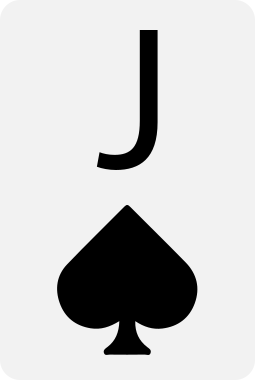
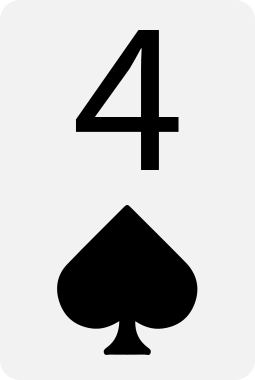
Jack-Four Suited is a seven-gap suited hand that sits at the point in the Jack-x suited family where the second card has effectively stopped contributing to the hand’s equity in any meaningful way. The gap between Jack and Four is large enough that straight combinations are negligible, the Four provides almost nothing as a kicker or pair card, and what remains is a flush draw attached to a Jack – the same basic structure as Q5s or Q4s in the Queen-x family, but with a weaker anchor card and correspondingly higher overcard exposure.
J4s is not a hand that belongs in most players’ ranges in most games. Understanding it is less about finding conditions where it thrives and more about understanding precisely where the Jack-x suited family reaches its practical floor.
What These Odds Show for J4s
The straight odds are essentially identical to Q5s. At 0.00% on the flop, 0.84% by the turn, and 3.24% by the river, J4s has the same river straight figure as Q5s – a coincidence of the specific straight combinations available around a Four when paired with a high card, producing the same result despite different anchor cards. The flop figure of 0.00% confirms that no three-card board can bridge the seven-card gap between Jack and Four to complete a straight, and the turn and river figures are too small to plan around in any meaningful way. Straight flush odds of 0.02% complete the picture.
Flush equity lands at 6.56% by the river, consistent with other suited hands throughout this series and the hand’s only reliable draw.
The overcard table sits at 56.96% on the flop, 67.95% by the turn, and 76.31% by the river – identical to J5s, J7s, and J9o. All Jack-x hands share this overcard profile because overcard frequency is determined entirely by the Jack. The Four contributes nothing to overcard suppression, just as the Five, Six, and Seven do not – only the Jack matters for that calculation. This consistency across the Jack-x family from J9s down to J2s means the overcard profile is a constant, and the only variables between these hands are flush equity, straight equity, and kicker strength when the Jack pairs. Of those three, flush equity is identical across all suited Jack-x hands, leaving straight equity and kicker strength as the only meaningful differentiators – and J4s is near the bottom of both.
Hand Strength Summary
- Hand type: Suited big-gap hand; approaching the lower boundary of any justifiable Jack-x playability
- Relative strength: Weak; one of the least justified holdings in the Jack-x suited family
- Main draws: Flush draws only in any practical sense; Jack top pair on boards without an Ace or King
- Main vulnerability: The Four is effectively a dead card; straight potential is functionally zero; kicker vulnerability when the Jack pairs is among the most severe of any Jack-x hand
How J4s Wins
J4s wins through limited routes:
- Pairing the Jack on boards without an Ace or King
- Completing a flush draw
- Making trips when a Four appears on the board in specific circumstances
- Winning uncontested pots through late-position steals on boards that favour a Jack-high range
- Two pair on the rare board where both the Jack and Four connect simultaneously
The Four’s contribution to winning is as close to zero as a hole card can be while still technically being part of the hand. J4s wins because of the Jack and the flush draw. In virtually every hand that reaches showdown, the Four is either irrelevant or a liability when the kicker plays.
Main Weaknesses
J4s has severe structural limitations:
- The seven-card gap makes straight draws nonexistent on the flop and negligible throughout – 3.24% by the river is not a draw worth incorporating into any plan
- The Four is a poor kicker when the Jack pairs – AJ, KJ, QJ, JT, J9, J8, J7, J6, and J5 all hold better kickers, covering virtually every Jack-x holding an opponent might reasonably play
- Flush draws are the hand’s sole practical equity source beyond pair potential, and that equity diminishes in multiway pots where opponents may hold higher flush draws
- On roughly 76% of rivers an overcard will have appeared, stepping the Jack down from top pair in most runouts
- The hand is almost entirely one-dimensional – Jack pairs or flush draw, with no third source of equity under any realistic board condition
Best and Worst Flop Textures
Strong flops
- Jack-high boards with very low disconnected cards (J♠ 2♦ 3♣) – top pair, and the low board minimises the probability opponents hold strong kickers while the Four blends into the low texture
- Flush draw boards in your suit where the Jack also pairs, creating a made hand plus draw combination that plays well against most opponents
- Boards containing a Four where trips are concealed – opponents holding Jack-x hands have no reason to suspect a Four kicker
Dangerous flops
- Ace or King-high boards – the Jack steps down from top pair and the Four is completely irrelevant
- Any coordinated board where opponents have draws and J4s has neither pair nor flush draw
- High two-tone boards in a suit you do not hold
How It Plays by Position
- Early position: Should not be opened under any standard circumstances; the structural weakness of the Four as a second card combined with the post-flop disadvantage of playing out of position makes J4s unjustifiable as an early-position holding
- Middle position: Fold in virtually all circumstances; the marginal case that exists for J6s and J5s in middle position has essentially closed by J4s
- Late position / button: The only position with any legitimate argument – steal equity from the Jack, flush draw potential post-flop, and the ability to fold cheaply when neither card connects, which will be the outcome on most flops
- Blinds: Very marginal as a big blind defend; the Jack provides minimal post-flop playability but against continuation betting on boards without a Jack or flush draw the hand has nothing to work with
Common Mistakes with Jack-Four Suited
- Playing J4s from any position other than late position based on the Jack’s rank without accounting for the Four’s near-complete lack of contribution
- Continuing past the flop without the Jack pairing or a flush draw – there is no third source of equity and the decision to fold should be straightforward
- Overplaying Jack top pair against resistance; the Four kicker is dominated by essentially every Jack-x holding an opponent is likely to play, making continuation into heavy action a consistent error
- Treating the hand as a bluff-catching instrument when neither the Jack nor flush draw has materialised – J4s has no showdown value in those situations
- Calling three-bets or significant raises in any position – the hand does not have the structural strength to justify the investment against a strong range
Comparison to Similar Hands
- Stronger than: J4 offsuit (without the flush draw J4s has almost no post-flop equity at all; the suited nature is the complete and entire argument for its existence), J3s and J2s which have even weaker second cards and further reduced straight potential
- Weaker than: J5s (one rank higher second card, river straight odds improve from 3.24% to 3.59%, and the Five is a marginally better kicker in the rare situations where kicker value is contested), J6s, J7s, and every Jack-x suited hand with a higher second card
- Family comparison: The decline across the Jack-x suited family from J9s to J4s mirrors the Queen-x family’s decline from Q9s to Q4s precisely. In both cases, each step down the rank ladder removes a little more of the second card’s contribution without changing the overcard profile, the flush equity, or the anchor card’s pair potential. By J4s, the second card has contributed about as little as it can while still being technically suited.
How J4s Performs in Multiway Pots
J4s is a weak multiway pot hand for the same reasons as J5s, Q4s, and Q5s. Straight equity is functionally zero, eliminating implied odds as a justification for playing in large fields. Flush draw equity decreases as more opponents may hold higher flush draws. Jack top pair deteriorates as more players contest the pot, increasing the probability of being outkicked or outdrawn.
This hand needs clean, simple situations – a preflop steal that succeeds, or a heads-up continuation bet on a Jack-high board against an opponent who folds. Anything more complicated than that exceeds what J4s can reliably navigate given its limited equity sources and severe kicker vulnerability.
FAQ: Jack-Four Suited
How does J4s differ from J5s in practice?
Almost imperceptibly in most situations. The river straight odds differ by 0.35 percentage points – 3.24% versus 3.59% – which is noise at the table. The overcard tables are identical. The flush equity is identical. The only practical difference is the Four versus the Five as a kicker when the Jack pairs, which matters in the rare situation where both players hold a Jack and the kicker plays – J5s wins that specific confrontation. In the vast majority of hands the two holdings play identically, with J5s having a negligible theoretical edge.
Is there any board texture where the Four specifically helps J4s?
Yes, in two narrow situations. First, when a Four appears on the board giving J4s trips – opponents holding Jack-x hands have no reason to expect a Four kicker, providing reasonable concealment for the trips. Second, on boards like A-2-3 where the Four gives a straight draw using the wheel structure, though this is a marginal situation that rarely arises and produces a weak straight even when completed. Beyond those specific circumstances, the Four is a passenger in every hand J4s plays.
At what point does the Jack-x suited family become genuinely unplayable?
J4s is very close to that threshold. J3s and J2s sit below it and are generally considered unplayable in most contexts – the second card has zero meaningful contribution, the kicker is among the worst possible, and the straight equity is lower than even the negligible figures seen with J4s. Where exactly the line falls depends on table dynamics and position, but J4s makes one of the weakest cases of any Jack-x hand for inclusion in a standard range.
Does J4s ever justify a three-bet?
Almost never. Three-betting requires a hand with either strong value equity or strong bluff equity – ideally both. J4s has neither in sufficient quantity. As a bluff three-bet it lacks the blocking properties of hands like A-x or K-x. As a value three-bet it is simply not strong enough. In rare late-position squeeze situations against specific opponents it might appear as a bluff, but even then stronger and more structurally sound bluff candidates exist. J4s is a call-or-fold hand preflop in virtually all situations.
Related Hands